Hoffmeister Helen, Fuchs Andreas, Erdel Fabian, Pinz Sophia, Gröbner-Ferreira Regina, Bruckmann Astrid, Deutzmann Rainer, Schwartz Uwe, Maldonado Rodrigo, Huber Claudia, Dendorfer Anne-Sarah, Rippe Karsten, Längst Gernot
Institute of Biochemistry, Genetics and Microbiology, University of Regensburg, 93053 Regensburg, Germany.
BioQuant, University of Heidelberg, 69120 Heidelberg, Germany.
Nucleic Acids Res. 2017 Oct 13;45(18):10534-10554. doi: 10.1093/nar/gkx711.
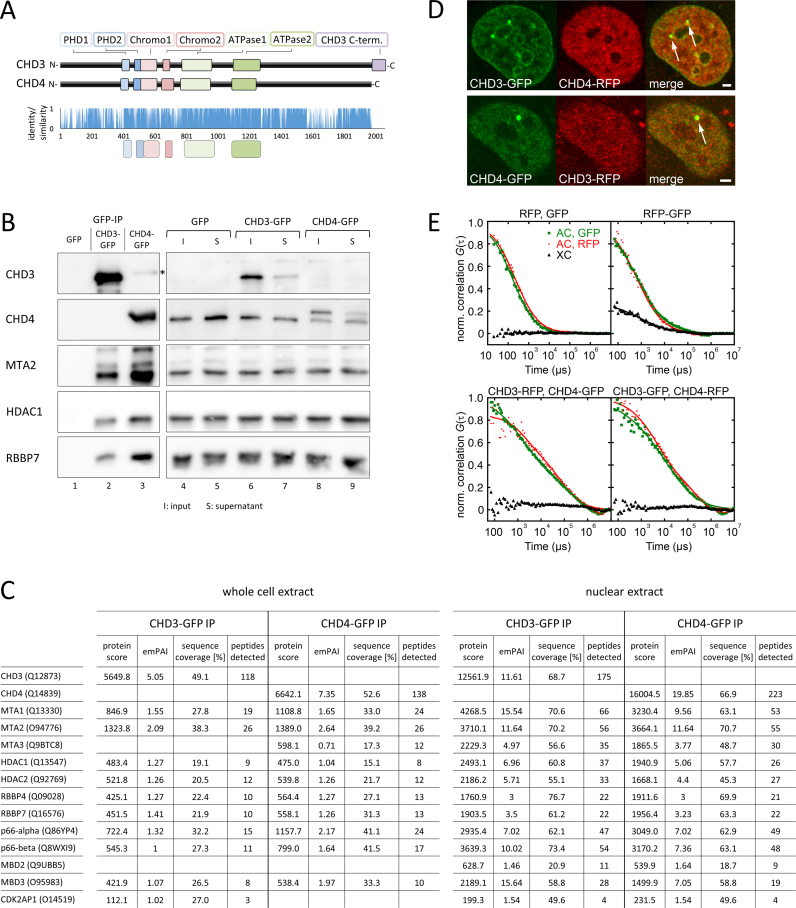
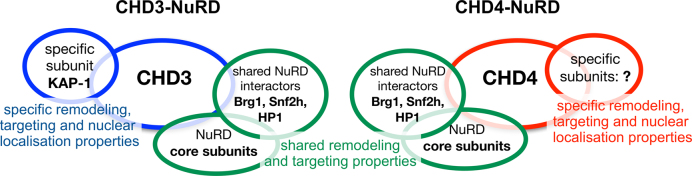
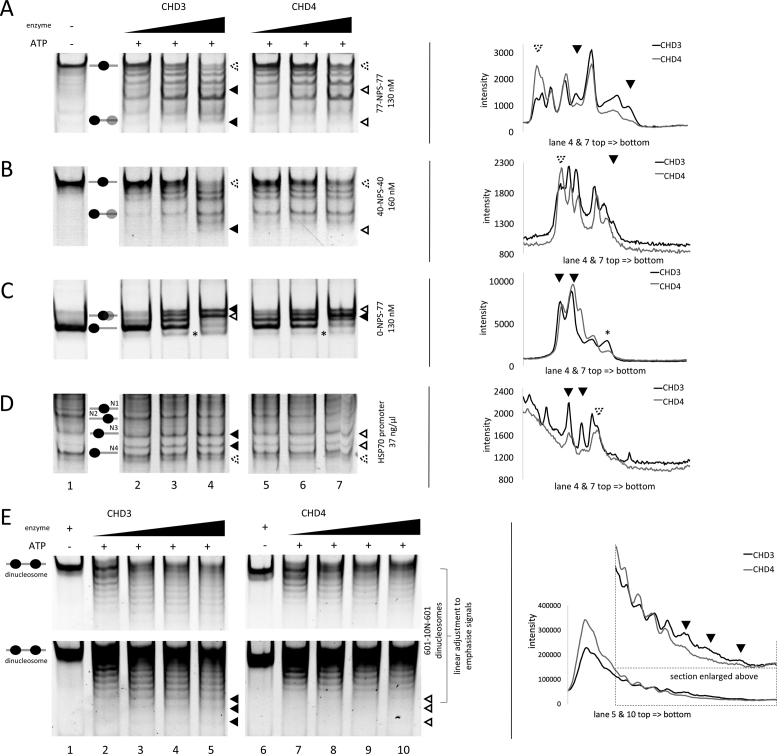
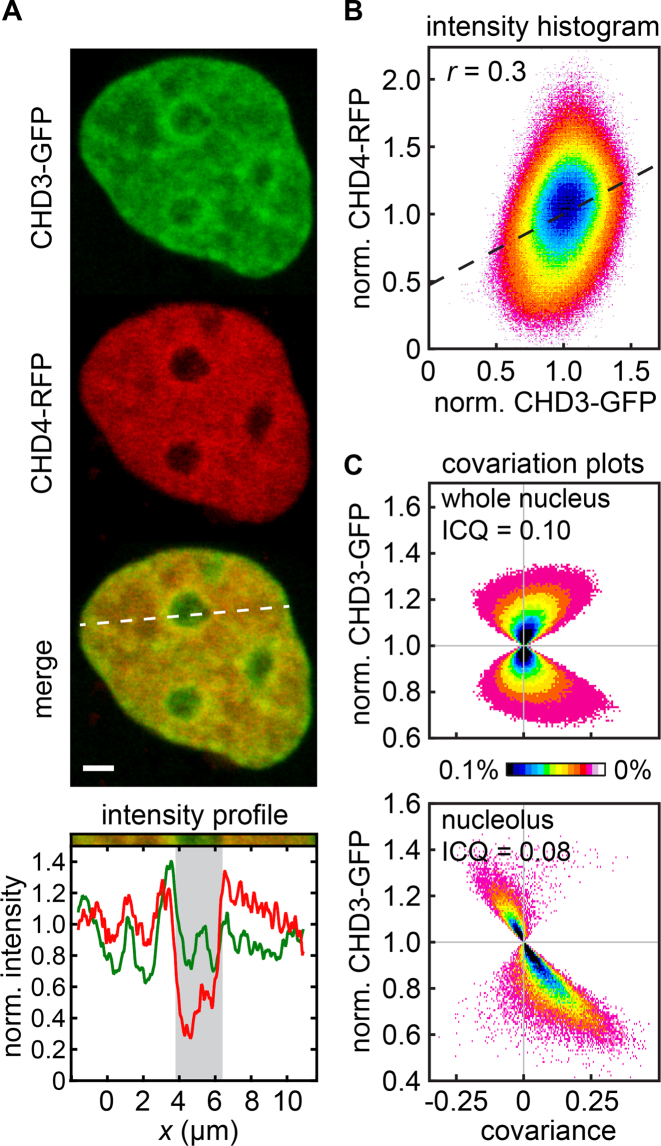
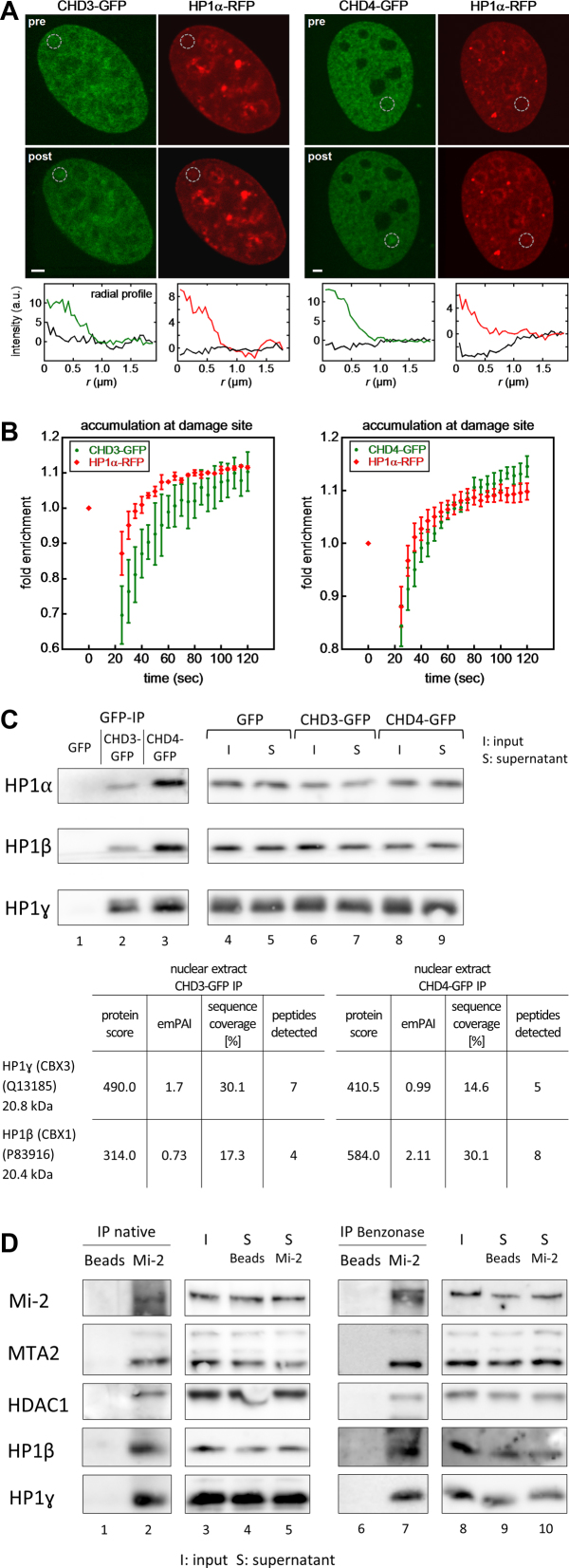
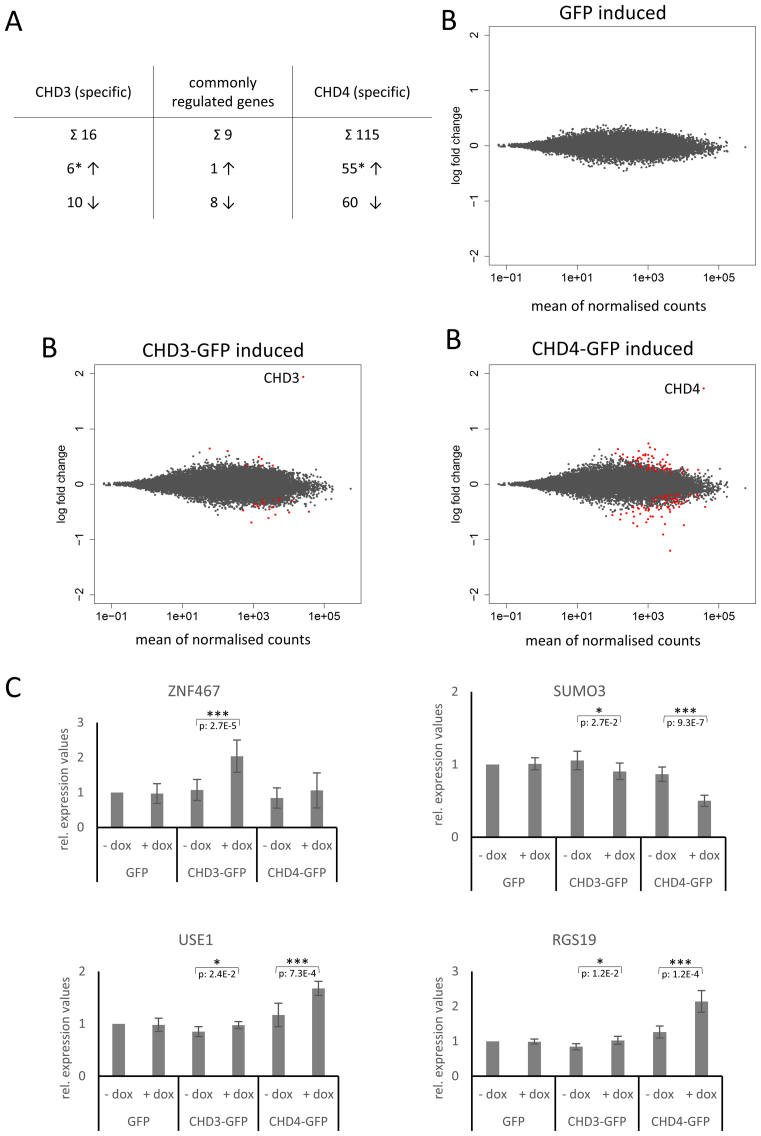
CHD3 and CHD4 (Chromodomain Helicase DNA binding protein), two highly similar representatives of the Mi-2 subfamily of SF2 helicases, are coexpressed in many cell lines and tissues and have been reported to act as the motor subunit of the NuRD complex (nucleosome remodeling and deacetylase activities). Besides CHD proteins, NuRD contains several repressors like HDAC1/2, MTA2/3 and MBD2/3, arguing for a role as a transcriptional repressor. However, the subunit composition varies among cell- and tissue types and physiological conditions. In particular, it is unclear if CHD3 and CHD4 coexist in the same NuRD complex or whether they form distinct NuRD complexes with specific functions. We mapped the CHD composition of NuRD complexes in mammalian cells and discovered that they are isoform-specific, containing either the monomeric CHD3 or CHD4 ATPase. Both types of complexes exhibit similar intranuclear mobility, interact with HP1 and rapidly accumulate at UV-induced DNA repair sites. But, CHD3 and CHD4 exhibit distinct nuclear localization patterns in unperturbed cells, revealing a subset of specific target genes. Furthermore, CHD3 and CHD4 differ in their nucleosome remodeling and positioning behaviour in vitro. The proteins form distinct CHD3- and CHD4-NuRD complexes that do not only repress, but can just as well activate gene transcription of overlapping and specific target genes.
CHD3和CHD4(染色质结构域解旋酶DNA结合蛋白)是SF2解旋酶Mi-2亚家族的两个高度相似的代表,它们在许多细胞系和组织中共同表达,据报道它们作为NuRD复合物(核小体重塑和去乙酰化酶活性)的动力亚基发挥作用。除了CHD蛋白外,NuRD还包含几种阻遏物,如HDAC1/2、MTA2/3和MBD2/3,这表明其具有转录阻遏物的作用。然而,亚基组成在不同的细胞和组织类型以及生理条件下有所不同。特别是,尚不清楚CHD3和CHD4是否共存于同一NuRD复合物中,或者它们是否形成具有特定功能的不同NuRD复合物。我们绘制了哺乳动物细胞中NuRD复合物的CHD组成图谱,发现它们是异构体特异性的,包含单体CHD3或CHD4 ATP酶。这两种类型的复合物表现出相似的核内迁移率,与HP1相互作用,并在紫外线诱导的DNA修复位点迅速积累。但是,CHD3和CHD4在未受干扰的细胞中表现出不同的核定位模式,揭示了一部分特定的靶基因。此外,CHD3和CHD4在体外的核小体重塑和定位行为也有所不同。这些蛋白质形成不同的CHD3-和CHD4-NuRD复合物,它们不仅可以抑制,还可以同样激活重叠和特定靶基因的基因转录。