
衣霉素诱导的内质网应激通过激活mTORC1促进前列腺癌细胞凋亡。
Tunicamycin induced endoplasmic reticulum stress promotes apoptosis of prostate cancer cells by activating mTORC1.
作者信息
Guha Prasun, Kaptan Engin, Gade Padmaja, Kalvakolanu Dhananjaya V, Ahmed Hafiz
机构信息
Department of Biochemistry and Molecular Biology, University of Maryland School of Medicine and Institute of Marine and Environmental Technology, Baltimore, Maryland, USA.
Current address: The Solomon H. Snyder Department of Neuroscience, Johns Hopkins University School of Medicine, Baltimore, Maryland, USA.
出版信息
Oncotarget. 2017 Jul 15;8(40):68191-68207. doi: 10.18632/oncotarget.19277. eCollection 2017 Sep 15.
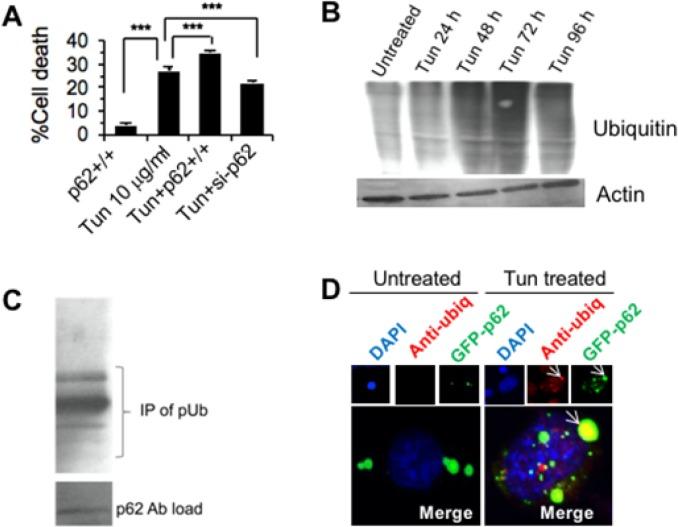
Studies suggest that tunicamycin may work as a therapeutic drug to cancer cells by inducing stress in the endoplasmic reticulum (ER) through unfolded protein response (UPR) and thereby promoting apoptosis. However, mechanisms of the prolonged activation of the UPR under sustained ER stress in the regulation of cell apoptosis are largely unknown. To delineate the role of candidate genes in the apoptotic process under ER stress and to search for new therapeutic strategies to treat metastatic castration resistant prostate cancer, we performed whole genome expression microarray analysis in tunicamycin treated metastatic androgen-insensitive prostate cancer cells, PC-3. Among several induced genes, the expression of eNOS () gene was remarkably high. The increased expression of eNOS activates mTORC1 through RagC. This results into an accumulation of p62 (SQSTM1) which facilitates aggregation of ubiquitinated protein thus compromising clearance of misfolded toxic protein aggregates. Lastly, association of p62 proteins and misfolded proteins promote reactive oxygen species (ROS) mediated mitochondrial apoptosis. Overall, our data demonstrate that tunicamycin induced ER stress promotes prostate cancer cell death by activating mTORC1 through eNOS-RagC pathway.
研究表明,衣霉素可能作为一种治疗癌细胞的药物,通过未折叠蛋白反应(UPR)在内质网(ER)中诱导应激,从而促进细胞凋亡。然而,在持续的内质网应激下,未折叠蛋白反应的长期激活在细胞凋亡调控中的机制很大程度上尚不清楚。为了阐明候选基因在内质网应激下凋亡过程中的作用,并寻找治疗转移性去势抵抗性前列腺癌的新治疗策略,我们在衣霉素处理的转移性雄激素不敏感前列腺癌细胞PC-3中进行了全基因组表达微阵列分析。在几个诱导基因中,eNOS()基因的表达显著升高。eNOS表达的增加通过RagC激活mTORC1。这导致p62(SQSTM1)的积累,这有助于泛素化蛋白的聚集,从而损害错误折叠的有毒蛋白聚集体的清除。最后,p62蛋白与错误折叠蛋白的结合促进活性氧(ROS)介导的线粒体凋亡。总体而言,我们的数据表明,衣霉素诱导的内质网应激通过eNOS-RagC途径激活mTORC1,促进前列腺癌细胞死亡。


 Zotero 插件