Dai Liqiang, Flechsig Holger, Yu Jin
Complex System Research Division, Beijing Computational Science Research Center, Beijing, China.
Department of Mathematical and Life Sciences, Graduate School of Science, Hiroshima University, Hiroshima, Japan.
Biophys J. 2017 Oct 3;113(7):1440-1453. doi: 10.1016/j.bpj.2017.08.015.
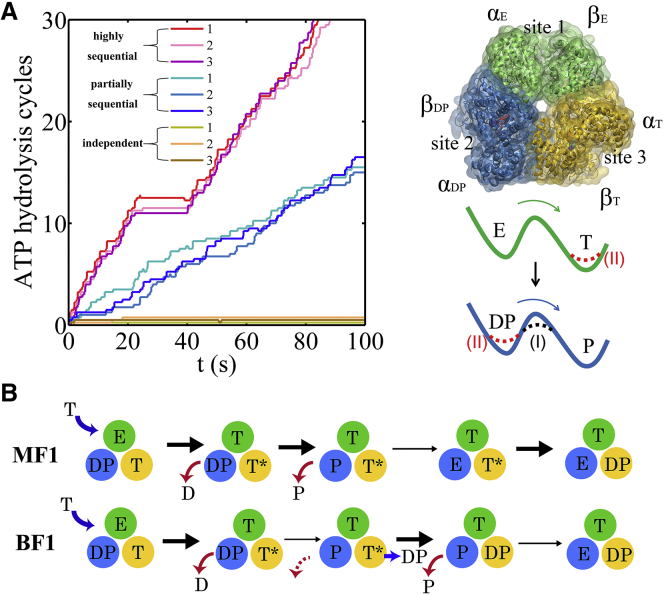
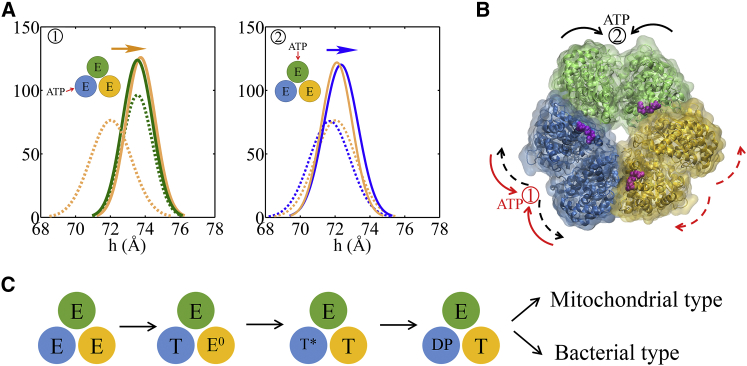
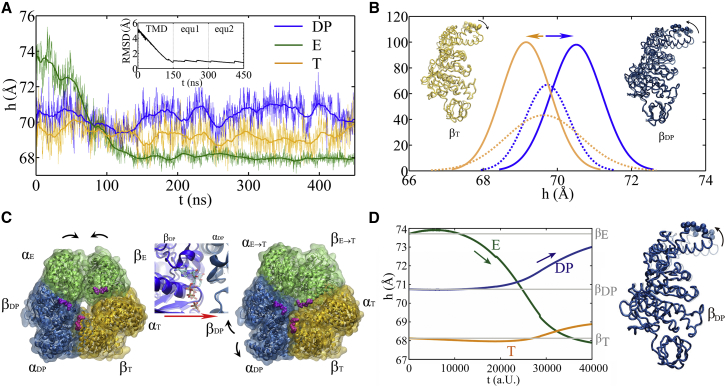
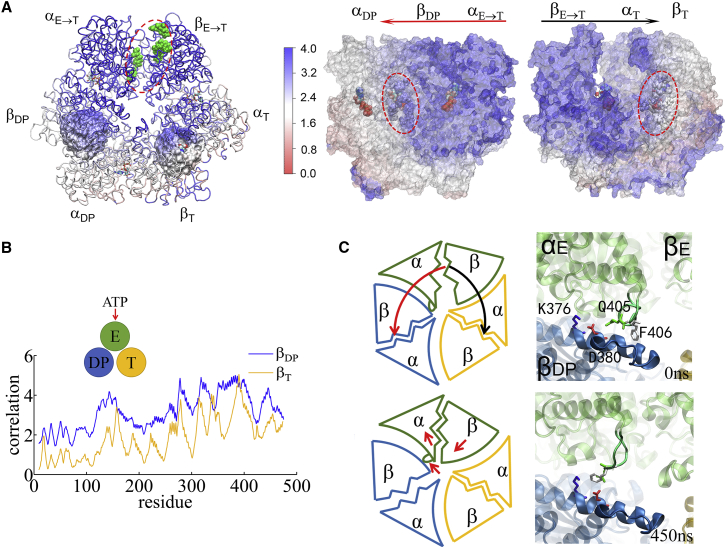
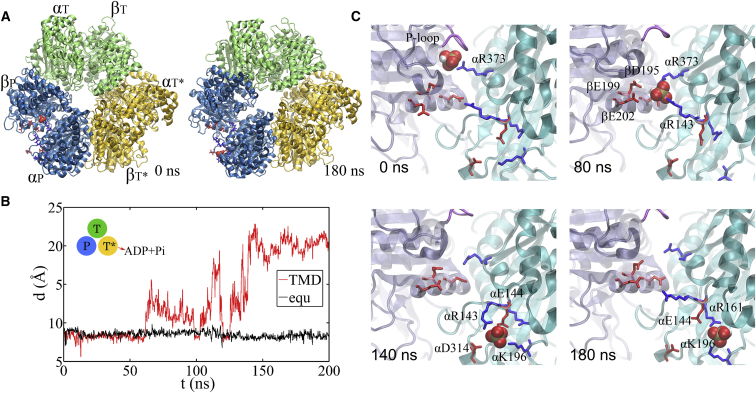
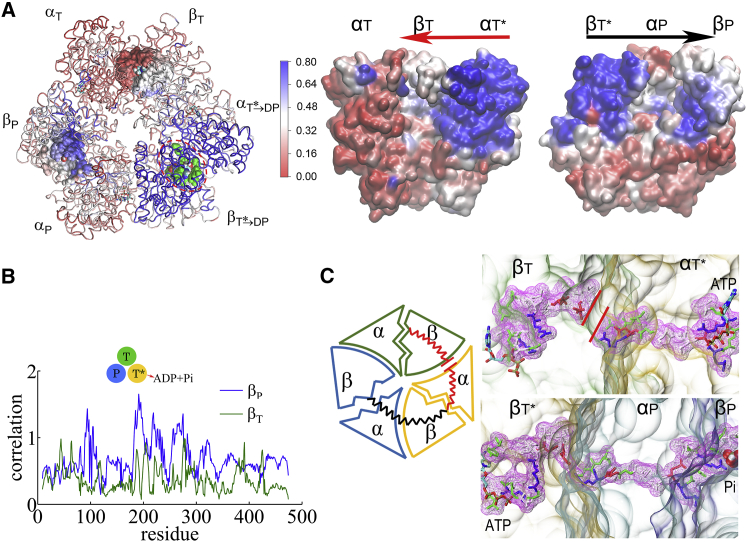
Rotary sequential hydrolysis of the metabolic machine F-ATPase is a prominent manifestation of high coordination among multiple chemical sites in ring-shaped molecular machines, and it is also functionally essential for F to tightly couple chemical reactions and central γ-shaft rotation. High-speed AFM experiments have identified that sequential hydrolysis is maintained in the F stator ring even in the absence of the γ-rotor. To explore the origins of intrinsic sequential performance, we computationally investigated essential inter-subunit couplings on the hexameric ring of mitochondrial and bacterial F. We first reproduced in stochastic Monte Carlo simulations the experimentally determined sequential hydrolysis schemes by kinetically imposing inter-subunit couplings and following subsequent tri-site ATP hydrolysis cycles on the F ring. We found that the key couplings to support the sequential hydrolysis are those that accelerate neighbor-site ADP and Pi release upon a certain ATP binding or hydrolysis reaction. The kinetically identified couplings were then examined in atomistic molecular dynamics simulations at a coarse-grained level to reveal the underlying structural mechanisms. To do that, we enforced targeted conformational changes of ATP binding or hydrolysis to one chemical site on the F ring and monitored the ensuing conformational responses of the neighboring sites using structure-based simulations. Notably, we found asymmetrical neighbor-site opening that facilitates ADP release upon enforced ATP binding. We also captured a complete charge-hopping process of the Pi release subsequent to enforced ATP hydrolysis in the neighbor site, confirming recent single-molecule analyses with regard to the role of ATP hydrolysis in F. Our studies therefore elucidate both the coordinated chemical kinetics and structural dynamics mechanisms underpinning the sequential operation of the F ring.
代谢机器F-ATPase的旋转顺序水解是环状分子机器中多个化学位点高度协同的一个突出表现,并且对于F紧密偶联化学反应和中心γ轴旋转在功能上也是必不可少的。高速原子力显微镜实验已经确定,即使在没有γ转子的情况下,F定子环中也能维持顺序水解。为了探究内在顺序性能的起源,我们通过计算研究了线粒体和细菌F的六聚体环上亚基间的关键偶联。我们首先在随机蒙特卡罗模拟中,通过动力学施加亚基间偶联并跟踪F环上随后的三位点ATP水解循环,重现了实验确定的顺序水解方案。我们发现,支持顺序水解的关键偶联是那些在特定的ATP结合或水解反应后加速相邻位点ADP和Pi释放的偶联。然后,在粗粒度水平的原子分子动力学模拟中检查了动力学确定的偶联,以揭示潜在的结构机制。为此,我们对F环上的一个化学位点强制进行ATP结合或水解的靶向构象变化,并使用基于结构的模拟监测相邻位点随后的构象响应。值得注意的是,我们发现了不对称的相邻位点开放,这在强制ATP结合时促进了ADP的释放。我们还捕捉到了在相邻位点强制ATP水解后Pi释放的完整电荷跳跃过程,证实了最近关于ATP水解在F中的作用的单分子分析。因此,我们的研究阐明了支撑F环顺序运行的协同化学动力学和结构动力学机制。