Gao Jie, Zhou Wutie, Chen Bida, Lin Weiming, Wu Sifang, Wu Feng
Department of Respiratory Medicine, The Third People's Hospital, Guangzhou Medical College, Huizhou, People's Republic of China.
Int J Chron Obstruct Pulmon Dis. 2017 Sep 11;12:2703-2710. doi: 10.2147/COPD.S142466. eCollection 2017.
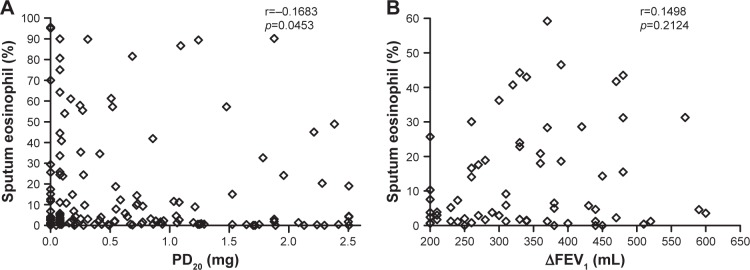
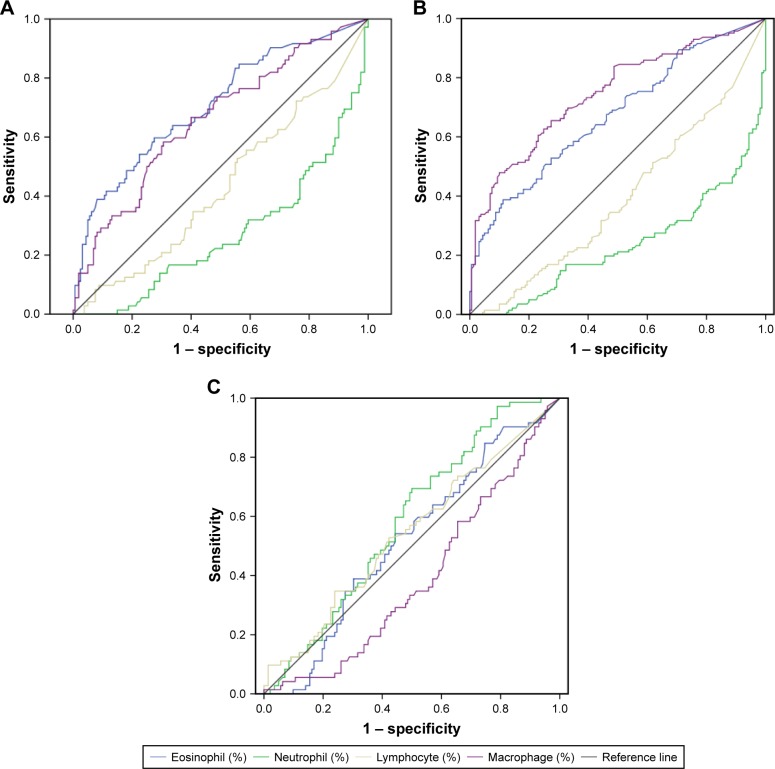
Cell count in induced sputum is a noninvasive biomarker to assess airway inflammation phenotypes. Accordingly, sputum cell counts are extensively used in the treatment of asthma and COPD. Nevertheless, the clinical application of sputum cell counts in patients with asthma-COPD overlap (ACO) remains elusive. The aim of this study was to investigate sputum cell counts in patients with ACO which are different from those in patients with asthma and COPD and also to examine the relationship between sputum cell counts in bronchial reversibility and bronchial hyperresponsiveness (BHR).
A total of 374 patients participated in the study, including 142 patients with asthma, 160 patients with COPD and 72 patients with ACO. All patients underwent the following tests on the same day: pulmonary function test (PFT), BHR test or bronchodilator reversibility test and inducing sputum. They were classified into the asthma group, COPD group or ACO group based on a clinical history, PFT values and BHR test or bronchodilator reversibility test.
The three groups had different PFT values (<0.001) except for forced vital capacity (FVC) between the asthma and ACO groups (=0.378). The sputum levels of eosinophil% were decreased in patients with COPD when compared with those in patients with asthma and ACO (<0.001 and <0.001, respectively). There was a difference in sputum neutrophil% and macrophage% counts among the three groups (<0.001 and <0.001, respectively); there was no difference in sputum eosinophil% counts between patients with ACO and asthma (=0.668) and there was no difference in the percentage of induced sputum cells between the stage of airway obstruction and the stage of BHR.
The clinical relevance of this study provides evidence that sputum cell counts as an inflammatory biomarker could carry some information to distinguish ACO, asthma and COPD, and these biomarkers need more studies to provide diagnostic value in the differentiation between ACO, asthma and COPD.
诱导痰细胞计数是评估气道炎症表型的一种非侵入性生物标志物。因此,痰细胞计数在哮喘和慢性阻塞性肺疾病(COPD)的治疗中被广泛应用。然而,痰细胞计数在哮喘-COPD重叠综合征(ACO)患者中的临床应用仍不明确。本研究的目的是调查ACO患者的痰细胞计数,这些计数与哮喘和COPD患者的不同,同时研究支气管可逆性和支气管高反应性(BHR)中痰细胞计数之间的关系。
共有374名患者参与本研究,其中包括142名哮喘患者、160名COPD患者和72名ACO患者。所有患者在同一天接受以下检查:肺功能测试(PFT)、BHR测试或支气管扩张剂可逆性测试以及诱导痰液。根据临床病史、PFT值以及BHR测试或支气管扩张剂可逆性测试结果,将他们分为哮喘组、COPD组或ACO组。
除哮喘组和ACO组之间的用力肺活量(FVC)(P = 0.378)外,三组的PFT值不同(P<0.001)。与哮喘和ACO患者相比,COPD患者痰液中嗜酸性粒细胞百分比降低(分别为P<0.001和P<0.001)。三组之间痰液中性粒细胞百分比和巨噬细胞百分比计数存在差异(分别为P<0.001和P<0.001);ACO患者和哮喘患者之间痰液嗜酸性粒细胞百分比计数无差异(P = 0.668),气道阻塞阶段和BHR阶段之间诱导痰细胞百分比也无差异。
本研究的临床意义提供了证据,表明痰细胞计数作为一种炎症生物标志物可能携带一些信息来区分ACO、哮喘和COPD,并且这些生物标志物需要更多研究以在ACO、哮喘和COPD的鉴别中提供诊断价值。