Department of Population Health, London School of Hygiene & Tropical Medicine, London, UK.
Department of Infectious Disease Epidemiology, Imperial College London, London, UK.
Health Policy Plan. 2017 Nov 1;32(9):1316-1326. doi: 10.1093/heapol/czx091.
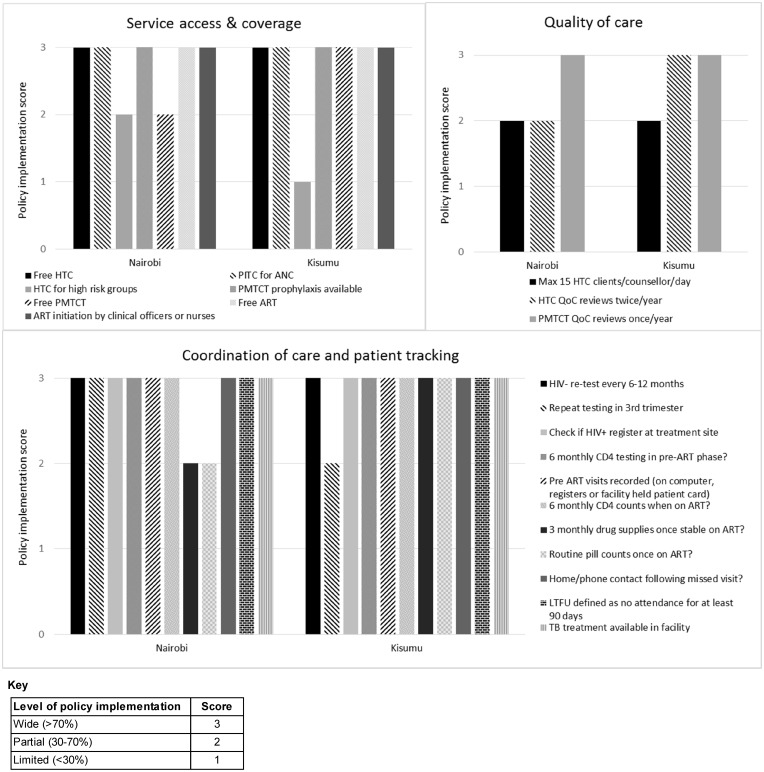
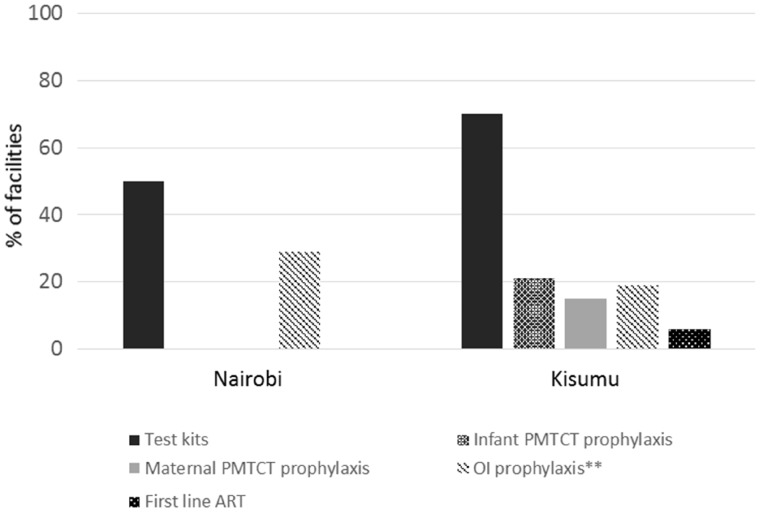
The last decade has seen rapid evolution in guidance from the WHO concerning the provision of HIV services along the diagnosis-to-treatment continuum, but the extent to which these recommendations are adopted as national policies in Kenya, and subsequently implemented in health facilities, is not well understood. Identifying gaps in policy coverage and implementation is important for highlighting areas for improving service delivery, leading to better health outcomes. We compared WHO guidance with national policies for HIV testing and counselling, prevention of mother-to-child transmission, HIV treatment and retention in care. We then investigated implementation of these national policies in health facilities in one rural (Kisumu) and one urban (Nairobi) sites in Kenya. Implementation was documented using structured questionnaires that were administered to in-charge staff at 10 health facilities in Nairobi and 34 in Kisumu. Policies were defined as widely implemented if they were reported to occur in > 70% facilities, partially implemented if reported to occur in 30-70% facilities, and having limited implementation if reported to occur in < 30% facilities. Overall, Kenyan national HIV care and treatment policies were well aligned with WHO guidance. Policies promoting access to treatment and retention in care were widely implemented, but there was partial or limited implementation of several policies promoting access to HIV testing, and the more recent policy of Option B+ for HIV-positive pregnant women. Efforts are needed to improve implementation of policies designed to increase rates of diagnosis, thus facilitating entry into HIV care, if morbidity and mortality burdens are to be further reduced in Kenya, and as the country moves towards universal access to antiretroviral therapy.
在诊断到治疗连续体方面,世界卫生组织(WHO)有关提供艾滋病毒服务的指导在过去十年中迅速发展,但这些建议在肯尼亚被采纳为国家政策的程度,以及随后在卫生机构中的实施程度,尚不清楚。确定政策覆盖范围和实施方面的差距对于突出改善服务提供的领域,从而改善健康结果非常重要。我们将世界卫生组织的指导意见与肯尼亚的艾滋病毒检测和咨询、预防母婴传播、艾滋病毒治疗和护理保留方面的国家政策进行了比较。然后,我们调查了这些国家政策在肯尼亚一个农村(基苏木)和一个城市(内罗毕)地点的卫生机构中的实施情况。通过对内罗毕 10 个卫生机构和基苏木 34 个卫生机构的负责人员进行问卷调查,记录实施情况。如果报告发生在超过 70%的机构中,则将政策定义为广泛实施;如果报告发生在 30-70%的机构中,则为部分实施;如果报告发生在 30%以下的机构中,则为实施有限。总的来说,肯尼亚国家艾滋病毒护理和治疗政策与世界卫生组织的指导方针非常一致。促进获得治疗和护理保留的政策得到了广泛实施,但促进获得艾滋病毒检测的几项政策以及最近针对艾滋病毒阳性孕妇的 B+方案的实施情况有限或部分实施。如果肯尼亚要进一步降低发病率和死亡率负担,并随着国家向普及抗逆转录病毒治疗迈进,则需要努力改善旨在提高诊断率的政策的实施情况,从而促进进入艾滋病毒护理。