Merz David, Richter Julia, Gonneau Martine, Sanchez-Rodriguez Clara, Eder Tobias, Sormani Rodnay, Martin Marjolaine, Hématy Kian, Höfte Herman, Hauser Marie-Theres
Department of Applied Genetics and Cell Biology, University of Natural Resources and Life Sciences, 1190 Vienna, Austria.
Institut Jean-Pierre Bourgin, INRA, Centre National pour la Recherche Scientifique, AgroParisTech, Université Paris-Saclay, RD10, 78026 Versailles Cedex, France.
J Exp Bot. 2017 Jul 20;68(16):4583-4593. doi: 10.1093/jxb/erx263.
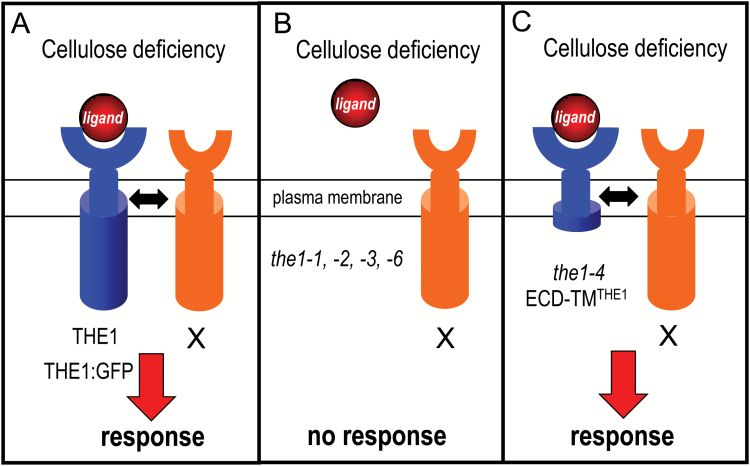
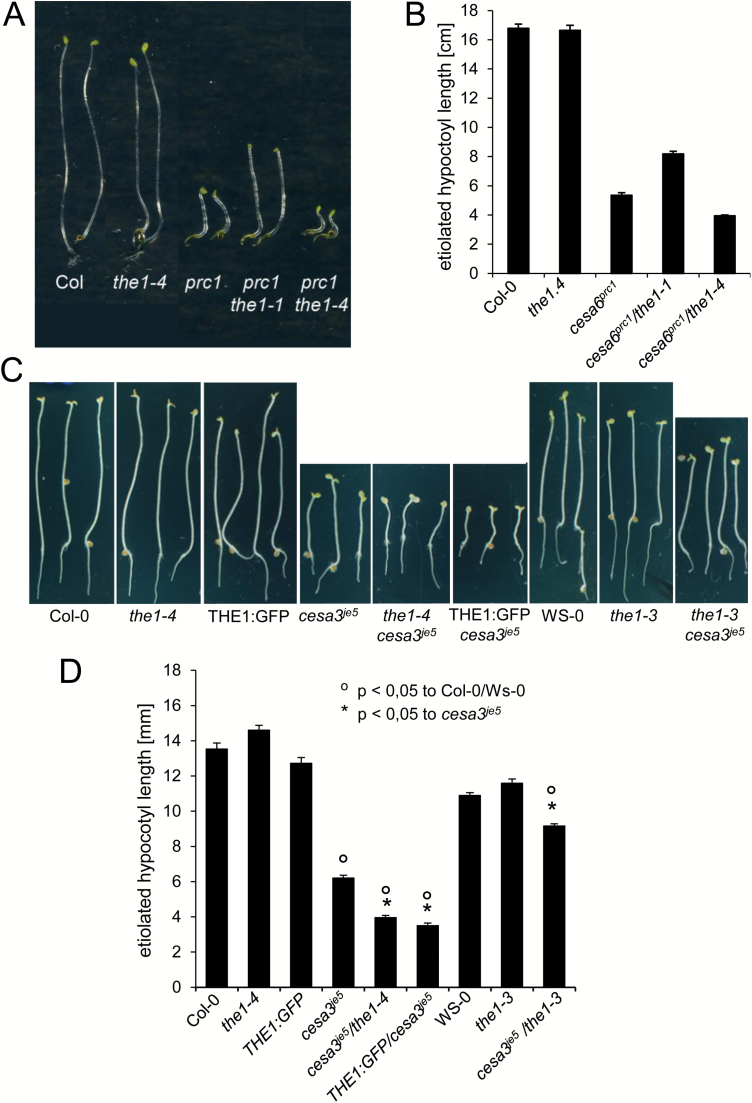
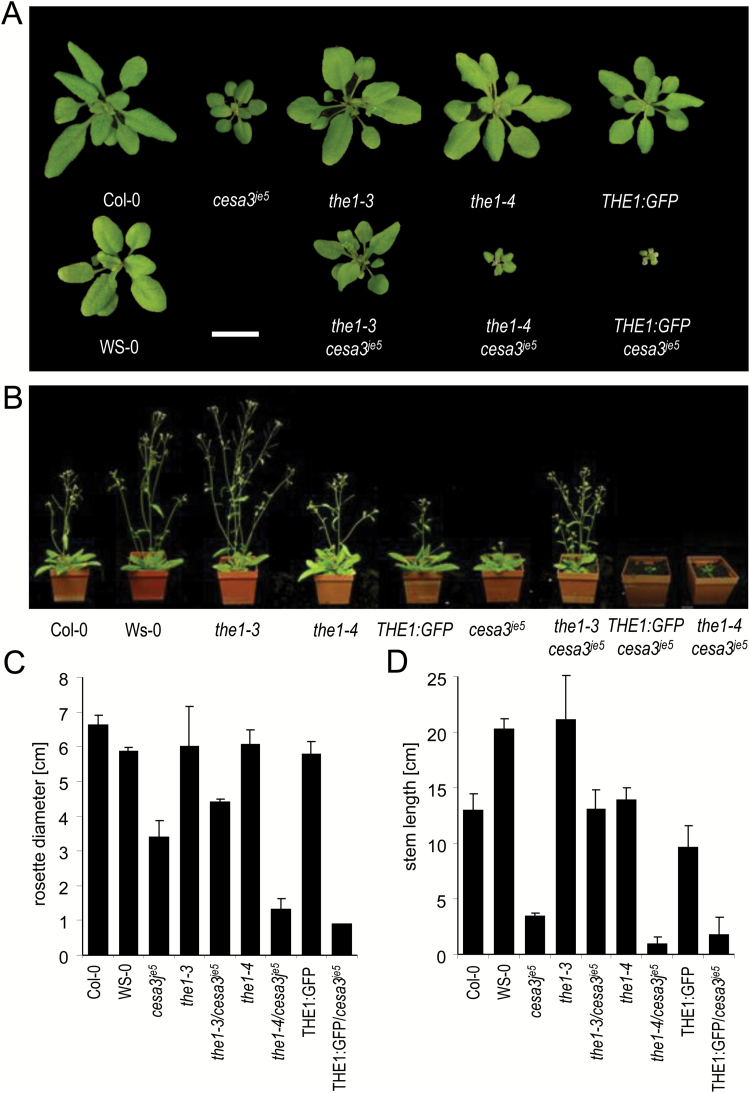
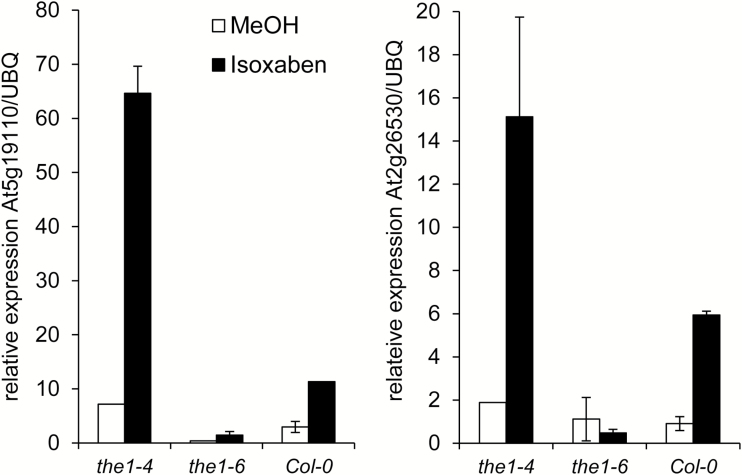
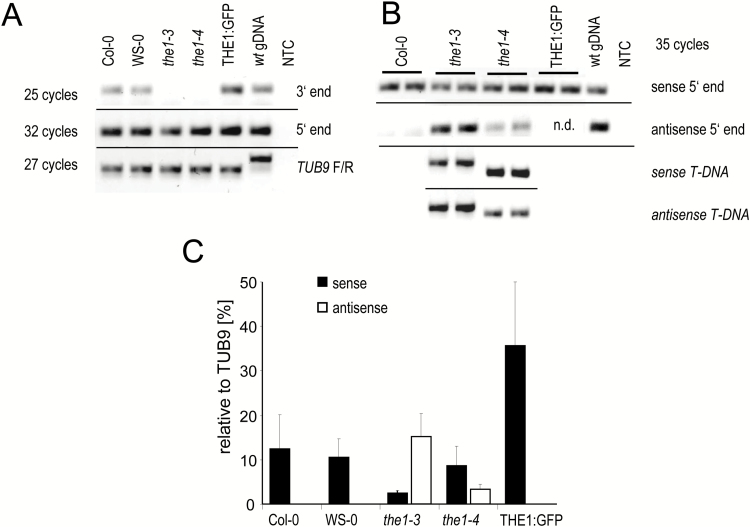
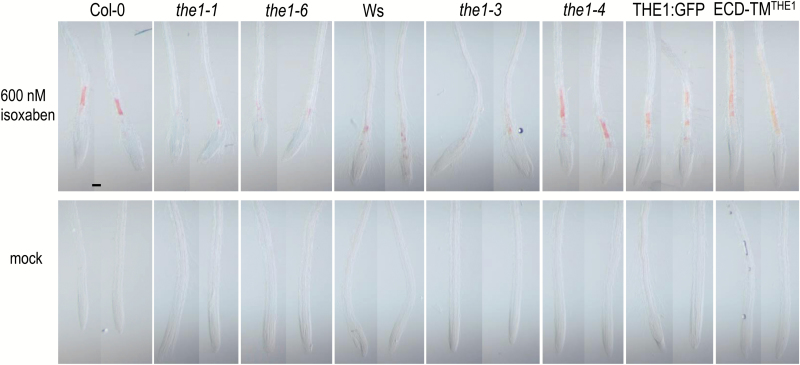
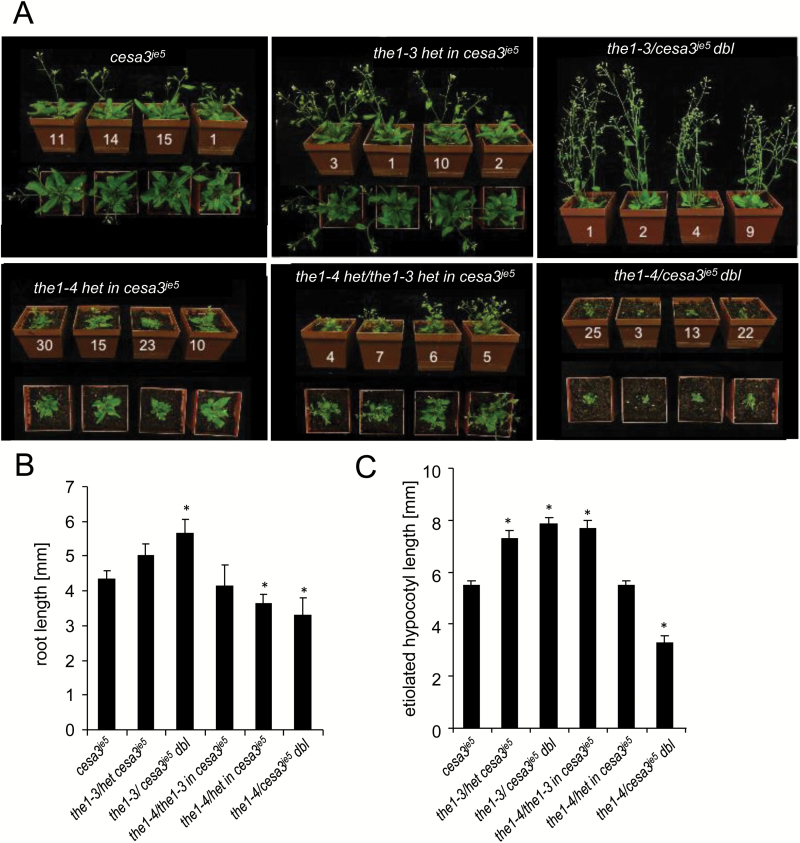
Perturbation of cellulose synthesis in plants triggers stress responses, including growth retardation, mediated by the cell wall integrity-sensing receptor-like kinase (RLK) THESEUS1 (THE1). The analysis of two alleles carrying T-DNA insertions at comparable positions has led to conflicting conclusions concerning the impact of THE1 signaling on growth. Here we confirm that, unlike the1-3 and other the1 alleles in which cellular responses to genetic or pharmacological inhibition of cellulose synthesis are attenuated, the1-4 showed enhanced responses, including growth inhibition, ectopic lignification, and stress gene expression. Both the1-3 and the1-4 express a transcript encoding a predicted membrane-associated truncated protein lacking the kinase domain. However, the1-3, in contrast to the1-4, strongly expresses antisense transcripts, which are expected to prevent the expression of the truncated protein as suggested by the genetic interactions between the two alleles. Seedlings overexpressing such a truncated protein react to isoxaben treatment similarly to the1-4 and the full-length THE overexpressor. We conclude that the1-4 is a hypermorphic allele; that THE1 signaling upon cell wall damage has a negative impact on cell expansion; and that caution is required when interpreting the phenotypic effects of T-DNA insertions in RLK genes.
植物中纤维素合成的扰动会引发应激反应,包括由细胞壁完整性感应类受体激酶(RLK)THESEUS1(THE1)介导的生长迟缓。对在可比位置携带T-DNA插入的两个等位基因的分析,就THE1信号传导对生长的影响得出了相互矛盾的结论。在这里,我们证实,与the1-3和其他the1等位基因不同,在the1-3和其他the1等位基因中,细胞对纤维素合成的遗传或药理学抑制的反应减弱,而the1-4表现出增强的反应,包括生长抑制、异位木质化和应激基因表达。the1-3和the1-4都表达一种转录本,该转录本编码一种预测的缺乏激酶结构域的膜相关截短蛋白。然而,与the1-4相反,the1-3强烈表达反义转录本,根据两个等位基因之间的遗传相互作用,预期这些反义转录本会阻止截短蛋白的表达。过表达这种截短蛋白的幼苗对异恶草酮处理的反应与the1-4和全长THE过表达体相似。我们得出结论,the1-4是一个超显性等位基因;细胞壁损伤时的THE1信号传导对细胞扩张有负面影响;并且在解释RLK基因中T-DNA插入的表型效应时需要谨慎。