Serra-Casas Elisa, Manrique Paulo, Ding Xavier C, Carrasco-Escobar Gabriel, Alava Freddy, Gave Anthony, Rodriguez Hugo, Contreras-Mancilla Juan, Rosas-Aguirre Angel, Speybroeck Niko, González Iveth J, Rosanas-Urgell Anna, Gamboa Dionicia
Department of Biomedical Sciences, Institute of Tropical Medicine, Antwerp, Belgium.
Laboratorios de Investigación y Desarrollo (LID), Facultad de Ciencias y Filosofía, Universidad Peruana Cayetano Heredia, Lima, Peru.
PLoS One. 2017 Oct 5;12(10):e0185742. doi: 10.1371/journal.pone.0185742. eCollection 2017.
Loop-mediated isothermal DNA amplification (LAMP) methodology offers an opportunity for point-of-care (POC) molecular detection of asymptomatic malaria infections. However, there is still little evidence on the feasibility of implementing this technique for population screenings in isolated field settings.
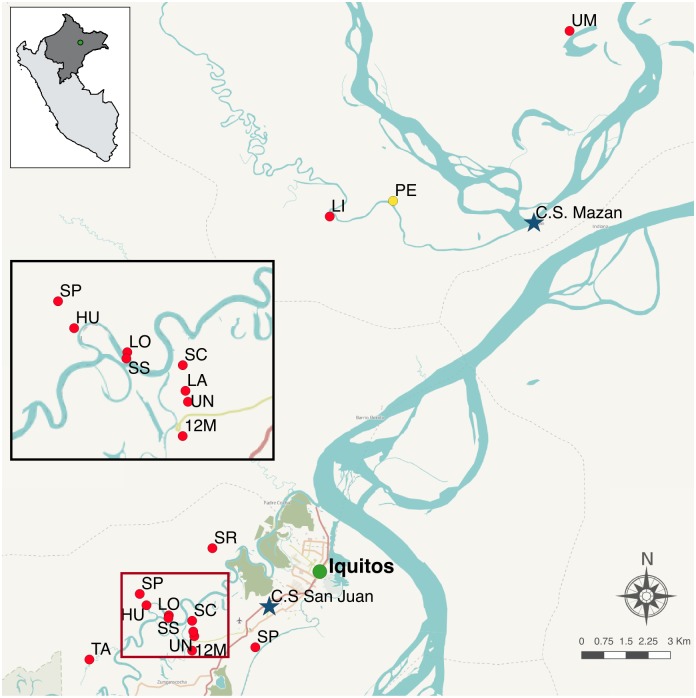
Overall, we recruited 1167 individuals from terrestrial ('road') and hydric ('riverine') communities of the Peruvian Amazon for a cross-sectional survey to detect asymptomatic malaria infections. The technical performance of LAMP was evaluated in a subgroup of 503 samples, using real-time Polymerase Chain Reaction (qPCR) as reference standard. The operational feasibility of introducing LAMP testing in the mobile screening campaigns was assessed based on field-suitability parameters, along with a pilot POC-LAMP assay in a riverine community without laboratory infrastructure.
LAMP had a sensitivity of 91.8% (87.7-94.9) and specificity of 91.9% (87.8-95.0), and the overall accuracy was significantly better among samples collected during road screenings than riverine communities (p≤0.004). LAMP-based diagnostic strategy was successfully implemented within the field-team logistics and the POC-LAMP pilot in the riverine community allowed for a reduction in the turnaround time for case management, from 12-24 hours to less than 5 hours. Specimens with haemolytic appearance were regularly observed in riverine screenings and could help explaining the hindered performance/interpretation of the LAMP reaction in these communities.
LAMP-based molecular malaria diagnosis can be deployed outside of reference laboratories, providing similar performance as qPCR. However, scale-up in remote field settings such as riverine communities needs to consider a number of logistical challenges (e.g. environmental conditions, labour-intensiveness in large population screenings) that can influence its optimal implementation.
环介导等温DNA扩增(LAMP)方法为无症状疟疾感染的即时检测(POC)提供了机会。然而,关于在偏远地区现场进行人群筛查时实施该技术的可行性,仍缺乏证据。
总体而言,我们从秘鲁亚马逊地区的陆地(“公路沿线”)和水域(“河流沿岸”)社区招募了1167人进行横断面调查,以检测无症状疟疾感染。在503份样本的亚组中,以实时聚合酶链反应(qPCR)作为参考标准,评估LAMP的技术性能。基于现场适用性参数评估了在流动筛查活动中引入LAMP检测的操作可行性,并在一个没有实验室基础设施的河流沿岸社区进行了POC-LAMP检测试点。
LAMP的灵敏度为91.8%(87.7-94.9),特异性为91.9%(87.8-95.0),公路沿线筛查采集的样本总体准确率明显高于河流沿岸社区(p≤0.004)。基于LAMP的诊断策略在现场团队后勤工作中成功实施,河流沿岸社区的POC-LAMP检测试点使病例管理的周转时间从12-24小时缩短至不到5小时。在河流沿岸筛查中经常观察到具有溶血外观的样本,这可能有助于解释LAMP反应在这些社区中性能/解释受阻的原因。
基于LAMP的分子疟疾诊断可以在参考实验室之外进行,其性能与qPCR相似。然而,在河流沿岸社区等偏远地区扩大规模需要考虑一些后勤挑战(如环境条件、大规模人群筛查中的劳动强度),这些挑战可能会影响其最佳实施。