Department of Tropical Medicine and Malaria, Research Institute, National Center for Global Health and Medicine, Tokyo, 162-8655, Japan.
Graduate School of Comprehensive Human Sciences, University of Tsukuba, Tsukuba, 305-8575, Japan.
Infect Dis Poverty. 2023 May 22;12(1):53. doi: 10.1186/s40249-023-01097-w.
Malaria continues to cause burden in various parts of the world. Haiti, a Caribbean country, is among those aiming to eliminate malaria within a few years. Two surveys were conducted in Haiti during which we aimed to evaluate the performance of the simple and rapid procedure for ultra-rapid extraction-loop-mediated isothermal amplification (PURE-LAMP) method with dried blood spots as an alternative diagnostic method for malaria in the context of low to very low rates of transmission.
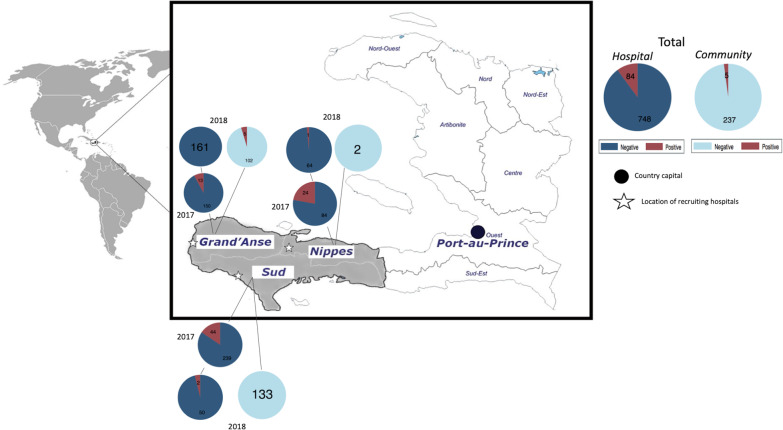
Febrile and afebrile people were recruited from three administrative divisions within Haiti: Nippes, Sud and Grand'Anse, during the summers of 2017 (early August to early September) and 2018 (late July to late August). Their blood samples were tested by microscopy, rapid diagnostic tests (RDT), PURE-LAMP and nested PCR to detect Plasmodium infection. Sensitivity, specificity, positive and negative predictive values and kappa statistics were estimated with the nested PCR results as the gold standard.
Among 1074 samples analyzed, a positive rate of 8.3% was calculated based on the nested PCR results. Among febrile participants, the rates in 2017 and 2018 were 14.6% and 1.4%, respectively. Three positives were detected among 172 afebrile participants in 2018 by PURE-LAMP and nested PCR, and all three were from the same locality. There was no afebrile participants recruited in 2017. The PURE-LAMP, RDT and microscopy had respective sensitivities of 100%, 85.4% and 49.4%. All of the testing methods had specificities over 99%.
This study confirmed the high performance of the PURE-LAMP method to detect Plasmodium infection with dried blood spots and recommends its use in targeted mass screening and treatment activities in low endemic areas of malaria.
疟疾在世界许多地区继续造成负担。海地是加勒比地区的一个国家,也在力争在几年内消除疟疾。在海地进行了两项调查,我们旨在评估超快速提取环介导等温扩增(PURE-LAMP)方法与干血斑作为在低至极低传播率情况下疟疾替代诊断方法的性能。
在 2017 年(8 月初至 9 月初)和 2018 年(7 月底至 8 月底)的夏季,从海地的三个行政区(尼普斯、南和大湾)招募发热和不发热的人。他们的血液样本通过显微镜检查、快速诊断检测(RDT)、PURE-LAMP 和巢式 PCR 检测疟原虫感染。以巢式 PCR 结果为金标准,估计了敏感性、特异性、阳性和阴性预测值以及kappa 统计数据。
在分析的 1074 个样本中,根据巢式 PCR 结果计算出阳性率为 8.3%。在发热参与者中,2017 年和 2018 年的阳性率分别为 14.6%和 1.4%。2018 年,3 名发热参与者通过 PURE-LAMP 和巢式 PCR 检测到 3 例阳性,均来自同一地点。2017 年没有招募到发热参与者。PURE-LAMP、RDT 和显微镜检查的敏感性分别为 100%、85.4%和 49.4%。所有检测方法的特异性均超过 99%。
本研究证实了 PURE-LAMP 方法在检测干血斑中的疟原虫感染方面的高性能,并建议在疟疾低流行地区的有针对性的大规模筛查和治疗活动中使用。