Dugré Jules R, Dellazizzo Laura, Giguère Charles-Édouard, Potvin Stéphane, Dumais Alexandre
Centre de recherche de l'Institut Universitaire en Santé Mentale de Montréal, Montréal, QC, Canada.
Department of Psychiatry, Faculty of Medicine, Université de Montréal, Montreal, QC, Canada.
Front Psychiatry. 2017 Sep 21;8:176. doi: 10.3389/fpsyt.2017.00176. eCollection 2017.
Violence is a major concern and is prevalent across several mental disorders. The use of substances has been associated with an exacerbation of psychiatric symptoms as well as with violence. Compared to other substances such as alcohol and cocaine, existing literature on the cannabis-violence relationship has been more limited, with most studies being conducted in the general population, and has shown controversial results. Evidence has suggested a stronger relationship when examining the effects of the persistency of cannabis use on future violent behaviors. Though, while cannabis use is highly prevalent amid psychiatric patients, far less literature on the subject has been conducted in this population. Hence, the present prospective study aims to investigate the persistency of cannabis use in psychiatric patients.
The sample comprised of 1,136 recently discharged psychiatric patients provided by the MacArthur Risk Assessment Study. A multi-wave (five-assessment) follow-up design was employed to allow temporal sequencing between substance use and violent behaviors. Generalized estimating equations (GEE) were used to examine the effect of persistency of cannabis use on violence, while controlling for potential confounding factors. Potential bidirectional association was also investigated using the same statistical approach.
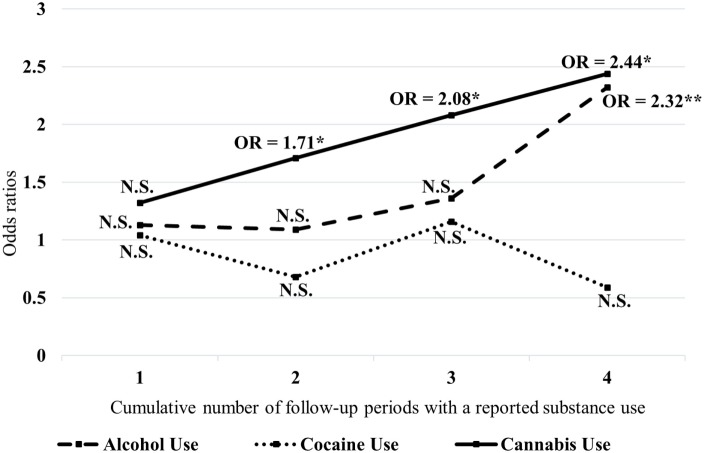
Our results suggest a unidirectional association between cannabis use and violence. GEE model revealed that the continuity of cannabis use across more than one time wave was associated with increased risks of future violent behavior. Patients who reported having used cannabis at each follow-up periods were 2.44 times more likely to display violent behaviors (OR = 2.44, 95% CI: 1.06-5.63, < 0.05).
These findings are particularly relevant as they suggest that the longer individuals report having used cannabis after a psychiatric discharge, the more likely they are of being violent in the following time waves. These results add to our understanding of the negative consequences of chronic cannabis use amid psychiatric patients.
暴力是一个主要问题,在多种精神障碍中普遍存在。物质使用与精神症状的加重以及暴力行为有关。与酒精和可卡因等其他物质相比,关于大麻与暴力关系的现有文献更为有限,大多数研究是在普通人群中进行的,并且结果存在争议。有证据表明,在研究大麻使用持续性对未来暴力行为的影响时,两者关系更为紧密。然而,虽然大麻使用在精神病患者中非常普遍,但针对这一人群的相关文献却少得多。因此,本前瞻性研究旨在调查精神病患者中大麻使用的持续性。
样本包括由麦克阿瑟风险评估研究提供的1136名近期出院的精神病患者。采用多波次(五次评估)随访设计,以确定物质使用和暴力行为之间的时间顺序。使用广义估计方程(GEE)来检验大麻使用持续性对暴力行为的影响,同时控制潜在的混杂因素。还使用相同的统计方法研究了潜在的双向关联。
我们的结果表明大麻使用与暴力行为之间存在单向关联。GEE模型显示,在多个时间波次中持续使用大麻与未来暴力行为风险增加有关。在每个随访期报告使用过大麻的患者出现暴力行为的可能性高2.44倍(OR = 2.44,95% CI:1.06 - 5.63,P < 0.05)。
这些发现特别重要,因为它们表明精神病患者出院后报告使用大麻的时间越长,在随后的时间波次中发生暴力行为的可能性就越大。这些结果加深了我们对精神病患者长期使用大麻负面后果的理解。