Armstrong Laura E, Guo Grace L
Department of Pharmacology and Toxicology, Ernest Mario School of Pharmacy, Rutgers University, Piscataway, New Jersey.
Environmental and Occupational Health Science Institute, Rutgers University, Piscataway, New Jersey.
Curr Pharmacol Rep. 2017 Apr;3(2):92-100. doi: 10.1007/s40495-017-0085-2. Epub 2017 Feb 21.
About 15-25% of patients with simple steatosis of non-alcoholic fatty liver disease progresses to non-alcoholic steatohepatitis (NASH), and the underlying mechanism for this progression has not been elucidated. NASH ultimately could progress to cirrhosis, an irreversible condition.
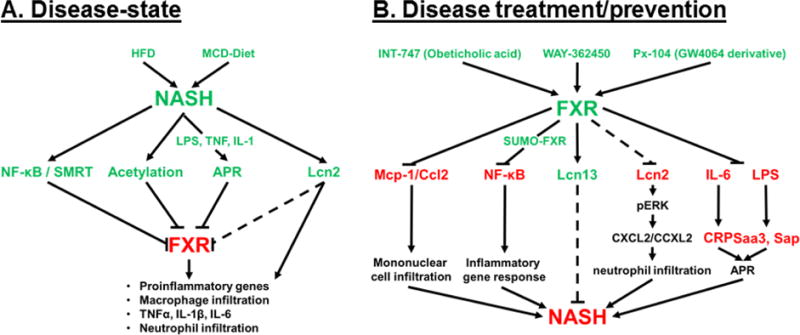
Farnesoid X receptor (FXR) has been studied for its role in modulating inflammation, and the expression of FXR is down-regulated during NASH development. FXR deficiency has shown to progress and exacerbate NASH development, and FXR activation has been protective against liver inflammation associated with NASH. The expression of factors in both the adaptive and innate immune response in the liver are regulated in a FXR-dependent and -independent manner.
Therefore, understanding key signaling pathways of liver inflammation in NASH is important to determine essential components that predispose, progress, or exacerbate NASH. FXR has been identified as a therapeutic target for NASH to prevent liver inflammation.
非酒精性脂肪性肝病单纯性脂肪变性患者中约15%-25%会进展为非酒精性脂肪性肝炎(NASH),但这种进展的潜在机制尚未阐明。NASH最终可能进展为肝硬化,这是一种不可逆的病症。
法尼酯X受体(FXR)在调节炎症中的作用已得到研究,且在NASH发展过程中FXR的表达下调。FXR缺乏已被证明会促进和加剧NASH的发展,而FXR激活对与NASH相关的肝脏炎症具有保护作用。肝脏中适应性和先天性免疫反应中各种因子的表达以FXR依赖性和非依赖性方式受到调节。
因此,了解NASH中肝脏炎症的关键信号通路对于确定易患、促进或加剧NASH的关键成分很重要。FXR已被确定为预防肝脏炎症的NASH治疗靶点。