Vayena Effy, Blasimme Alessandro
Health Ethics and Policy Lab-Department of Health Sciences and Technology, ETH Zurich, Auf der Mauer, 17, 8001, Zurich, Switzerland.
J Bioeth Inq. 2017 Dec;14(4):501-513. doi: 10.1007/s11673-017-9809-6. Epub 2017 Oct 5.
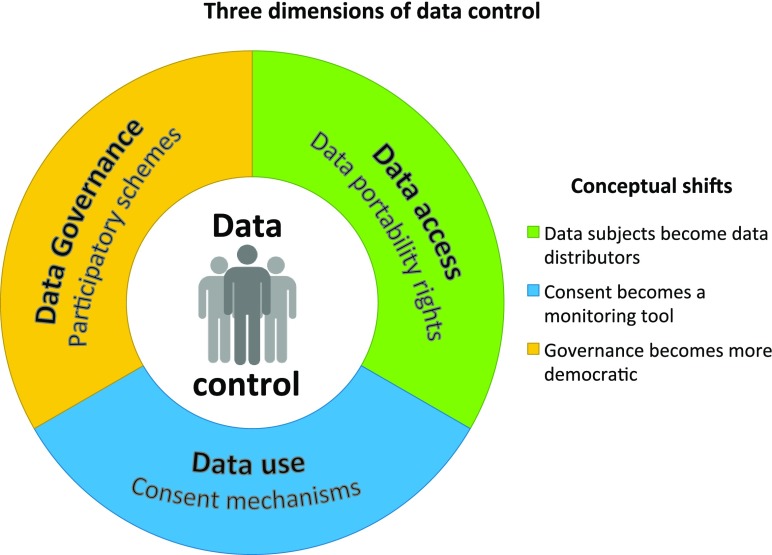
Empirical evidence suggests that while people hold the capacity to control their data in high regard, they increasingly experience a loss of control over their data in the online world. The capacity to exert control over the generation and flow of personal information is a fundamental premise to important values such as autonomy, privacy, and trust. In healthcare and clinical research this capacity is generally achieved indirectly, by agreeing to specific conditions of informational exposure. Such conditions can be openly stated in informed consent documents or be implicit in the norms of confidentiality that govern the relationships of patients and healthcare professionals. However, with medicine becoming a data-intense enterprise, informed consent and medical confidentiality, as mechanisms of control, are put under pressure. In this paper we explore emerging models of informational control in data-intense healthcare and clinical research, which can compensate for the limitations of currently available instruments. More specifically, we discuss three approaches that hold promise in increasing individual control: the emergence of data portability rights as means to control data access, new mechanisms of informed consent as tools to control data use, and finally, new participatory governance schemes that allow individuals to control their data through direct involvement in data governance. We conclude by suggesting that, despite the impression that biomedical big data diminish individual control, the synergistic effect of new data management models can in fact improve it.
实证证据表明,尽管人们高度重视对自己数据的控制权,但他们在网络世界中越来越感到对自己的数据失去了控制。对个人信息的生成和流动施加控制的能力是诸如自主性、隐私和信任等重要价值观的基本前提。在医疗保健和临床研究中,这种能力通常是通过同意特定的信息披露条件间接实现的。这些条件可以在知情同意文件中公开说明,或者隐含在管理患者与医疗保健专业人员关系的保密规范中。然而,随着医学成为一个数据密集型行业,作为控制机制的知情同意和医疗保密受到了压力。在本文中,我们探讨了数据密集型医疗保健和临床研究中新兴的信息控制模式,这些模式可以弥补现有工具的局限性。更具体地说,我们讨论了三种有望增强个人控制权的方法:数据可携带权的出现作为控制数据访问的手段、新的知情同意机制作为控制数据使用的工具,以及最后,新的参与式治理方案,允许个人通过直接参与数据治理来控制自己的数据。我们的结论是,尽管有一种印象认为生物医学大数据会削弱个人控制权,但新数据管理模式的协同效应实际上可以改善这种情况。