Molecular Medicine Section, National Heart & Lung Institute, Imperial College London, South Kensington Campus, London, SW7 2AZ, UK.
National Institute for Health Research Respiratory Biomedical Research Unit at Royal Brompton and Harefield NHS Foundation Trust and Imperial College, London, SW3 6NP, UK.
J Cachexia Sarcopenia Muscle. 2018 Feb;9(1):119-128. doi: 10.1002/jcsm.12236. Epub 2017 Oct 6.
Loss of muscle mass and strength are important sequelae of chronic disease, but the response of individuals is remarkably variable, suggesting important genetic and epigenetic modulators of muscle homeostasis. Such factors are likely to modify the activity of pathways that regulate wasting, but to date, few such factors have been identified.
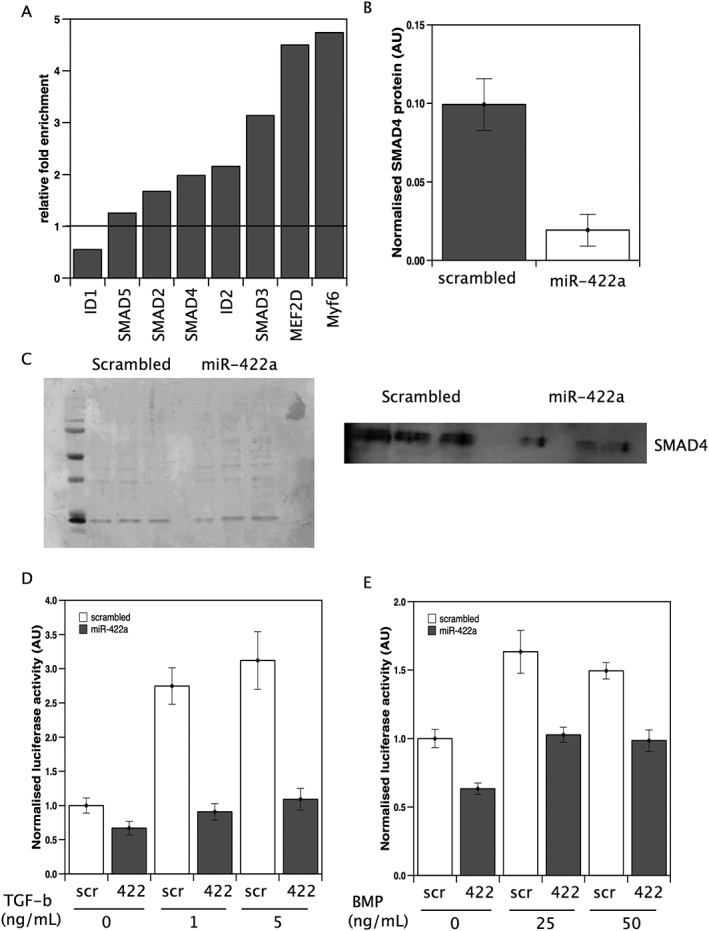
The effect of miR-422a on SMAD4 expression and transforming growth factor (TGF)-β signalling were determined by western blotting and luciferase assay. miRNA expression was determined by qPCR in plasma and muscle biopsy samples from a cross-sectional study of patients with chronic obstructive pulmonary disease (COPD) and a longitudinal study of patients undergoing aortic surgery, who were subsequently admitted to the intensive care unit (ICU).
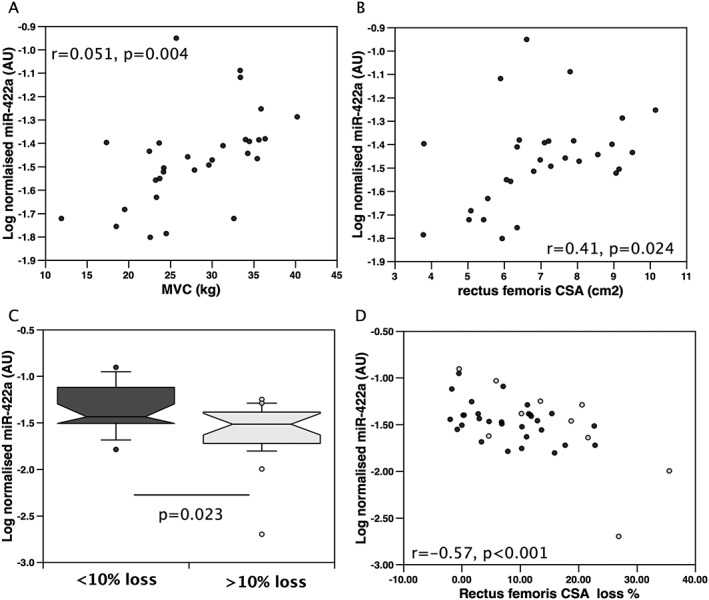
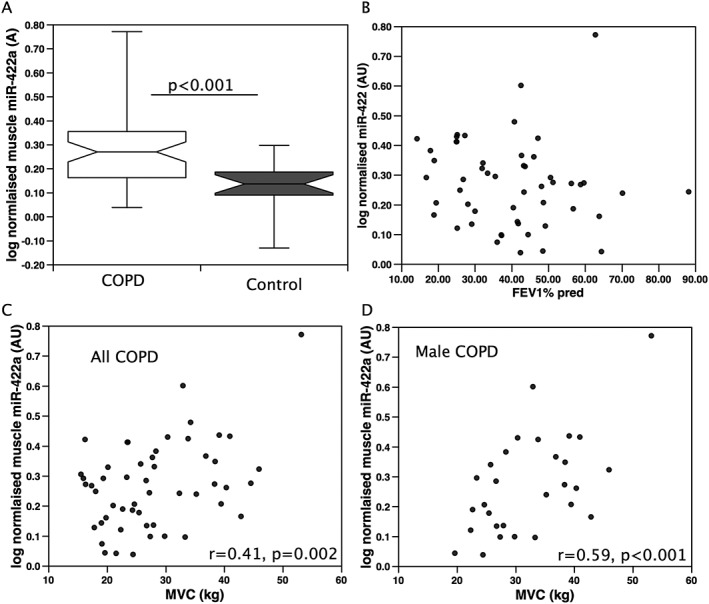
miR-422a was identified, by a screen, as a microRNA that was present in the plasma of patients with COPD and negatively associated with muscle strength as well as being readily detectable in the muscle of patients. In vitro, miR-422a suppressed SMAD4 expression and inhibited TGF-beta and bone morphogenetic protein-dependent luciferase activity in muscle cells. In male patients with COPD and those undergoing aortic surgery and on the ICU, a model of ICU-associated muscle weakness, quadriceps expression of miR-422a was positively associated with muscle strength (maximal voluntary contraction r = 0.59, P < 0.001 and r = 0.51, P = 0.004, for COPD and aortic surgery, respectively). Furthermore, pre-surgery levels of miR-422a were inversely associated with the amount of muscle that would be lost in the first post-operative week (r = -0.57, P < 0.001).
These data suggest that differences in miR-422a expression contribute to the susceptibility to muscle wasting associated with chronic and acute disease and that at least part of this activity may be mediated by reduced TGF-beta signalling in skeletal muscle.
肌肉质量和力量的丧失是慢性疾病的重要后遗症,但个体的反应差异很大,这表明肌肉稳态存在重要的遗传和表观遗传调节剂。这些因素可能会改变调节消耗的途径的活性,但迄今为止,很少有这样的因素被发现。
通过 Western 印迹和荧光素酶测定法确定 miR-422a 对 SMAD4 表达和转化生长因子 (TGF)-β信号的影响。通过对慢性阻塞性肺疾病 (COPD) 患者的横断面研究和接受主动脉手术的患者的纵向研究中的血浆和肌肉活检样本进行 qPCR 确定 miRNA 表达,这些患者随后被收入重症监护病房 (ICU)。
通过筛选发现,miR-422a 是一种存在于 COPD 患者血浆中的 microRNA,与肌肉力量呈负相关,并且在患者的肌肉中容易检测到。在体外,miR-422a 抑制 SMAD4 表达,并抑制肌肉细胞中的 TGF-β 和骨形态发生蛋白依赖性荧光素酶活性。在 COPD 男性患者以及接受主动脉手术和 ICU 的患者中,ICU 相关肌肉无力的模型中,股四头肌 miR-422a 的表达与肌肉力量呈正相关(COPD 和主动脉手术的最大自主收缩 r=0.59,P<0.001 和 r=0.51,P=0.004)。此外,手术前的 miR-422a 水平与术后第一周内肌肉丢失量呈负相关(r=-0.57,P<0.001)。
这些数据表明,miR-422a 表达的差异导致与慢性和急性疾病相关的肌肉消耗易感性,至少部分活性可能是通过降低骨骼肌中的 TGF-β 信号传递介导的。