Zhou Yaxian, Tsai Tsung-Lin, Li Wan-Ju
Laboratory of Musculoskeletal Biology and Regenerative Medicine, Department of Orthopedics and Rehabilitation, University of Wisconsin-Madison, Madison, Wisconsin.
Department of Biomedical Engineering, University of Wisconsin-Madison, Madison, Wisconsin.
Ann N Y Acad Sci. 2017 Dec;1409(1):3-17. doi: 10.1111/nyas.13451. Epub 2017 Oct 6.
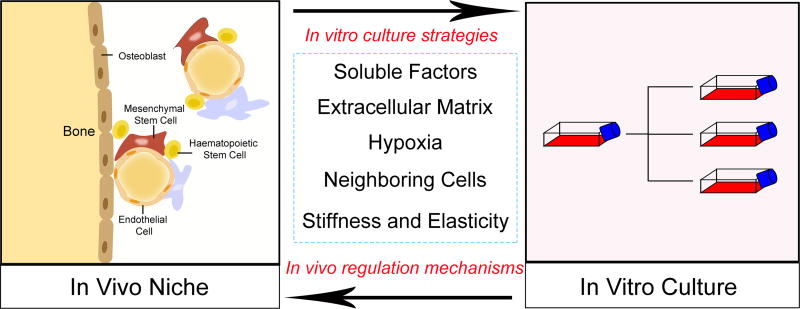
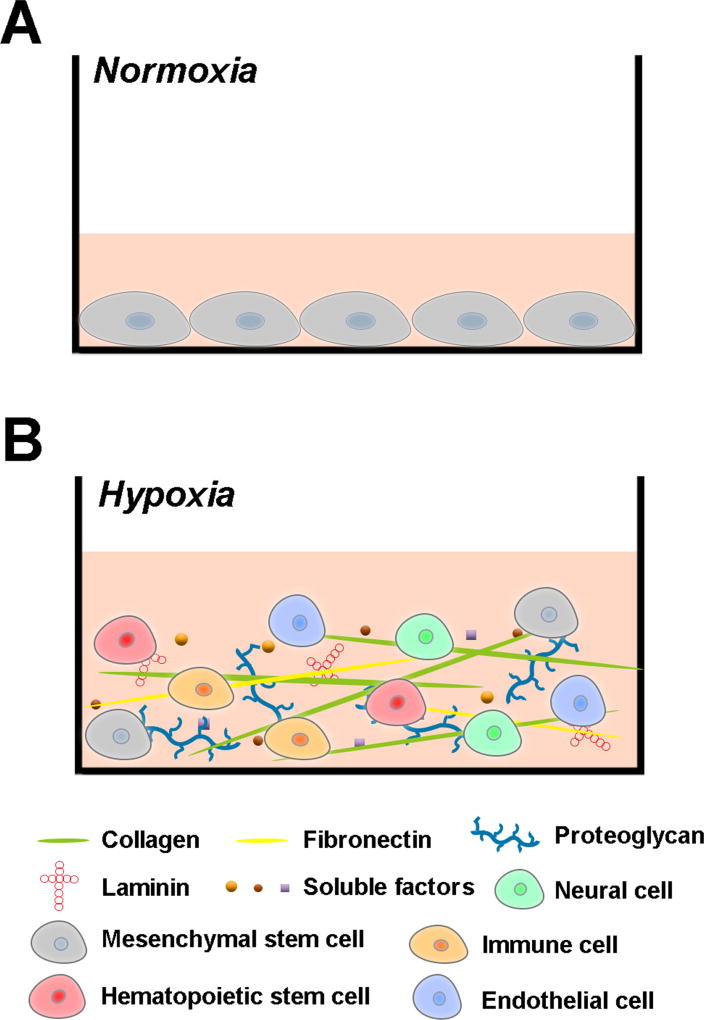
Mesenchymal stem cells (MSCs) have been extensively used for cell therapies and tissue engineering. The current MSC strategy requires a large quantity of cells for such applications, which can be achieved through cell expansion in culture. In the body, stem cell fate is largely determined by their microenvironment, known as the niche. The complex and dynamic stem cell niche provides physical, mechanical, and chemical cues to collaboratively regulate cell activities. It remains a great challenge to maintain the properties of MSCs in culture. Constructing a microenvironment as an engineered stem cell niche in culture to maintain MSC phenotypes, properties, and functions is a viable strategy to address the issue. Here, we review the current understanding of MSC behavior in the bone marrow niche, describe different strategies to engineer an in vitro microenvironment for maintaining MSC properties and functions, and discuss previous findings on environmental factors critical to the modulation of MSC activities in engineered microenvironments.
间充质干细胞(MSCs)已被广泛应用于细胞治疗和组织工程。当前的间充质干细胞策略需要大量细胞用于此类应用,这可以通过在培养中进行细胞扩增来实现。在体内,干细胞的命运很大程度上由其微环境决定,即所谓的干细胞龛。复杂且动态的干细胞龛提供物理、机械和化学信号,协同调节细胞活动。在培养中维持间充质干细胞的特性仍然是一个巨大的挑战。构建一种微环境作为培养中的工程化干细胞龛以维持间充质干细胞的表型、特性和功能,是解决该问题的可行策略。在此,我们综述了目前对间充质干细胞在骨髓龛中行为的理解,描述了构建体外微环境以维持间充质干细胞特性和功能的不同策略,并讨论了先前关于工程化微环境中对调节间充质干细胞活动至关重要的环境因素的研究结果。