Li Hao, Liu Wenzhong, Sorenson Christine M, Sheibani Nader, Albert Daniel M, Senanayake Thulani, Vinogradov Serguei, Henkin Jack, Zhang Hao F
Department of Biomedical Engineering, Northwestern University, Evanston, Illinois, United States.
Department of Pediatrics, University of Wisconsin-Madison, Madison, Wisconsin, United States.
Invest Ophthalmol Vis Sci. 2017 Oct 1;58(12):5142-5150. doi: 10.1167/iovs.17-22160.
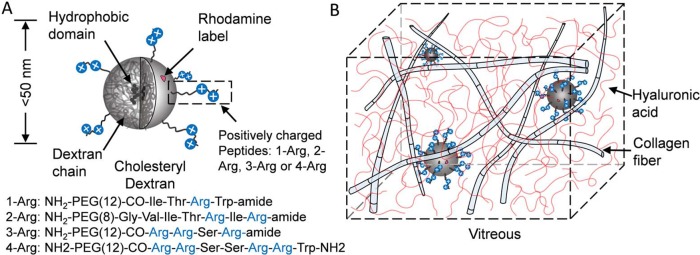
Intravitreal injection of antiangiogenic agents is becoming a standard treatment for neovascular retinal diseases. Sustained release of therapeutics by injecting colloidal carriers is a promising approach to reduce the injection frequency, which reduces treatment burdens and the risk of complications on patients. Such sustained release often requires carriers to have micrometer-scale dimension that, however, can potentially promote glaucoma and inflammation. Small, polycationic particles can be immobilized in vitreous through multiple cooperative ionic interactions with hyaluronic acid of the vitreous interior, but such particles are generally toxic. Here, we synthesized and examined a biocompatible dextran-based nanocarrier (<50 nm in diameter) conjugated with cationic peptides containing L-arginine with minimal toxicity, aiming to provide sustained release of therapeutic drugs in vitreous.
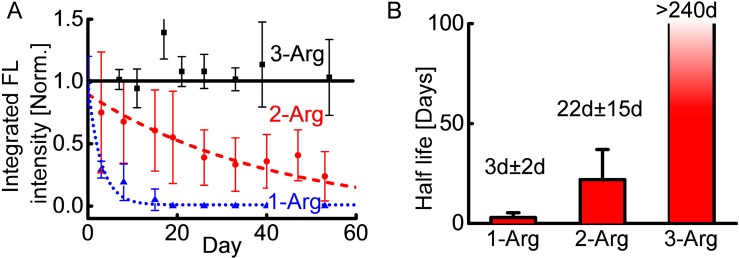
We synthesized the nanocarriers with condensed cholesteryl dextran (CDEX) as core material. Cationic peptides containing 1 to 4 arginine groups, along with fluorescence tags, were conjugated to the CDEX surface. We monitored the carrier diffusion rate ex vivo and half-lives in vivo in rodent vitreous using fluorescence imaging. We evaluated the toxicity by histological examinations at the second, third, eighth, and thirty-sixth week.
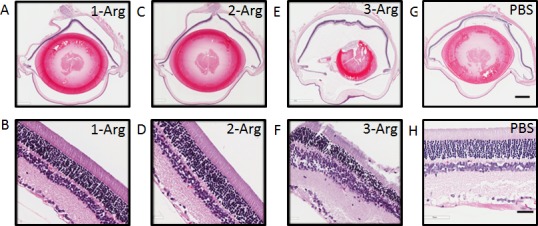
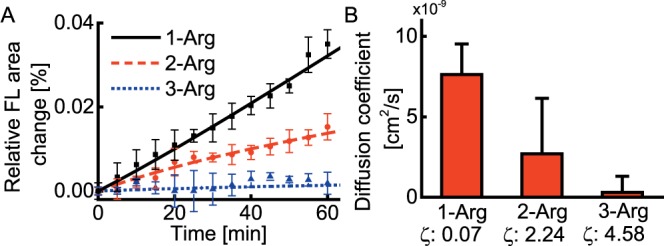
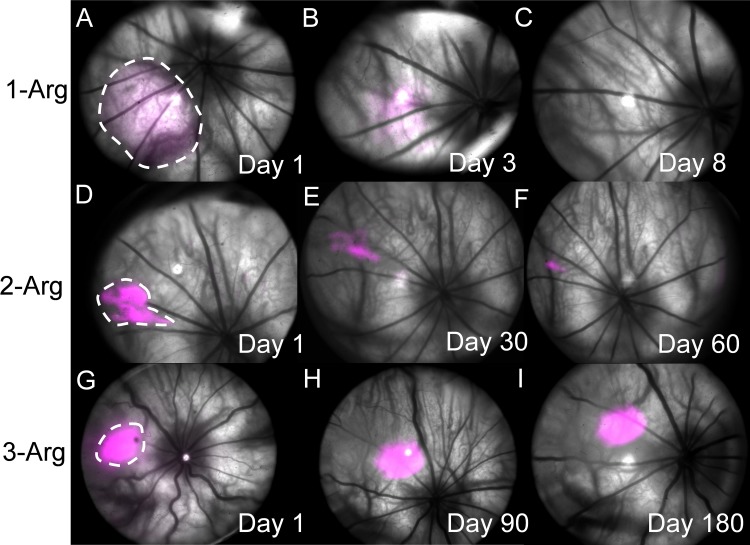
The diffusion rate of nanocarriers was inversely related to zeta potential values in freshly isolated vitreous humor. We observed increased half-lives in vivo with increasing zeta potential (up to 240 days). Histological examinations confirmed no adverse effects on ocular morphology and organization.
We demonstrated the potential of L-arginine peptide-conjugated nanocarriers toward safe and sustained therapeutic release system for posterior eye diseases.
玻璃体内注射抗血管生成药物正成为治疗新生血管性视网膜疾病的标准方法。通过注射胶体载体实现治疗药物的持续释放是一种有望减少注射频率的方法,这可以减轻患者的治疗负担和并发症风险。这种持续释放通常要求载体具有微米级尺寸,然而,这可能会潜在地引发青光眼和炎症。小的聚阳离子颗粒可以通过与玻璃体内透明质酸的多种协同离子相互作用固定在玻璃体内,但此类颗粒通常具有毒性。在此,我们合成并研究了一种与含L-精氨酸的阳离子肽缀合的生物相容性葡聚糖基纳米载体(直径<50 nm),其毒性最小,旨在在玻璃体内实现治疗药物的持续释放。
我们以缩合胆固醇葡聚糖(CDEX)为核心材料合成了纳米载体。将含有1至4个精氨酸基团的阳离子肽以及荧光标签缀合到CDEX表面。我们使用荧光成像在离体状态下监测载体扩散速率,并在啮齿动物玻璃体内监测其体内半衰期。我们在第2、3、8和36周通过组织学检查评估毒性。
纳米载体在新鲜分离的玻璃体液中的扩散速率与zeta电位值呈负相关。我们观察到随着zeta电位增加(高达240天),体内半衰期延长。组织学检查证实对眼部形态和组织结构无不良影响。
我们证明了L-精氨酸肽缀合的纳米载体对于后部眼病安全且持续的治疗释放系统具有潜力。