Medical University of Vienna, Center for Physiology and Pharmacology, Institute of Pharmacology, Waehringerstrasse 13A, 1090, Vienna, Austria.
Center for Drug Discovery, Research Triangle Institute, Research Triangle Park, NC, USA.
Neuropharmacology. 2018 May 15;134(Pt A):149-157. doi: 10.1016/j.neuropharm.2017.10.006. Epub 2017 Oct 6.
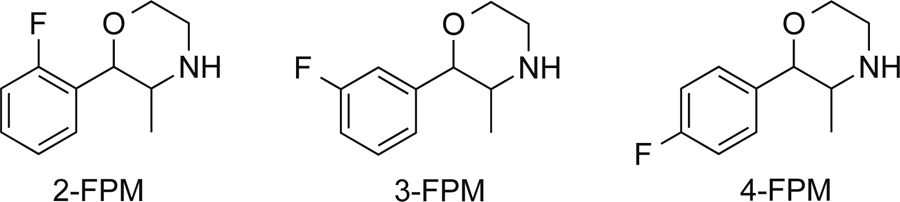
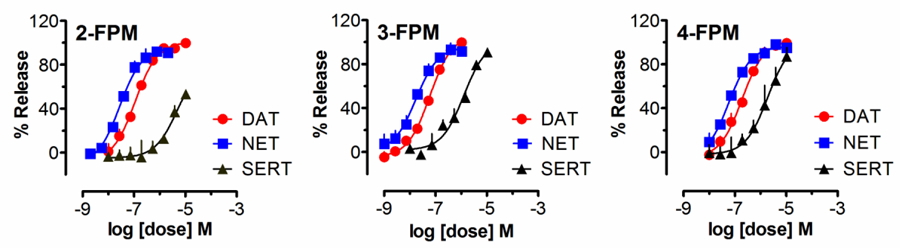
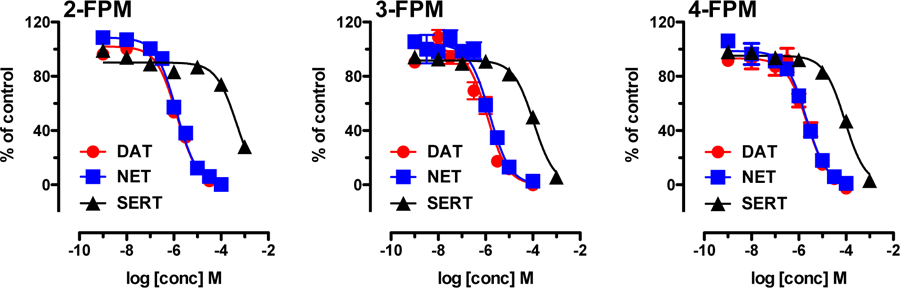
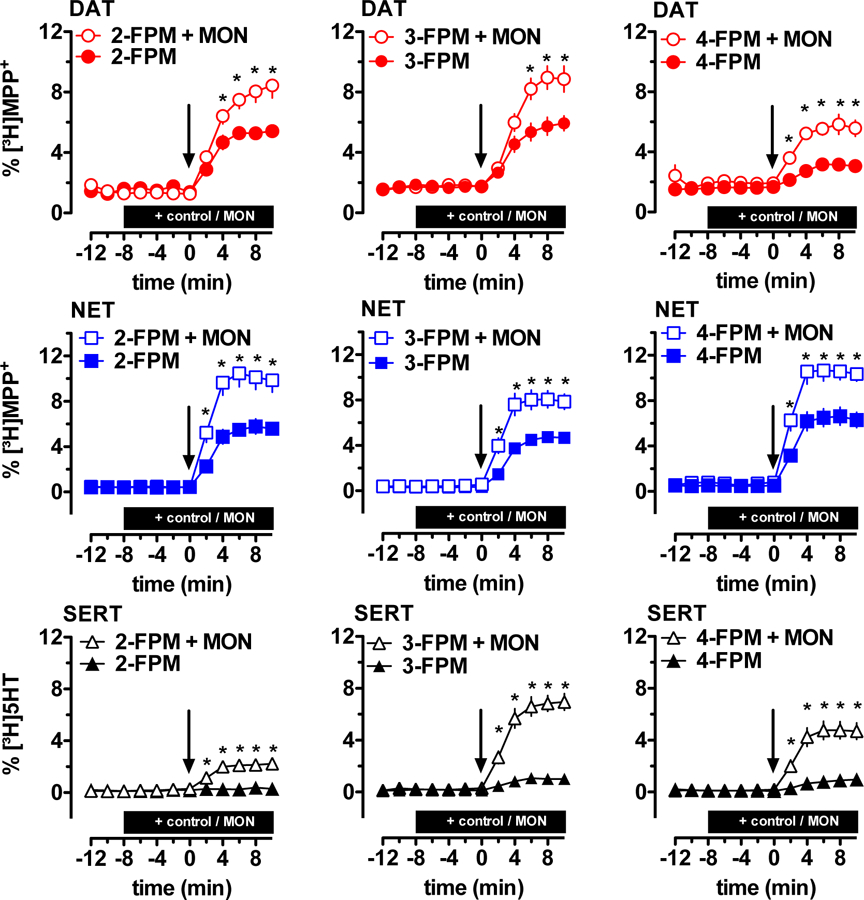
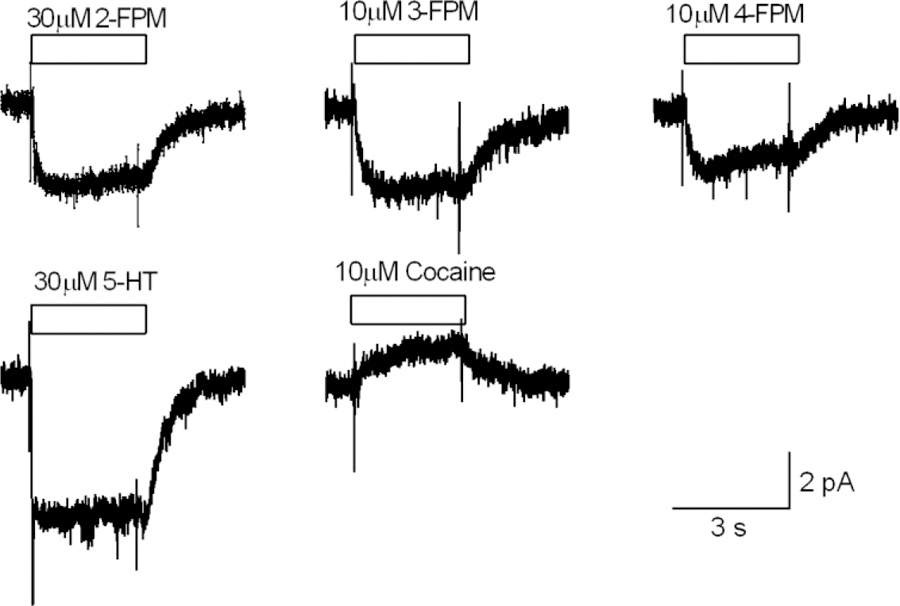
A variety of new psychoactive substances (NPS) are appearing in recreational drug markets worldwide. NPS are compounds that target various receptors and transporters in the central nervous system to achieve their psychoactive effects. Chemical modifications of existing drugs can generate NPS that are not controlled by current legislation, thereby providing legal alternatives to controlled substances such as cocaine or amphetamine. Recently, 3-fluorophenmetrazine (3-FPM), a derivative of the anorectic compound phenmetrazine, appeared on the recreational drug market and adverse clinical effects have been reported. Phenmetrazine is known to elevate extracellular monoamine concentrations by an amphetamine-like mechanism. Here we tested 3-FPM and its positional isomers, 2-FPM and 4-FPM, for their abilities to interact with plasma membrane monoamine transporters for dopamine (DAT), norepinephrine (NET) and serotonin (SERT). We found that 2-, 3- and 4-FPM inhibit uptake mediated by DAT and NET in HEK293 cells with potencies comparable to cocaine (IC values < 2.5 μM), but display less potent effects at SERT (IC values >80 μM). Experiments directed at identifying transporter-mediated reverse transport revealed that FPM isomers induce efflux via DAT, NET and SERT in HEK293 cells, and this effect is augmented by the Na/H ionophore monensin. Each FPM evoked concentration-dependent release of monoamines from rat brain synaptosomes. Hence, this study reports for the first time the mode of action for 2-, 3- and 4-FPM and identifies these NPS as monoamine releasers with marked potency at catecholamine transporters implicated in abuse and addiction. This article is part of the Special Issue entitled 'Designer Drugs and Legal Highs.'
各种新型精神活性物质(NPS)正在全球娱乐性毒品市场上出现。NPS 是靶向中枢神经系统中各种受体和转运体以产生其精神活性作用的化合物。现有药物的化学修饰可以产生不受当前立法管制的 NPS,从而为可卡因或安非他命等管制物质提供合法替代品。最近,苯丙甲嗪的衍生物 3-氟苯丙甲嗪(3-FPM)出现在娱乐性毒品市场上,并报告了不良的临床影响。苯丙甲嗪已知通过类似安非他命的机制升高细胞外单胺浓度。在这里,我们测试了 3-FPM 及其位置异构体 2-FPM 和 4-FPM,以研究它们与多巴胺(DAT)、去甲肾上腺素(NET)和血清素(SERT)的质膜单胺转运体相互作用的能力。我们发现 2-、3-和 4-FPM 以类似于可卡因(IC 值 < 2.5 μM)的效力抑制 HEK293 细胞中 DAT 和 NET 介导的摄取,但在 SERT 上的作用较弱(IC 值 > 80 μM)。针对鉴定转运体介导的反向转运的实验表明,FPM 异构体在 HEK293 细胞中通过 DAT、NET 和 SERT 诱导外排,这种作用被 Na/H 离子载体莫能菌素增强。每种 FPM 都会引发大鼠脑突触小体中单胺的浓度依赖性释放。因此,本研究首次报道了 2-、3-和 4-FPM 的作用模式,并将这些 NPS 鉴定为单胺释放剂,对涉及滥用和成瘾的儿茶酚胺转运体具有显著效力。本文是特刊“设计药物和合法兴奋剂”的一部分。