Center for Physiology and Pharmacology, Institute of Pharmacology , Medical University of Vienna , Währingerstraße 13A , 1090 Vienna , Austria.
School of Pharmacy and Biomolecular Sciences , Liverpool John Moores University , Byrom Street , Liverpool L3 3AF , United Kingdom.
ACS Chem Neurosci. 2018 Oct 17;9(10):2484-2502. doi: 10.1021/acschemneuro.8b00415. Epub 2018 Oct 5.
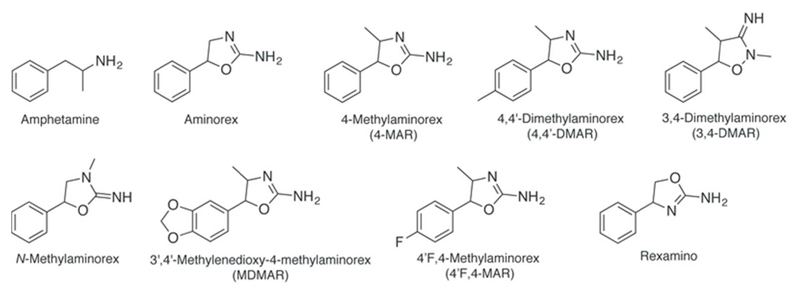
Aminorex (5-phenyl-4,5-dihydro-1,3-oxazol-2-amine) and 4-methylaminorex (4-methyl-5-phenyl-4,5-dihydro-1,3-oxazol-2-amine) are psychostimulants that have long been listed in Schedules IV and I of the UN Convention on Psychotropic Substances of 1971. However, a range of psychoactive analogues exist that are not internationally controlled and therefore often classified as new psychoactive substances (NPS). Aminorex analogues encompass failed pharmaceuticals that reemerged as drugs of abuse, and newly synthesized substances that were solely designed for recreational use by clandestine chemists. NPS, sometimes also referred to as "designer drugs" in alignment with a phenomenon arising in the early 1980s, serve as alternatives to controlled drugs. Aminorex and its derivatives interact with monoaminergic neurotransmission by interfering with the function of monoamine transporters. Hence, these compounds share pharmacological and neurochemical similarities with amphetamines and cocaine. The consumption of aminorex, 4-methylaminorex and 4,4'-dimethylaminorex (4-methyl-5-(4-methylphenyl)-4,5-dihydro-1,3-oxazol-2-amine) has been associated with adverse events including death, bestowing an inglorious fame on aminorex-derived drugs. In this Review, a historical background is presented, as well as an account of the pharmacodynamic and pharmacokinetic properties of aminorex and various analogues. Light is shed on their misuse as drug adulterants of well-established drugs on the market. This Review not only provides a detailed overview of an abused substance-class, but also emphasizes the darkest aspect of the NPS market, i.e., deleterious side effects that arise from the ingestion of certain NPS, as knowledge of the pharmacology, the potency, or the identity of the active ingredients remains obscure to NPS users.
氨苯恶唑(5-苯基-4,5-二氢-1,3-恶唑-2-胺)和 4-甲基氨苯恶唑(4-甲基-5-苯基-4,5-二氢-1,3-恶唑-2-胺)是精神兴奋剂,长期以来一直被列入 1971 年《联合国精神药物公约》附表四和附表一。然而,存在一系列非国际管制的精神活性类似物,因此通常被归类为新精神活性物质(NPS)。氨苯恶唑类似物包括重新出现的滥用药物和新合成的物质,这些物质仅由秘密化学家设计用于娱乐用途。NPS,有时也被称为“设计药物”,与 20 世纪 80 年代初出现的一种现象一致,是管制药物的替代品。氨苯恶唑及其衍生物通过干扰单胺转运体的功能与单胺能神经传递相互作用。因此,这些化合物与安非他命和可卡因具有相似的药理学和神经化学特性。氨苯恶唑、4-甲基氨苯恶唑和 4,4'-二甲氨基苯恶唑(4-甲基-5-(4-甲基苯基)-4,5-二氢-1,3-恶唑-2-胺)的使用与不良事件有关,包括死亡,这给氨苯恶唑衍生药物带来了不光彩的名声。在这篇综述中,介绍了一个历史背景,以及氨苯恶唑和各种类似物的药效动力学和药代动力学特性。还介绍了它们作为市场上已确立药物的药物掺杂物的滥用情况。这篇综述不仅提供了一种滥用物质类别的详细概述,还强调了 NPS 市场最黑暗的方面,即摄入某些 NPS 引起的有害副作用,因为 NPS 用户对药理学、效力或活性成分的身份知之甚少。