Comanns Philipp, Esser Falk J, Kappel Peter H, Baumgartner Werner, Shaw Jeremy, Withers Philip C
Institute of Biology II, RWTH Aachen University, Worringerweg 3, 52074 Aachen, Germany.
Botanischer Garten, Plant Biomechanics Group Freiburg, University of Freiburg, Schänzlestraße 1, 79104 Freiburg, Germany.
R Soc Open Sci. 2017 Sep 13;4(9):170591. doi: 10.1098/rsos.170591. eCollection 2017 Sep.
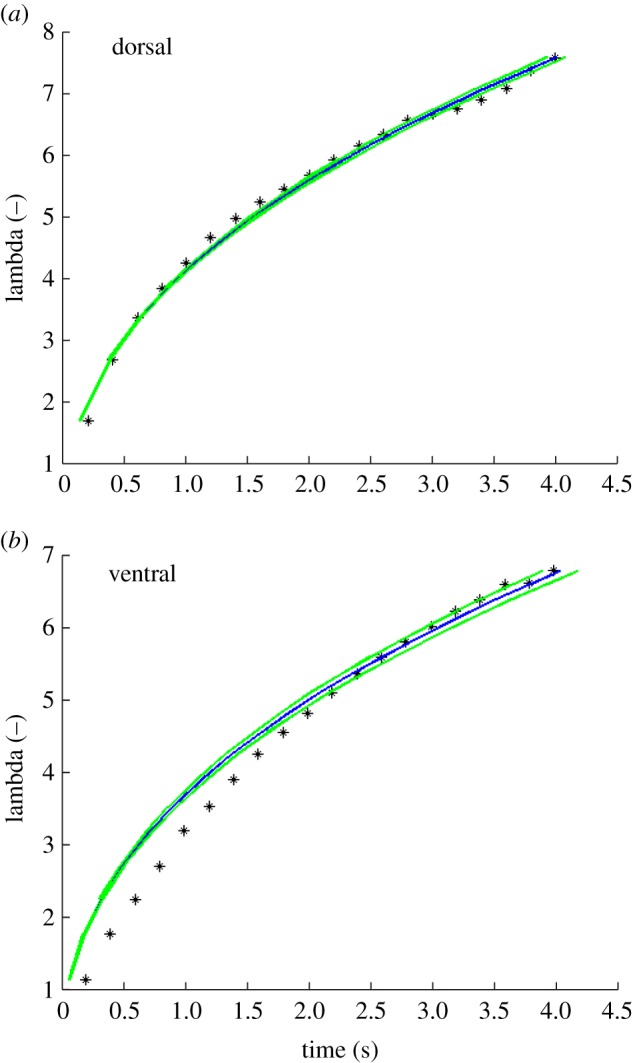
Moisture-harvesting lizards, such as the Australian thorny devil , have remarkable adaptations for inhabiting arid regions. Their microstructured skin surface, with channels in between overlapping scales, enables them to collect water by capillarity and passively transport it to the mouth for ingestion. We characterized this capillary water transport for live thorny devils using high-speed video analyses. Comparison with preserved specimens showed that live lizards are required for detailed studies of skin water transport. For thorny devils, there was no directionality in cutaneous water transport (unlike ) as 7 µl water droplets applied to the skin were transported radially over more than 9.2 mm. We calculated the total capillary volume as 5.76 µl cm (dorsal) and 4.45 µl cm (ventral), which is reduced to 50% filling by the time transportation ceases. Using micro-computed tomography and scanning electron microscopy of shed skin to investigate capillary morphology, we found that the channels are hierarchically structured as a large channel between the scales that is sub-divided by protrusions into smaller sub-capillaries. The large channel quickly absorbs water whereas the sub-capillary structure extends the transport distance by about 39% and potentially reduces the water volume required for drinking. An adapted dynamics function, which closely reflects the channel morphology, includes that ecological role.
集水蜥蜴,如澳大利亚棘蜥,对干旱地区的栖息环境有着非凡的适应性。它们微观结构的皮肤表面,在重叠的鳞片之间有通道,这使它们能够通过毛细作用收集水分,并将其被动地输送到口中以供摄取。我们使用高速视频分析对活体棘蜥的这种毛细水运输进行了表征。与保存标本的比较表明,对于皮肤水分运输的详细研究需要活体蜥蜴。对于棘蜥来说,皮肤水分运输没有方向性(与……不同),因为施加在皮肤上的7微升水滴会径向运输超过9.2毫米。我们计算出总毛细体积为5.76微升/平方厘米(背部)和4.45微升/平方厘米(腹部),在运输停止时,其填充量减少到50%。通过对蜕下皮肤进行微计算机断层扫描和扫描电子显微镜观察来研究毛细形态,我们发现这些通道具有分层结构,鳞片之间有一个大通道,该大通道被突起细分为较小的子毛细血管。大通道能快速吸收水分,而子毛细血管结构使运输距离延长了约39%,并可能减少饮水所需的水量。一个能紧密反映通道形态的适应性动力学函数包含了这种生态作用。