Wu Nicholas C, Anderson Rodolfo O, Borzée Amaël, Buttimer Shannon, Dezetter Mathias, Dubiner Shahar, Li Quan-Heng, Navas Carlos A, Sánchez-Ochoa Daniel, Sheridan Jennifer A, Shewale Swapnil A, Sun Bao-Jun, Suryawanshi Sunil J, Wang Jia-Huan, Bovo Rafael P
Centre for Terrestrial Ecosystem Science and Sustainability, Harry Butler Institute, Murdoch University, Murdoch, 90 South Street, WA 6150, Australia.
School of Environmental and Conservation Science, Murdoch University, Murdoch, 90 South Street, WA 6150, Australia.
Conserv Physiol. 2025 Jun 16;13(1):coaf038. doi: 10.1093/conphys/coaf038. eCollection 2025.
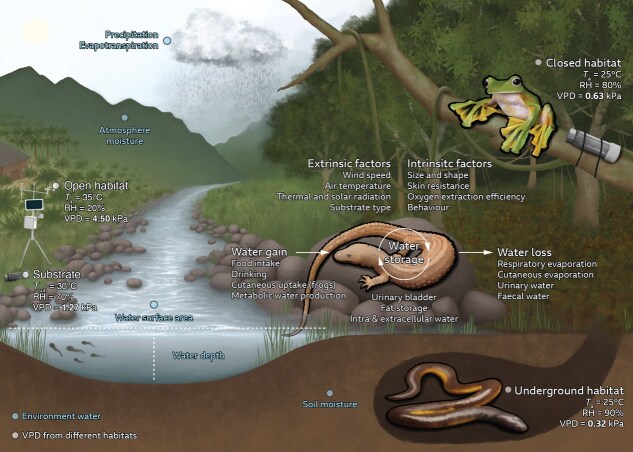
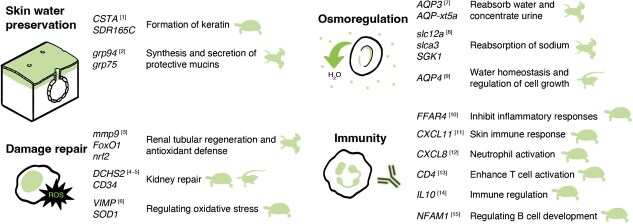
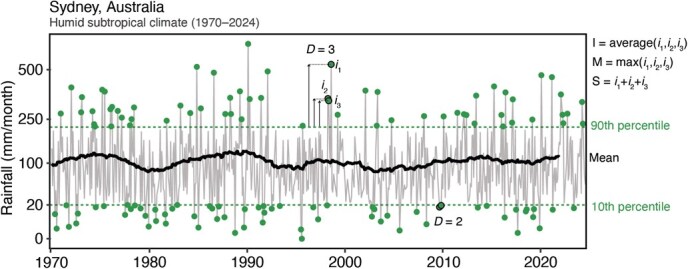
Human impacts on ecosystems have intensified variation in water variability for terrestrial life, thus challenging the maintenance of water balance, or hydroregulation. The accelerated development and accessibility of technologies and computational models over the past decade have enabled researchers to predict changes in animal hydroregulation and environmental water with greater spatial and temporal precision. Focusing on reptiles and amphibians, we discuss current methods, limitations and advances for quantifying ecologically relevant metrics of environmental water stressors and organismal responses to both acute and long-term water stress that are applicable for conservation and management. We also highlight approaches that integrate environmental water data with an organism's water balance and physiological, behavioural and life history traits to predict the limits of species' responses and assess their vulnerability to climate change. Finally, we outline promising future directions and opportunities in hydroregulation studies with a conservation focus, including broader inferences about acclimation responses, linking gene expression to functional changes, and exploring inter- and transgenerational plasticity and adaptive evolution. Advances in these fields will facilitate more accurate assessments of species' capacities and the limits of hydroregulation in response to a more variable and unpredictable future climate.
人类对生态系统的影响加剧了陆地生物所面临的水变异性变化,从而对水平衡的维持,即水文调节构成挑战。在过去十年中,技术和计算模型的加速发展与普及使研究人员能够以更高的时空精度预测动物水文调节和环境水的变化。以爬行动物和两栖动物为重点,我们讨论了量化环境水压力源与生物体对急性和长期水胁迫的生态相关指标的当前方法、局限性和进展,这些指标适用于保护和管理。我们还强调了将环境水数据与生物体的水平衡以及生理、行为和生活史特征相结合的方法,以预测物种反应的极限并评估它们对气候变化的脆弱性。最后,我们概述了以保护为重点的水文调节研究中未来有前景的方向和机会,包括对适应反应的更广泛推断、将基因表达与功能变化联系起来,以及探索代际间和跨代可塑性及适应性进化。这些领域的进展将有助于更准确地评估物种应对未来更变化无常和不可预测气候的水文调节能力及极限。