Department of Neurology, Xiangya Hospital, Central South University, Changsha, Hunan 410008, P.R. China.
Department of Neurology, Fifth Affiliated Hospital of Zhengzhou University, Zhengzhou, Henan 450052, P.R. China.
Mol Med Rep. 2017 Dec;16(6):8930-8936. doi: 10.3892/mmr.2017.7694. Epub 2017 Oct 3.
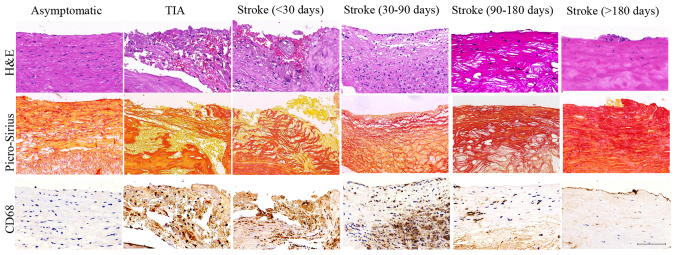
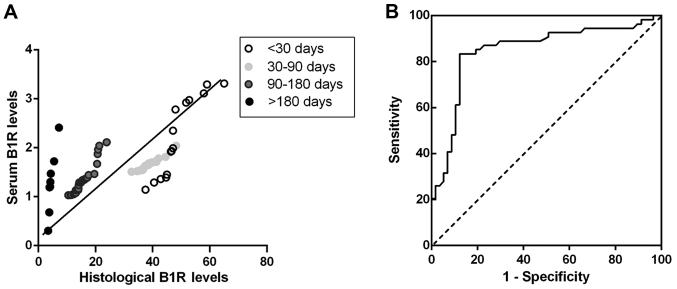
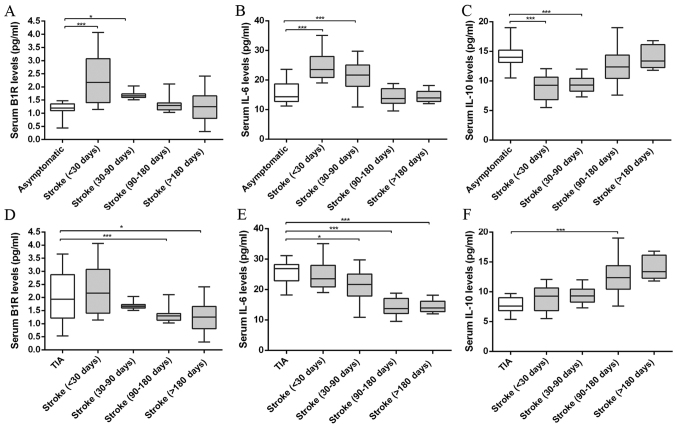
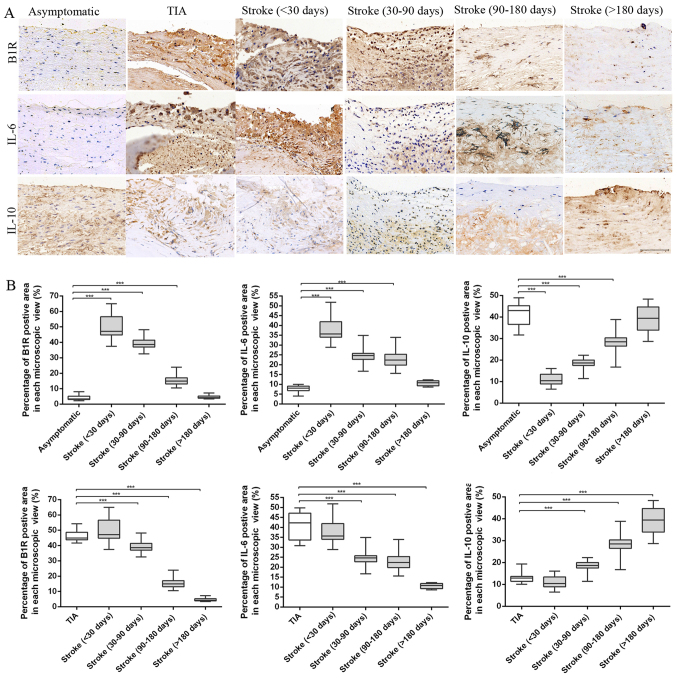
Stroke caused by atherosclerosis remains a leading cause of morbidity and mortality worldwide, associated with carotid plaque rupture and inflammation progression. However, the inflammatory biomarkers which aid in predicting the future course of plaques are less detailed. The present study investigated the association between plaque vulnerable and inflammatory biomarkers using blood and plaque specimens. Carotid plaque specimens were obtained from 80 patients following stroke, 14 patients suffering from transient ischaemic attack and 17 asymptomatic patients that underwent carotid endarterectomy. To assess changes in plaque characteristics at histological levels, plaques were categorized by the time between the latest ischemic stroke and surgical intervention within 30, 30‑90, 90‑180 and over 180 days following stroke. Serum levels of inflammatory biomarkers interleukin (IL)‑6, IL‑10 and kinin B1 receptor (B1R) were measured by ELISA. Histological assessment of plaque was used to evaluate the plaque stability, progression and the inflammatory biomarker levels. Comparisons of histological characteristics demonstrated that plaques revealed an unstable phenotype following stroke within 30, 30‑90 days and then remodeled into more stable plaques following stroke at 90‑180 and over 180 days. By comparing the serum levels of inflammatory biomarkers, it was observed that IL‑6 and B1R levels tended to decline whereas IL‑10 levels increased in stroke patients from <30 days to over 180 days. Immunohistochemical analysis of IL‑6, IL‑10 and B1R demonstrated similar alterations in serum levels. Correlation analyses revealed that only B1R serum level was significantly correlated with histological level in patients with carotid atherosclerosis. The findings revealed that serum B1R levels may provide prognostic information and currently act as potential indicators for progression in atherosclerosis.
动脉粥样硬化引起的中风仍然是全球发病率和死亡率的主要原因,与颈动脉斑块破裂和炎症进展有关。然而,有助于预测斑块未来进程的炎症生物标志物则不那么详细。本研究使用血液和斑块标本研究了斑块易损性和炎症生物标志物之间的关系。从 80 名中风患者、14 名短暂性脑缺血发作患者和 17 名无症状接受颈动脉内膜切除术的患者中获得颈动脉斑块标本。为了评估组织学水平上斑块特征的变化,根据最近的缺血性中风和手术干预之间的时间,将斑块分为中风后 30、30-90、90-180 和超过 180 天的四个亚组。通过 ELISA 测量血清中炎症生物标志物白细胞介素 (IL) -6、IL-10 和激肽 B1 受体 (B1R) 的水平。通过组织学评估斑块来评估斑块的稳定性、进展和炎症生物标志物水平。组织学特征的比较表明,中风后 30 天内的斑块表现出不稳定的表型,然后在中风后 90-180 天和超过 180 天内重塑为更稳定的斑块。通过比较炎症生物标志物的血清水平,观察到中风患者从<30 天到超过 180 天的 IL-6 和 B1R 水平呈下降趋势,而 IL-10 水平呈上升趋势。IL-6、IL-10 和 B1R 的免疫组织化学分析显示血清水平也发生了类似的变化。相关性分析表明,只有 B1R 血清水平与颈动脉粥样硬化患者的组织学水平显著相关。研究结果表明,血清 B1R 水平可能提供预后信息,目前是动脉粥样硬化进展的潜在指标。