Händel Mina Nicole, Larsen Sofus Christian, Rohde Jeanett Friis, Stougaard Maria, Olsen Nanna Julie, Heitmann Berit Lilienthal
Department of Clinical Research, University of Southern Denmark, Odense Patient Data Explorative Network (OPEN), Odense University Hospital, Odense, Denmark.
Research Unit for Dietary Studies, The Parker Institute and the Institute of Preventive Medicine, Bispebjerg and Frederiksberg Hospital, Frederiksberg, Denmark.
PLoS One. 2017 Oct 9;12(10):e0185266. doi: 10.1371/journal.pone.0185266. eCollection 2017.
There is limited evidence to support the effectiveness of primary interventions aiming to prevent excess weight gain among young children. Evaluating behavioral changes, such as physical activity (PA), may add to future development of efficient interventions. The objective was to evaluate the effect on PA outcomes of the 15 month Healthy Start intervention that focused on changing diet, PA, sleep and stress management among normal weight but obesity-prone preschool children. Children were defined as obesity-prone if they had a birth weight > 4,000 g, mothers with a pre-pregnancy body mass index of > 28 kg/m2, or mothers with ≤ 10 years of schooling.
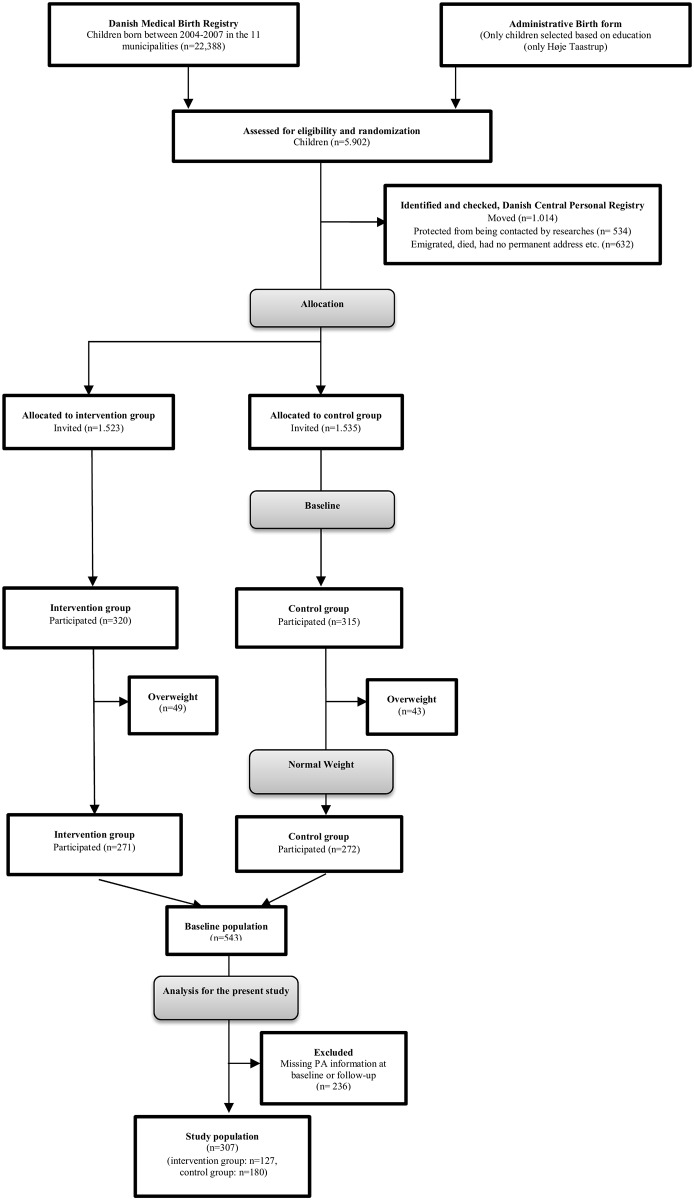
From a baseline study population of 635 normal weight 2-6 year old preschool children from the greater Copenhagen area, parents of 307 children had given information on PA at both the baseline and follow-up examinations. PA was obtained from a 7 days recording in the Children's Physical Activity Questionnaire. Time used for sport activities were combined with outdoor playing time to achieve a proxy of total PA level of moderate to vigorous intensity.
Linear regression analyses revealed that at follow-up the intervention group spent more time on sports and outdoor activities combined per week than the control group (ITT analyses: intervention: 400 min/week; 95% confidence interval (CI): 341, 459 versus control: 321 min/week; 95% CI: 277, 366; p = 0.02), although no significant intervention effects were seen for each of the subcategories, e.g. sports participation, outdoor activities, screen time, or commuting frequency.
Our results suggest that the overall time spent on sports and outdoor activities combined was increased at follow-up among normal weight obesity-prone children, as a result of the Healthy Start intervention.
ClinicalTrials.gov NCT01583335.
旨在预防幼儿体重过度增加的一级干预措施有效性的证据有限。评估身体活动(PA)等行为变化可能有助于未来高效干预措施的开发。目的是评估针对体重正常但易肥胖的学龄前儿童进行的为期15个月的健康开端干预对PA结果的影响。如果儿童出生体重>4000克、母亲孕前体重指数>28kg/m²或母亲受教育年限≤10年,则被定义为易肥胖。
从哥本哈根大区635名体重正常的2 - 6岁学龄前儿童的基线研究人群中,307名儿童的家长在基线和随访检查时均提供了PA信息。PA通过儿童身体活动问卷中的7天记录获得。用于体育活动的时间与户外玩耍时间相结合,以获得中等至剧烈强度的总PA水平的近似值。
线性回归分析显示,随访时干预组每周用于体育和户外活动的总时间比对照组多(意向性分析:干预组:400分钟/周;95%置信区间(CI):341, 459,对照组:321分钟/周;95%CI:277, 366;p = 0.02),尽管在各个子类别中未观察到显著的干预效果,例如体育参与、户外活动、屏幕时间或通勤频率。
我们的结果表明,由于健康开端干预,随访时体重正常且易肥胖的儿童用于体育和户外活动的总时间增加。
ClinicalTrials.gov NCT01583335。