Sidra Medical and Research Center, Doha, Qatar.
Department of Clinical Microbiology, Hôpital Necker Enfants Malades, Assistance Publique - Hôpitaux de Paris (AP-HP), Paris, France; Pediatric Hematology and Immunology Unit, Hôpital Necker Enfants Malades, AP-HP, Paris, France.
Curr Opin Immunol. 2017 Oct;48:122-133. doi: 10.1016/j.coi.2017.09.002. Epub 2017 Oct 6.
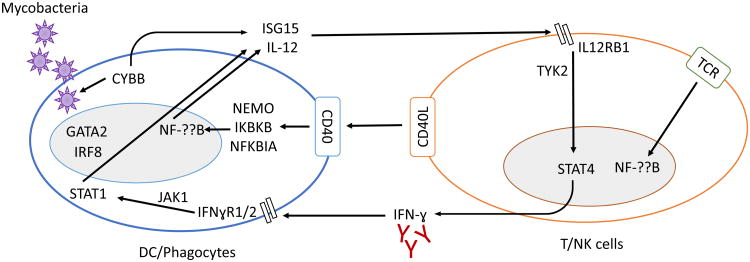
Following infection with almost any given microorganism other than an emerging pathogen, only a minority of individuals develop life-threatening clinical disease, implying that these individuals have some form of immunodeficiency. A growing number of inherited and acquired immunodeficiencies have been deciphered over the last 50 years. HIV infection is probably the best-known acquired immunodeficiency. It emerged about 40 years ago and precipitates various severe infections, the occurrence of which is associated with a fall in circulating CD4 T cells. However, despite the strength of this correlation, infection rates differ between patients with similar levels and durations of CD4 T lymphopenia in the presence or absence of antiretroviral treatment. Moreover, a few infections seem to be less dependent on total CD4 T-cell levels. The fine detail of the mechanisms underlying these infections is unknown. We discuss here how studies of the human genetics and immunology of some of these infections in patients with primary immunodeficiencies (PIDs) have provided unique insights into their molecular and cellular basis. Defects of specific CD4 Th-cell subsets account for some of these infections, as best exemplified by Th1* for mycobacteriosis and Th17 for candidiasis. PIDs are individually rare, but collectively much more common than initially thought, with new disorders being discovered at an ever-increasing pace and a global prevalence worldwide approaching that of HIV infection. Studies of known and new PIDs should make it possible to dissect the pathogenesis of most human infections at an unprecedented level of molecular and cellular precision. The predictive, preventive, and therapeutic implications of studies of immunity to infection in PIDs may extend to HIV-infected patients and patients with infectious diseases in other settings.
除新兴病原体外,几乎任何一种特定微生物感染后,只有少数个体发展为危及生命的临床疾病,这意味着这些个体存在某种形式的免疫缺陷。在过去的 50 年中,越来越多的遗传性和获得性免疫缺陷被揭示出来。人类免疫缺陷病毒(HIV)感染可能是最著名的获得性免疫缺陷。它大约在 40 年前出现,引发了各种严重感染,其发生与循环 CD4 T 细胞的减少有关。然而,尽管这种相关性很强,但在存在或不存在抗逆转录病毒治疗的情况下,具有相似 CD4 T 淋巴细胞减少水平和持续时间的患者的感染率存在差异。此外,一些感染似乎不太依赖于总 CD4 T 细胞水平。这些感染的机制的细节尚不清楚。在这里,我们讨论了在原发性免疫缺陷(PID)患者中对这些感染中的一些的人类遗传学和免疫学研究如何提供了对其分子和细胞基础的独特见解。特定 CD4 Th 细胞亚群的缺陷解释了其中一些感染,这在分枝杆菌病的 Th1*和念珠菌病的 Th17 中表现得最为明显。PID 个体罕见,但总的来说比最初认为的要常见得多,随着新疾病以越来越快的速度被发现,全球范围内的患病率接近 HIV 感染。对已知和新 PID 的研究应该使我们能够以前所未有的分子和细胞精度水平剖析大多数人类感染的发病机制。PID 对感染免疫的研究的预测、预防和治疗意义可能扩展到 HIV 感染患者和其他环境中感染性疾病患者。