Department of Human Movement Sciences, Faculty of Behavioural and Movement Sciences, Vrije Universiteit Amsterdam, Amsterdam Movement Sciences, Van der Boechorststraat 7, 1081 BT Amsterdam, The Netherlands.
Department of Neurology, Leiden University Medical Center, Albinusdreef 2, 2333 ZA Leiden, The Netherlands.
Sensors (Basel). 2017 Oct 10;17(10):2301. doi: 10.3390/s17102301.
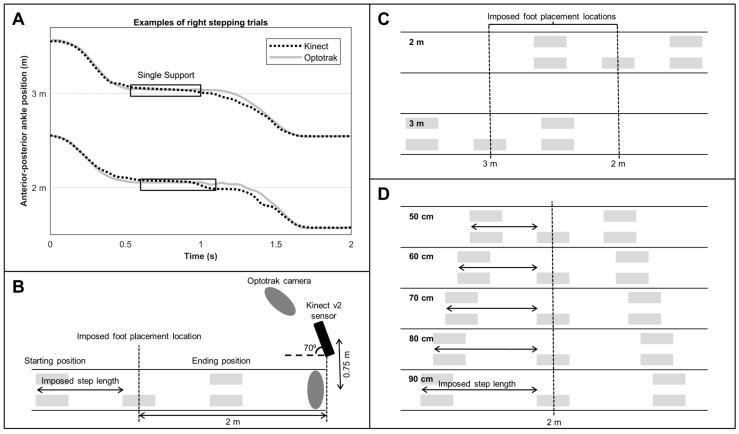
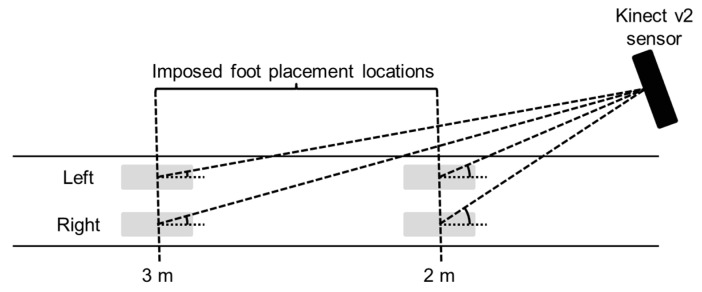
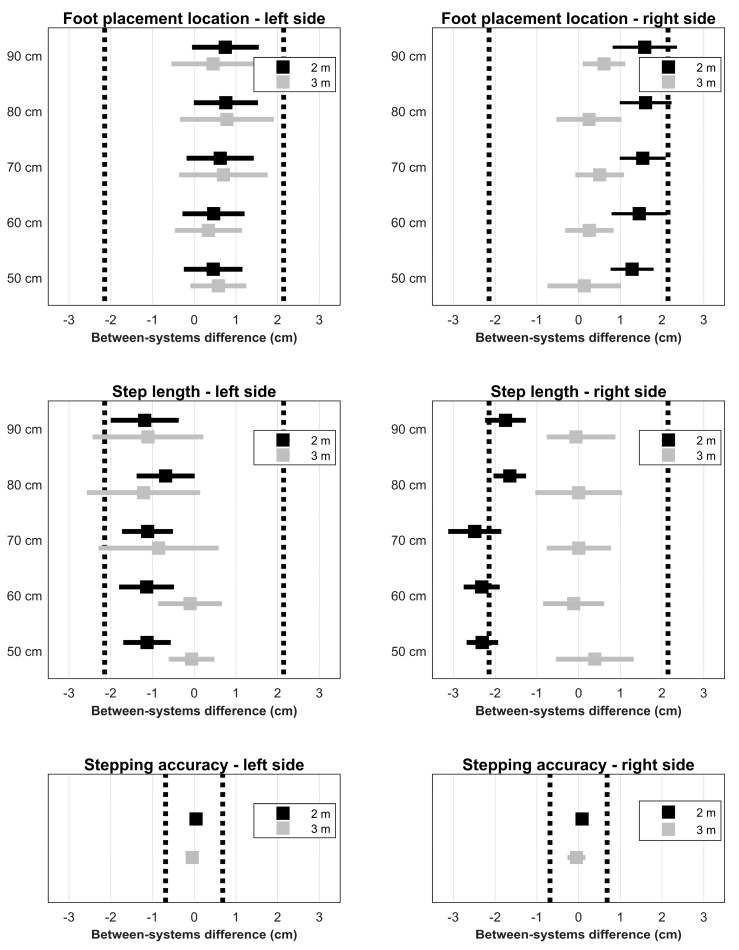
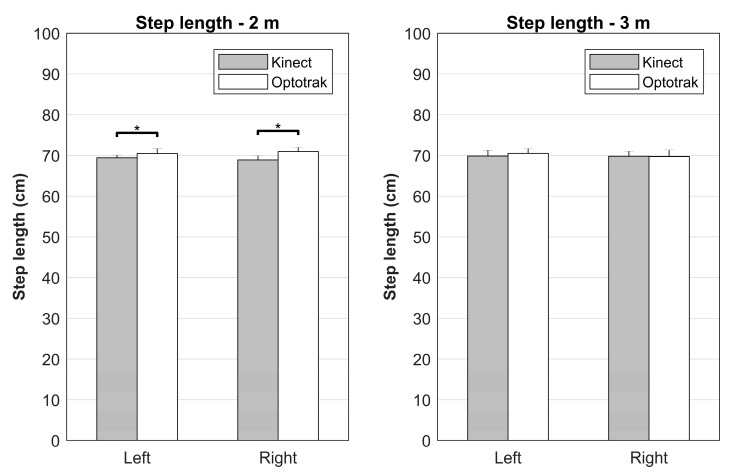
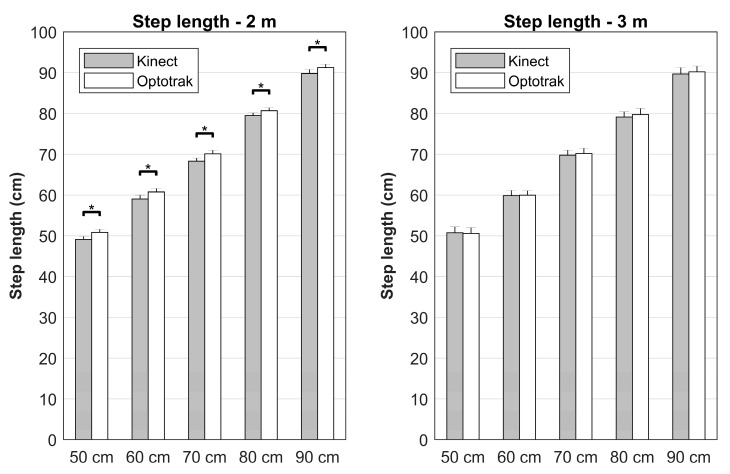
The Kinect v2 sensor may be a cheap and easy to use sensor to quantify gait in clinical settings, especially when applied in set-ups integrating multiple Kinect sensors to increase the measurement volume. Reliable estimates of foot placement locations are required to quantify spatial gait parameters. This study aimed to systematically evaluate the effects of distance from the sensor, side and step length on estimates of foot placement locations based on Kinect's ankle body points. Subjects (n = 12) performed stepping trials at imposed foot placement locations distanced 2 m or 3 m from the Kinect sensor (distance), for left and right foot placement locations (side), and for five imposed step lengths. Body points' time series of the lower extremities were recorded with a Kinect v2 sensor, placed frontoparallelly on the left side, and a gold-standard motion-registration system. Foot placement locations, step lengths, and stepping accuracies were compared between systems using repeated-measures ANOVAs, agreement statistics and two one-sided -tests to test equivalence. For the right side at the 2 m distance from the sensor we found significant between-systems differences in foot placement locations and step lengths, and evidence for nonequivalence. This distance by side effect was likely caused by differences in body orientation relative to the Kinect sensor. It can be reduced by using Kinect's higher-dimensional depth data to estimate foot placement locations directly from the foot's point cloud and/or by using smaller inter-sensor distances in the case of a multi-Kinect v2 set-up to estimate foot placement locations at greater distances from the sensor.
Kinect v2 传感器可能是一种廉价且易于使用的传感器,可用于在临床环境中量化步态,尤其是在应用集成多个 Kinect 传感器以增加测量体积的设置时。需要可靠的估计足部位置来量化空间步态参数。本研究旨在系统评估距离传感器、侧方和步长对基于 Kinect 踝关节体点的足部位置估计的影响。受试者(n=12)在距离 Kinect 传感器 2 米或 3 米(距离)、左足和右足位置(侧方)以及五个设定的步长处进行了踏足试验。使用 Kinect v2 传感器和一个金标准运动注册系统记录了下肢的体点时间序列。使用重复测量方差分析、一致性统计和双边检验来检验等效性,比较了两种系统的足部位置、步长和踏足准确性。对于距离传感器 2 米的右侧,我们发现两种系统在足部位置和步长方面存在显著差异,并且证据表明不等效。这种距离与侧方的影响可能是由于身体相对于 Kinect 传感器的方向差异造成的。可以通过使用 Kinect 的更高维深度数据直接从足部点云中估计足部位置,或者在使用多个 Kinect v2 设置的情况下使用较小的传感器间距离来估计距离传感器更远的足部位置来减少这种影响。