Department of Neurology, Southwest Hospital, Third Military Medical University, Chongqing, China.
Stroke Vasc Neurol. 2017 Aug 24;2(3):124-131. doi: 10.1136/svn-2017-000086. eCollection 2017 Sep.
Intravenous tissue plasminogen activator with or without mechanical thrombectomy during the acute phase are approved therapies for ischaemic stroke. Due to the short treatment time window (<6 hours) and often treatment failure, these patients would still have an intracranial arterial occlusion (IAO). It is unclear whether these patients can benefit from subsequent interventional recanalizationof their occluded artery in the subacute phase. In this retrospective study, we have examined the efficacy and safety in patients who have received either percutaneous transluminal angioplasty (PTA) or percutaneous transluminal angioplasty and stenting (PTAS) for IAO in the subacute phase of their stroke.
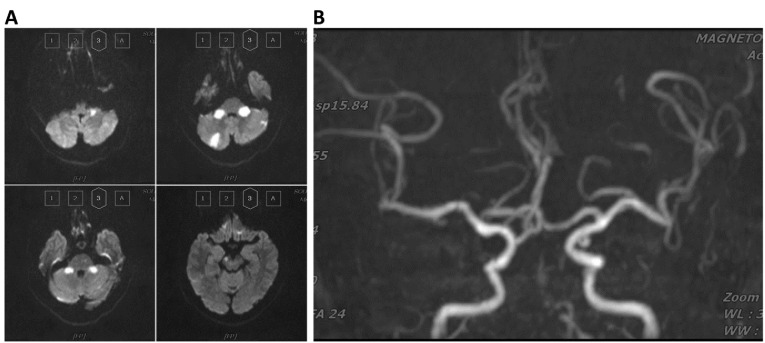
Patients with subacute symptomatic ischaemic stroke caused by IAO were assessed to identify the responsible artery and low perfusion areas by CT angiography, MR angiography or digital subtraction angiography. In eligible patients, a PTA or PTAS was performed to reopen the occluded artery. Regular antithrombotic therapy, use of statins, control of risk factors and rehabilitation therapy were prescribed after the procedure. All patients had regular follow-up up to 12 months.
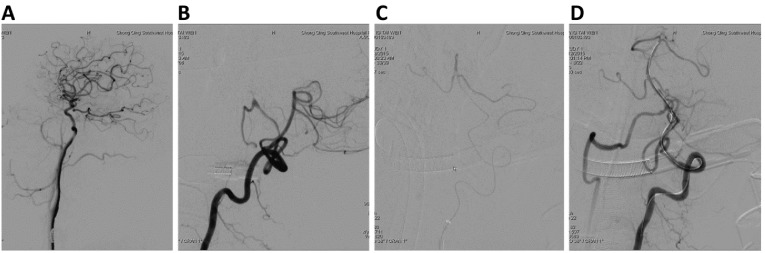
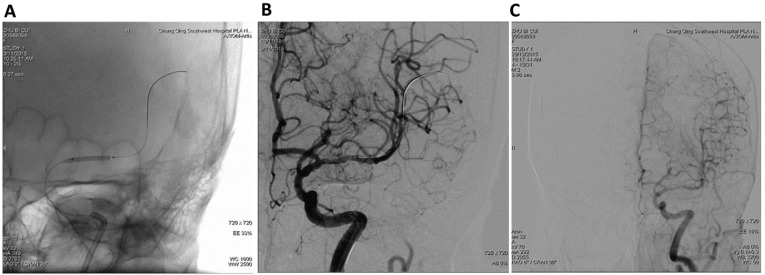
PTA or PTAS was performed in 16 patients with cerebral infarction caused by IAO in the subacute phase. After the procedure, 12 cases were recanalized, two were partially recanalized and two failed to open. One patient with left C6 segment occlusion of the carotid artery had a central retinal artery embolism after PTAS. The perioperative adverse events were 6.25%. At 3 months, the distribution of modified Rankin scale scores was 0 (seven cases), 1 (three cases), 2 (five cases) and 3 (one case).
Selective PTA or PTAS could be performed in ischaemic stroke patients with a small infarct size and large area of hypoperfusion from an occluded large cerebral artery after the acute phase. It may improve neurological dysfunction and reduce the incidence of disability.
急性阶段静脉内组织纤溶酶原激活物联合或不联合机械取栓治疗缺血性脑卒中是被批准的疗法。由于治疗时间窗很短(<6 小时)且经常治疗失败,这些患者仍会有颅内动脉闭塞(IAO)。这些患者在亚急性期是否能从随后的闭塞动脉介入再通中获益尚不清楚。在这项回顾性研究中,我们检查了在亚急性期接受经皮腔内血管成形术(PTA)或经皮腔内血管成形术和支架置入术(PTAS)治疗 IAO 的患者的疗效和安全性。
通过 CT 血管造影、MR 血管造影或数字减影血管造影评估亚急性症状性缺血性脑卒中患者的 IAO 情况,以确定责任动脉和低灌注区域。在符合条件的患者中,进行 PTA 或 PTAS 以重新开通闭塞动脉。术后常规给予抗血栓治疗、使用他汀类药物、控制危险因素和康复治疗。所有患者均进行定期随访,随访时间最长 12 个月。
16 例亚急性 IAO 性脑梗死患者行 PTA 或 PTAS 治疗。术后 12 例再通,2 例部分再通,2 例未开通。1 例左侧颈内动脉 C6 段闭塞患者行 PTAS 后发生视网膜中央动脉栓塞。围手术期不良事件发生率为 6.25%。3 个月时,改良 Rankin 量表评分分布为 0 分(7 例)、1 分(3 例)、2 分(5 例)和 3 分(1 例)。
对于急性阶段后小梗死灶和大的闭塞性大脑动脉低灌注区的缺血性脑卒中患者,选择性 PTA 或 PTAS 可能是有效的,可以改善神经功能障碍,降低残疾发生率。