Department of Neurology, School of Medicine, Ajou University Medical Center, Suwon, Korea.
Department of Radiology, School of Medicine, Ajou University Medical Center, Suwon, Korea.
J Stroke. 2016 Jan;18(1):96-101. doi: 10.5853/jos.2015.01347. Epub 2015 Oct 15.
The goal of stent retriever-based thrombectomy is removal of embolic clots in patients with intracranial large artery occlusion. However, outcomes of stent retrieval may differ between acute arterial occlusions due to intracranial atherosclerotic disease (IAD) and those due to embolism. This case series describes the outcomes of stent retriever-based thrombectomy and rescue treatments in 9 patients with IAD-related occlusion.
Among patients who underwent endovascular treatment for acute intracranial large artery occlusion, those in whom stent retrieval was attempted as first-line treatment were included in this review. IAD was defined as significant fixed focal stenosis at the occlusion site, which was evident on final angiographic assessment or observed during endovascular treatment.
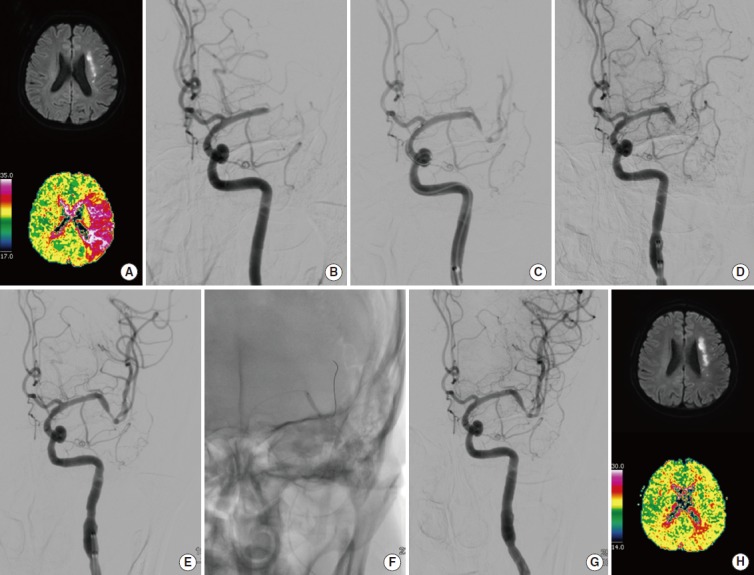
Median number of stent retriever passes was 2 (range, 1-3), and temporary bypass was seen in all patients. Immediate partial recanalization (arterial occlusive lesion grade 2-3) was observed in 7 patients. Immediate modified thrombolysis in cerebral infarction grade 2b-3 was seen in 6 patients, but the lesions often required rescue treatment due to reocclusion or flow insufficiency. In terms of rescue treatments, angioplasty and intra-arterial tirofiban infusion seemed to be effective.
Our findings suggest that stent retrieval can effectively remove thrombi from stenotic lesions and achieve partial recanalization despite the tendency toward reocclusion in most patients with IAD-related occlusion. Further research into the use of rescue treatments, such as tirofiban infusion and angioplasty, is warranted.
支架取栓术的目的是清除颅内大动脉闭塞患者的栓塞性血栓。然而,由于颅内动脉粥样硬化性疾病(IAD)和栓塞导致的急性动脉闭塞,支架取栓的效果可能存在差异。本病例系列描述了 9 例 IAD 相关闭塞患者采用支架取栓术及挽救性治疗的结果。
在接受急性颅内大动脉闭塞血管内治疗的患者中,纳入了作为一线治疗尝试支架取栓的患者。IAD 的定义为闭塞部位存在明显的固定性局灶性狭窄,这在最终血管造影评估或血管内治疗过程中观察到。
中位支架取栓次数为 2 次(范围,1-3 次),所有患者均进行了临时旁路治疗。7 例患者即刻出现部分再通(动脉闭塞病变分级 2-3 级)。6 例患者即刻出现改良脑梗死溶栓分级 2b-3 级,但由于再闭塞或血流不足,病变通常需要挽救性治疗。在挽救性治疗方面,血管成形术和动脉内替罗非班输注似乎是有效的。
我们的发现表明,支架取栓术可以有效清除狭窄病变中的血栓,并实现部分再通,尽管大多数 IAD 相关闭塞患者存在再闭塞的趋势。有必要进一步研究替罗非班输注和血管成形术等挽救性治疗的应用。