Imperial Centre for Translational and Experimental Medicine, National Heart and Lung Institute, Imperial College London, Hammersmith Campus, Du Cane Road, London W12?0NN, UK.
Department of Cardiac Surgery, University of Verona, Verona, Italy.
Cardiovasc Res. 2018 Jan 1;114(1):77-89. doi: 10.1093/cvr/cvx152.
Cardiac fibroblasts (CFs) are considered the principal regulators of cardiac fibrosis. Factors that influence CF activity are difficult to determine. When isolated and cultured in vitro, CFs undergo rapid phenotypic changes including increased expression of α-SMA. Here we describe a new model to study CFs and their response to pharmacological and mechanical stimuli using in vitro cultured mouse, dog and human myocardial slices.
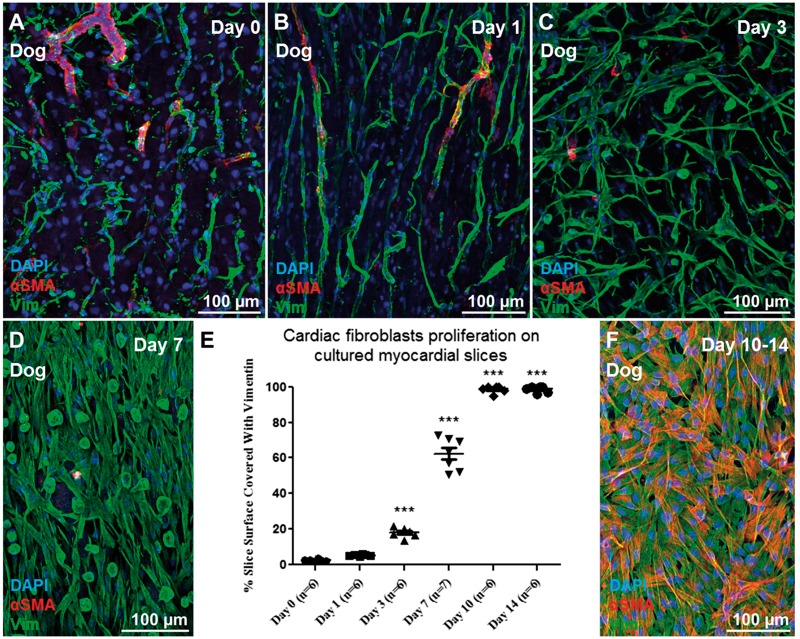
Unloading of myocardial slices induced CF proliferation without α-SMA expression up to 7 days in culture. CFs migrating onto the culture plastic support or cultured on glass expressed αSMA within 3 days. The cells on the slice remained αSMA(-) despite transforming growth factor-β (20 ng/ml) or angiotensin II (200 µM) stimulation. When diastolic load was applied to myocardial slices using A-shaped stretchers, CF proliferation was significantly prevented at Days 3 and 7 (P < 0.001).
Myocardial slices allow the study of CFs in a multicellular environment and may be used to effectively study mechanisms of cardiac fibrosis and potential targets.
心脏成纤维细胞(CFs)被认为是心脏纤维化的主要调节者。影响 CF 活性的因素很难确定。当在体外分离和培养时,CF 会经历快速的表型变化,包括α-SMA 的表达增加。在这里,我们描述了一种新的模型,用于使用体外培养的小鼠、狗和人心肌切片研究 CFs 及其对药理学和机械刺激的反应。
心肌切片的卸载诱导 CF 增殖,在培养的第 7 天之前不表达α-SMA。在培养 3 天内,CFs 迁移到培养塑料支持物上或在玻璃上表达αSMA。尽管用转化生长因子-β(20ng/ml)或血管紧张素 II(200µM)刺激,切片上的细胞仍保持αSMA(-)。当使用 A 形拉伸器对心肌切片施加舒张负荷时,CF 增殖在第 3 天和第 7 天明显受到抑制(P < 0.001)。
心肌切片允许在多细胞环境中研究 CFs,并且可以用于有效地研究心脏纤维化的机制和潜在的靶点。