Córdoba Gloria, Holm Anne, Hansen Frank, Hammerum Anette M, Bjerrum Lars
The Research Unit for General Practice and Section of General Practice, Department of Public Health, University of Copenhagen; Øster Farimagsgade 5, 1014, Copenhagen, Denmark.
Department for Bacteria, Parasites and Fungi, Statens Serum Institut, Copenhagen, Denmark.
BMC Infect Dis. 2017 Oct 10;17(1):670. doi: 10.1186/s12879-017-2785-y.
Escherichia coli is the most common pathogen causing Urinary Tract Infections (UTI). Data from the current National Surveillance program in Denmark (DANMAP) may not accurately represent the prevalence of resistant E. coli in primary care, because only urine samples from complicated cases may be forwarded to the microbiological departments at hospitals for diagnostic examination. The aim of this study was to assess the prevalence of resistant E. coli to the most commonly used antimicrobial agents in primary care in a consecutive sample of patients from general practice.
Observational study carried out from December 2014 to December 2015. Thirty-nine general practices from The Capital Region of Denmark included adult patients with urinary tract symptoms and suspected UTI. All urine samples were sent to the central laboratory Statens Serum Institut (SSI). Significant bacteriuria was interpreted according to the European Urinalysis Standards. Susceptibility testing was performed and interpreted according to the European Committee on Antimicrobial Susceptibility Testing (EUCAST) standards.
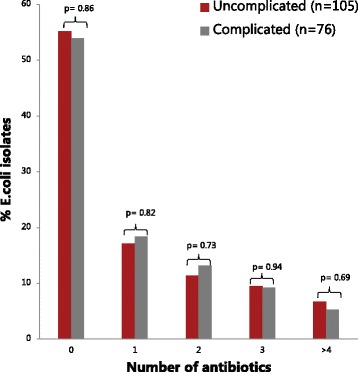
From the 39 general practices 505 patients were recruited. Completed data were obtained from 485 (96%) patients. According to the European Urinalysis Standards, 261 (54%) patients had positive bacteriuria. The most common uropathogen in patients with uncomplicated (uUTI) and complicated (cUTI) urinary tract infection was E. coli 105 (69%) and 76 (70%), respectively. Eighty-two (45%) of 181 E. coli isolates were resistant to at least one of the tested antibiotics and 50 out of 82 isolates were resistant to two or more antimicrobial agents. The highest resistance-rate was found against ampicillin 34% (95% CI 24;42) in uUTI and 36% (24;46) in cUTI. There were no differences in the distribution of resistance between uncomplicated and complicated cases. The prevalence of resistance was similar to the one reported in DANMAP 2014.
In E. coli from uUTI there is high resistance rates to antimicrobial agents commonly used in primary care. There was no difference in the distribution of resistant E. coli in suspected uUTI vs cUTI. In Denmark, data from the National Surveillance program DANMAP can guide the decision for choice of antibiotic in patients with suspected UTI seeking care in primary care.
ClinicalTrials.gov NCT02249273 .
大肠杆菌是引起尿路感染(UTI)最常见的病原体。丹麦当前国家监测项目(DANMAP)的数据可能无法准确反映初级医疗中耐药大肠杆菌的流行情况,因为只有复杂病例的尿液样本可能被送往医院微生物科进行诊断检查。本研究的目的是评估在连续抽取的来自普通诊所的患者样本中,初级医疗中对最常用抗菌药物耐药的大肠杆菌的流行情况。
2014年12月至2015年12月进行的观察性研究。丹麦首都地区的39家普通诊所纳入了有尿路症状且疑似UTI的成年患者。所有尿液样本均被送往中央实验室丹麦国家血清研究所(SSI)。显著菌尿根据欧洲尿液分析标准进行解读。药敏试验按照欧洲抗菌药物敏感性试验委员会(EUCAST)标准进行并解读。
从39家普通诊所招募了505例患者。485例(96%)患者获得了完整数据。根据欧洲尿液分析标准,261例(54%)患者菌尿呈阳性。单纯性尿路感染(uUTI)和复杂性尿路感染(cUTI)患者中最常见的尿路病原体均为大肠杆菌,分别为105例(69%)和76例(70%)。181株大肠杆菌分离株中,82株(45%)对至少一种受试抗生素耐药,82株分离株中有50株对两种或更多抗菌药物耐药。uUTI中对氨苄西林的耐药率最高,为34%(95%CI 24;42),cUTI中为36%(24;46)。单纯性和复杂性病例之间的耐药分布无差异。耐药率与2014年DANMAP报告的相似。
在uUTI的大肠杆菌中,对初级医疗中常用抗菌药物的耐药率很高。疑似uUTI与cUTI中耐药大肠杆菌的分布无差异。在丹麦,国家监测项目DANMAP的数据可指导在初级医疗中寻求治疗的疑似UTI患者选择抗生素的决策。
ClinicalTrials.gov NCT02249273 。