Respiratory Diseases Unit-AOU Policlinico, Department of Medical and Surgical Sciences, University of Modena Reggio Emilia, Modena, Italy.
Respiratory Diseases Unit, Cardiovascular Department, University of Padua, Padua, Italy.
BMC Pulm Med. 2017 Oct 10;17(1):130. doi: 10.1186/s12890-017-0476-5.
Recent evidences show that Pulmonary Rehabilitation (PR) is effective in patients with Interstitial Lung Disease (ILD). It is still unclear whether disease severity and/or etiology might impact on the reported benefits. We designed this prospective study 1) to confirm the efficacy of rehabilitation in a population of patients with ILDs and 2) to investigate whether baseline exercise capacity, disease severity or ILD etiology might affect outcomes.
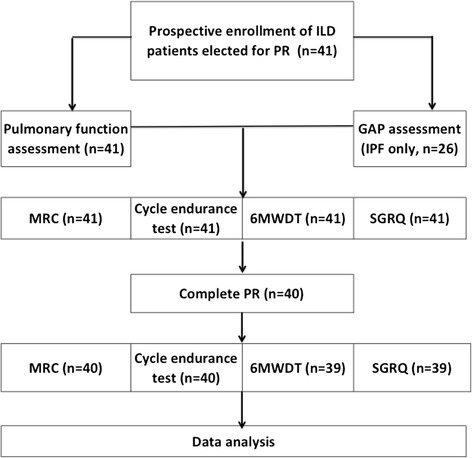
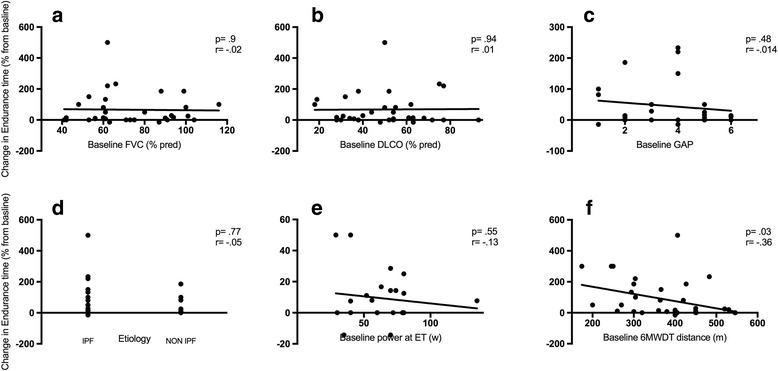
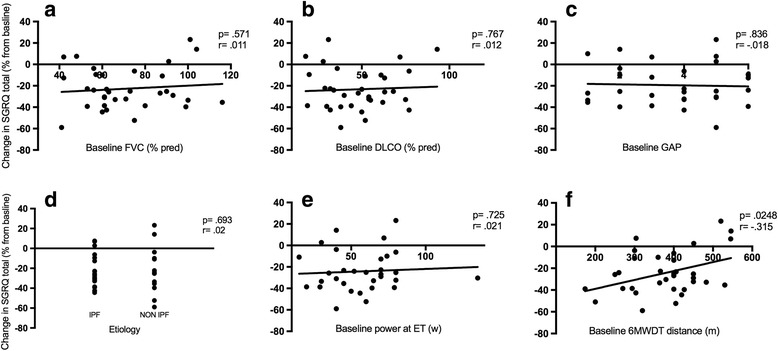
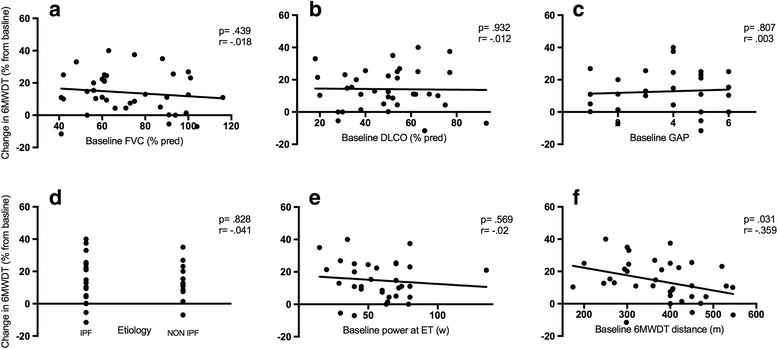
Forty-one patients (IPF 63%, age 66.9 ± 11 ys) were enrolled in a standard PR course in two centers. Lung function, incremental and endurance cyclo-ergometry, Six Minutes Walking Distance (6MWD), chronic dyspnea (Medical Research Council scale-MRC) and quality of life (St. George Respiratory Questionnaire-SGRQ) were recorded before and at the end of PR to measure any pre-to-post change. Correlation coefficients between the baseline level of Diffuse Lung Capacity for Carbon monoxide (DLCO), Forced Vital Capacity (FVC), 6MWD, power developed during incremental endurance test, GAP index (in IPF patients only) and etiology (IPF or non-IPF) with the functional improvement at the 6MWDT (meters), at the incremental and endurance cyclo-ergometry (endurance time) and the HRQoL were assessed.
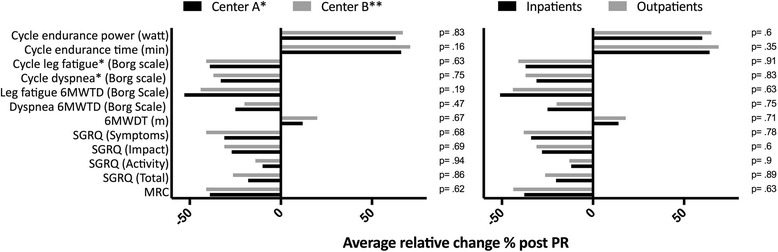
Out of the 41 patients, 97% (n = 40) completed the PR course. Exercise performance (both at peak load and submaximal effort), symptoms (iso-time dyspnea and leg fatigue), SGRQ and MRC significantly improved after PR (p < .001). Patients with lower baseline 6MWD showed greater improvement in 6MWD (Spearman r score = - .359, p = .034) and symptoms relief at SGRQ (r = -.315, p = .025) regardless of underlying disease.
Present study confirms that comprehensive rehabilitation is feasible and effective in patients with ILD of different severity and etiology. The baseline submaximal exercise capacity inversely correlates with both functional and symptom gains in this heterogeneous population.
最近的证据表明,肺康复(PR)对间质性肺疾病(ILD)患者有效。目前尚不清楚疾病严重程度和/或病因是否会影响报告的益处。我们设计了这项前瞻性研究,1)在ILD 患者人群中确认康复的疗效,2)研究基线运动能力、疾病严重程度或ILD 病因是否会影响结果。
在两个中心,41 名患者(特发性肺纤维化 63%,年龄 66.9±11 岁)参加了标准的 PR 课程。在 PR 前后记录肺功能、递增和耐力踏车运动试验、六分钟步行距离(6MWD)、慢性呼吸困难(医学研究委员会量表-MRC)和生活质量(圣乔治呼吸问卷-SGRQ),以测量任何从治疗前到治疗后的变化。使用相关系数评估基线一氧化碳弥散量(DLCO)、用力肺活量(FVC)、6MWD、递增耐力测试期间产生的功率、GAP 指数(仅在特发性肺纤维化患者中)和病因(特发性肺纤维化或非特发性肺纤维化)与 6MWDT(米)、递增和耐力踏车运动试验(耐力时间)和 HRQoL 的功能改善之间的关系。
41 名患者中,97%(n=40)完成了 PR 课程。运动表现(峰值负荷和亚最大努力)、症状(等时呼吸困难和腿部疲劳)、SGRQ 和 MRC 在 PR 后显著改善(p<0.001)。基线 6MWD 较低的患者在 6MWD(Spearman r 评分-0.359,p=0.034)和 SGRQ 症状缓解(r=-0.315,p=0.025)方面的改善更大,无论潜在疾病如何。
本研究证实,综合康复对不同严重程度和病因的 ILD 患者是可行且有效的。在这个异质人群中,基线亚最大运动能力与功能和症状的改善呈负相关。