Laboratory on Thymus Research, Oswaldo Cruz Institute, Oswaldo Cruz Foundation, Av. Brasil 4365, Manguinhos, Rio de Janeiro, 21045-900, Brazil.
Brazilian National Institute of Science and Technology on Neuroimmunomodulation (INCT-NIM), Av. Brasil 4365, Manguinhos, 21045-900, Rio de Janeiro, Brasil.
Skelet Muscle. 2017 Oct 10;7(1):20. doi: 10.1186/s13395-017-0138-6.
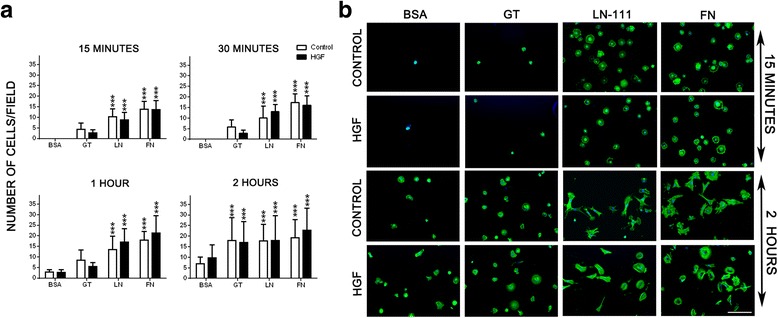
The hepatocyte growth factor (HGF) is required for the activation of muscle progenitor cells called satellite cells (SC), plays a role in the migration of proliferating SC (myoblasts), and is present as a soluble factor during muscle regeneration, along with extracellular matrix (ECM) molecules. In this study, we aimed at determining whether HGF is able to interact with ECM proteins, particularly laminin 111 and fibronectin, and to modulate human myoblast migration.
We evaluated the expression of the HGF-receptor c-Met, laminin, and fibronectin receptors by immunoblotting, flow cytometry, or immunofluorescence and used Transwell assays to analyze myoblast migration on laminin 111 and fibronectin in the absence or presence of HGF. Zymography was used to check whether HGF could modulate the production of matrix metalloproteinases by human myoblasts, and the activation of MAPK/ERK pathways was evaluated by immunoblotting.
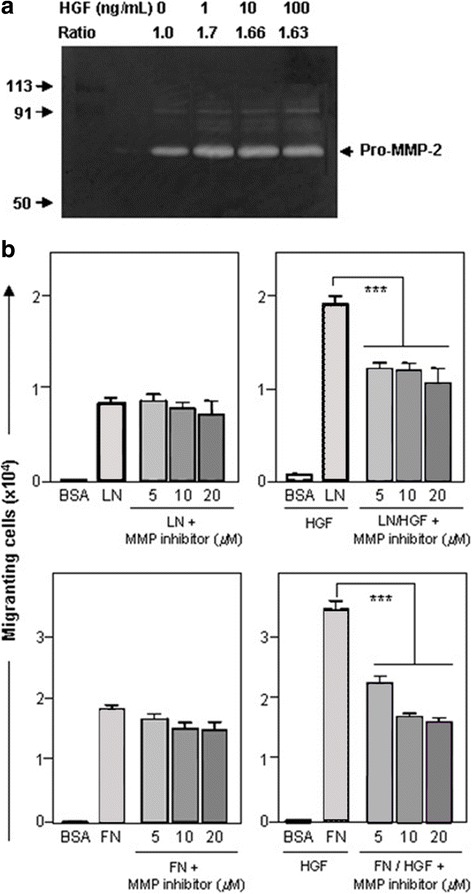
We demonstrated that human myoblasts express c-Met, together with laminin and fibronectin receptors. We observed that human laminin 111 and fibronectin have a chemotactic effect on myoblast migration, and this was synergistically increased when low doses of HGF were added. We detected an increase in MMP-2 activity in myoblasts treated with HGF. Conversely, MMP-2 inhibition decreased the HGF-associated stimulation of cell migration triggered by laminin or fibronectin. HGF treatment also induced in human myoblasts activation of MAPK/ERK pathways, whose specific inhibition decreased the HGF-associated stimulus of cell migration triggered by laminin 111 or fibronectin.
We demonstrate that HGF induces ERK phosphorylation and MMP production, thus stimulating human myoblast migration on ECM molecules. Conceptually, these data state that the mechanisms involved in the migration of human myoblasts comprise both soluble and insoluble moieties. This should be taken into account to optimize the design of therapeutic cell transplantation strategies by improving the migration of donor cells within the host tissue, a main issue regarding this approach.
肝细胞生长因子 (HGF) 是激活称为卫星细胞 (SC) 的肌肉祖细胞所必需的,在增殖的 SC(成肌细胞)的迁移中起作用,并且作为可溶性因子存在于肌肉再生过程中,同时存在细胞外基质 (ECM) 分子。在这项研究中,我们旨在确定 HGF 是否能够与 ECM 蛋白相互作用,特别是层粘连蛋白 111 和纤维连接蛋白,并调节人成肌细胞的迁移。
我们通过免疫印迹、流式细胞术或免疫荧光评估 HGF 受体 c-Met、层粘连蛋白和纤维连接蛋白受体的表达,并使用 Transwell 测定分析 HGF 存在或不存在时人成肌细胞在层粘连蛋白 111 和纤维连接蛋白上的迁移。通过明胶酶谱分析检查 HGF 是否可以调节人成肌细胞基质金属蛋白酶的产生,并通过免疫印迹评估 MAPK/ERK 途径的激活。
我们证明人成肌细胞表达 c-Met 以及层粘连蛋白和纤维连接蛋白受体。我们观察到人层粘连蛋白 111 和纤维连接蛋白对成肌细胞迁移有趋化作用,当添加低剂量 HGF 时,这种趋化作用协同增加。我们检测到用 HGF 处理的成肌细胞中 MMP-2 活性增加。相反,MMP-2 抑制降低了由层粘连蛋白或纤维连接蛋白触发的与 HGF 相关的细胞迁移刺激。HGF 处理还诱导人成肌细胞中 MAPK/ERK 途径的激活,其特异性抑制降低了由层粘连蛋白 111 或纤维连接蛋白触发的与 HGF 相关的细胞迁移刺激。
我们证明 HGF 诱导 ERK 磷酸化和 MMP 产生,从而刺激人成肌细胞在 ECM 分子上迁移。从概念上讲,这些数据表明,人成肌细胞迁移所涉及的机制既包括可溶性部分,也包括不溶性部分。在设计通过改善供体细胞在宿主组织内的迁移来优化治疗性细胞移植策略时,应考虑到这一点,这是该方法的一个主要问题。