Life and Health Sciences Research Institute (ICVS), School of Medicine, University of Minho, Braga, Portugal.
ICVS/3B's, PT Government Associate Laboratory, Braga/Guimarães, Portugal.
BMC Med Educ. 2017 Oct 10;17(1):184. doi: 10.1186/s12909-017-1006-0.
Factors associated with depression of medical students are poorly understood. The purpose of this study is to determine the prevalence of depression in medical students, its change during the course, if depression persists for affected students, what are the factors associated with depression and how these factors change over time.
A prospective, longitudinal observational study was conducted at the Medical School of the University of Minho, Portugal, between academic years 2009-2010 to 2012-2013. We included students who maintained their participation by annually completing a questionnaire including Beck Depression Inventory (BDI). Anxiety and burnout were assessed using the State Trait Anxiety Inventory and Maslach Burnout Inventory. Surveys on socio-demographic variables were applied to evaluate potential predictors, personal and academic characteristics and perceived difficulties. ANOVA with multiple comparisons were used to compare means of BDI score. The medical students were organized into subgroups by K-means cluster analyses. ANOVA mixed-design repeated measurement was performed to assess a possible interaction between variables associated with depression.
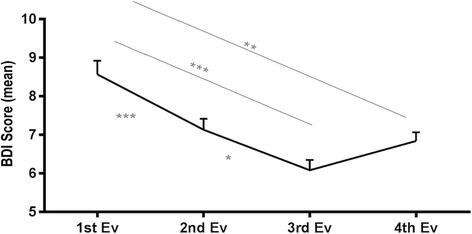
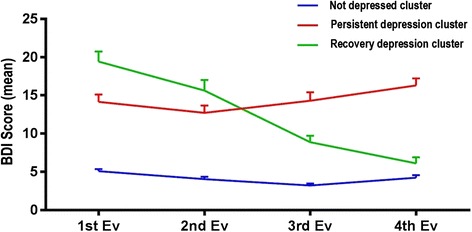
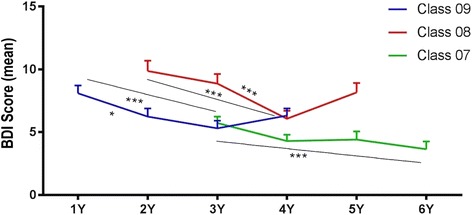
The response rate was 84, 92, 88 and 81% for academic years 2009-2010, 2010-2011,2011-2012 and 2012/2013, respectively. Two hundred thirty-eight medical students were evaluated longitudinally. For depression the prevalence ranged from 21.5 to 12.7% (academic years 2009/2010 and 2012/2013). BDI scores decreased during medical school. 19.7% of students recorded sustained high BDI over time. These students had high levels of trait-anxiety and choose medicine for anticipated income and prestige, reported more relationship issues, cynicism, and decreased satisfaction with social activities. Students with high BDI scores at initial evaluation with low levels of trait-anxiety and a primary interest in medicine as a career tended to improve their mood and reported reduced burnout, low perceived learning problems and increased satisfaction with social activities at last evaluation. No difference was detected between men and women in the median BDI score over time.
Our findings suggest that personal factors (anxiety traits, medicine choice factors, relationship patterns and academic burnout) are relevant for persistence of high levels of BDI during medical training. Medical schools need to identity students who experience depression and support then, as early as possible, particularly when depression has been present over time.
与医学生抑郁相关的因素尚未完全阐明。本研究旨在确定医学生抑郁的发生率、其在课程期间的变化、抑郁是否会持续影响受影响的学生、与抑郁相关的因素有哪些以及这些因素随时间的变化。
本研究为前瞻性、纵向观察性研究,在葡萄牙米尼奥大学医学院进行,时间为 2009-2010 学年至 2012-2013 学年。我们纳入了每年通过贝克抑郁量表(BDI)完成问卷以保持参与度的学生。使用状态特质焦虑量表和马斯拉赫职业倦怠量表评估焦虑和倦怠。应用社会人口统计学变量调查以评估潜在的预测因素、个人和学术特征以及感知困难。采用方差分析(ANOVA)和多重比较比较 BDI 评分均值。通过 K-均值聚类分析将医学生分为亚组。采用方差混合设计重复测量评估与抑郁相关的变量之间的可能交互作用。
2009-2010 学年、2010-2011 学年、2011-2012 学年和 2012-2013 学年的应答率分别为 84%、92%、88%和 81%。对 238 名医学生进行了纵向评估。抑郁的患病率为 21.5%至 12.7%(2009/2010 学年和 2012/2013 学年)。医学生在校期间 BDI 评分逐渐下降。19.7%的学生随着时间的推移持续出现高 BDI。这些学生特质焦虑水平较高,选择医学是为了预期收入和声誉,报告了更多的人际关系问题、愤世嫉俗以及对社会活动的满意度降低。在初始评估时 BDI 评分较高且特质焦虑水平较低、对医学作为职业的主要兴趣的学生,倾向于改善情绪,并报告倦怠程度降低、感知学习问题减少以及对社会活动的满意度增加。在整个研究期间,男女医学生的 BDI 评分中位数无差异。
我们的研究结果表明,个人因素(焦虑特质、医学选择因素、人际关系模式和学业倦怠)与医学生培训期间持续高水平 BDI 相关。医学院校需要识别出经历抑郁的学生,并尽早为他们提供支持,尤其是当抑郁持续存在时。