Himes Katherine Park, Donovan Heidi, Wang Stephanie, Weaver Carrie, Grove Jillian Rae, Facco Francesca Lucia
Magee-Womens Research Institute, Department of Obstetrics, Gynecology, and Reproductive Sciences, University of Pittsburgh, Pittsburgh, PA, United States.
School of Nursing, Health and Community Systems, University of Pittsburgh, Pittsburgh, PA, United States.
JMIR Hum Factors. 2017 Oct 10;4(4):e26. doi: 10.2196/humanfactors.7964.
During the postpartum visit, health care providers address issues with short- and long-term implications for maternal and child health. Women with Medicaid insurance are less likely to return for a postpartum visit compared with women with private insurance. Behavioral economics acknowledges that people do not make exclusively rational choices, rather immediate gratification, cognitive and psychological biases, and social norms influence decision making. Drawing on insights from decision science, behavioral economists have examined how these biases can be modulated through carefully designed interventions. We have developed a Web-based tool, Healthy Beyond Pregnancy, that incorporates empirically derived concepts of behavioral economics to improve adherence rates to the postpartum visit.
The primary objectives of this pilot study were to (1) refine and assess the usability of Healthy Beyond Pregnancy and (2) assess the feasibility of a randomized controlled trial (RCT) of the intervention.
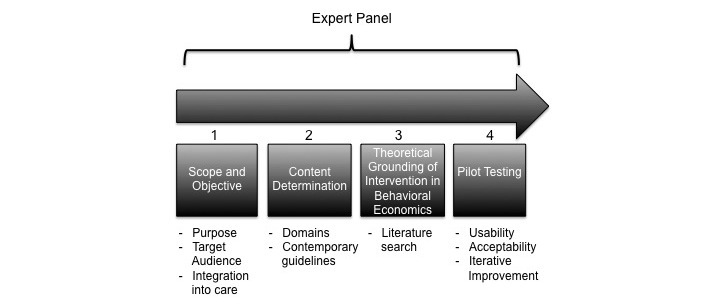
We used a multistep process and multidisciplinary team of maternal-fetal medicine physicians, a behavioral economist, and researchers with expertise in behavioral interventions to design Healthy Beyond Pregnancy. We assessed the usability of the program with the Post-Study System Usability Questionnaire (PSSUQ), a validated 7-point scale, and semistructured interviews with postpartum women. We then conducted a feasibility trial to determine the proportion of eligible women who were willing to participate in an RCT of Healthy Beyond Pregnancy and the proportion of women willing to complete the Web-based program. Exploratory outcomes of the pilot trial included attendance at the postpartum visit, uptake of long-acting reversible contraception, and uptake of any contraception.
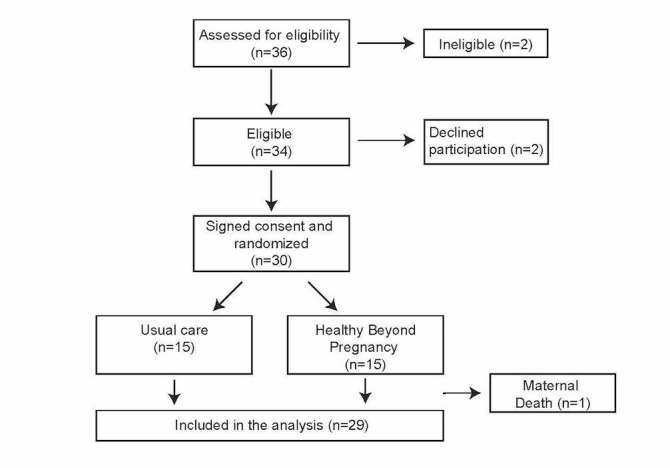
The median PSSUQ score for Healthy Beyond Pregnancy was 6.5 (interquartile range: 6.1-7) demonstrating high usability. Semistructured interviews (n=10) provided in-depth comments about users' experience and further improved the program. A total of 34 postpartum women with Medicaid insurance were approached for the pilot trial, and 30 (88%) were consented and randomized. All women randomized to Healthy Beyond Pregnancy completed the Web-based program, had text-enabled cell phones, and were willing to receive text messages from the study team. Women in the Healthy Beyond Pregnancy arm were more likely to return for a postpartum visit compared with women in the control arm with 85% of women in Healthy Beyond Pregnancy returning versus 53% in the control arm (odds ratio in the Healthy Beyond Pregnancy group: 5.3; 95% CI 0.9-32.0; P=.06).
We have developed a highly usable and acceptable Web-based program designed to increase attendance at the postpartum visit. Our pilot trial demonstrates that women are willing and able to participate in a randomized trial of a Web-based program and text messaging system.
Clinicaltrials.gov NCT03296774; https://clinicaltrials.gov/ct2/show/NCT03296774 (Archived by WebCite at http://www.webcitation.org/6tpgXFzyk).
在产后访视期间,医疗保健提供者会处理对母婴健康有短期和长期影响的问题。与拥有私人保险的女性相比,参加医疗补助保险的女性产后回访的可能性较小。行为经济学承认,人们并非只做出完全理性的选择,即时满足、认知和心理偏差以及社会规范都会影响决策。行为经济学家借鉴决策科学的见解,研究了如何通过精心设计的干预措施来调节这些偏差。我们开发了一个基于网络的工具“孕期后健康”,该工具纳入了行为经济学的实证概念,以提高产后回访的依从率。
这项试点研究的主要目的是:(1)完善并评估“孕期后健康”的可用性;(2)评估该干预措施的随机对照试验(RCT)的可行性。
我们采用了多步骤流程,并由母胎医学医生、行为经济学家以及行为干预领域的专家组成多学科团队来设计“孕期后健康”。我们使用经过验证的7分制《研究后系统可用性问卷》(PSSUQ)以及对产后女性的半结构化访谈来评估该项目的可用性。然后,我们进行了一项可行性试验,以确定符合条件的女性愿意参加“孕期后健康”RCT的比例以及愿意完成该基于网络项目的女性比例。试点试验的探索性结果包括产后回访的出勤率、长效可逆避孕措施的采用率以及任何避孕措施的采用率。
“孕期后健康”的PSSUQ中位数得分为6.5(四分位间距:6.1 - 7),表明可用性高。半结构化访谈(n = 10)提供了关于用户体验的深入评论,并进一步改进了该项目。共有34名参加医疗补助保险的产后女性被邀请参加试点试验,其中30名(88%)同意并被随机分组。所有被随机分配到“孕期后健康”组的女性都完成了基于网络的项目,拥有可收发短信的手机,并且愿意接收研究团队发送的短信。与对照组女性相比,“孕期后健康”组的女性更有可能回来进行产后回访,“孕期后健康”组85%的女性回来回访,而对照组为53%(“孕期后健康”组的优势比:5.3;95%置信区间0.9 - 32.0;P = 0.06)。
我们开发了一个高度可用且可接受的基于网络的项目,旨在提高产后回访的出勤率。我们的试点试验表明,女性愿意且能够参与基于网络项目和短信系统的随机试验。
Clinicaltrials.gov NCT03296774;https://clinicaltrials.gov/ct2/show/NCT03296774(由WebCite存档于http://www.webcitation.org/6tpgXFzyk)