Department of Neurology, The First Affiliated Hospital of Anhui Medical University, Hefei, China.
Collaborative Innovation Center of Neuropsychiatric Disorders and Mental Health, Hefei, China.
J Am Heart Assoc. 2017 Oct 10;6(10):e005561. doi: 10.1161/JAHA.117.005561.
Obesity is a risk factor for many diseases. However, the potential association between adiposity and cognitive decline in hypertensive patients is inconclusive. We performed a secondary data analysis of the CSPPT (China Stroke Primary Prevention Trial) to examine whether adiposity is correlated with longitudinal cognitive performance in hypertensive adults.
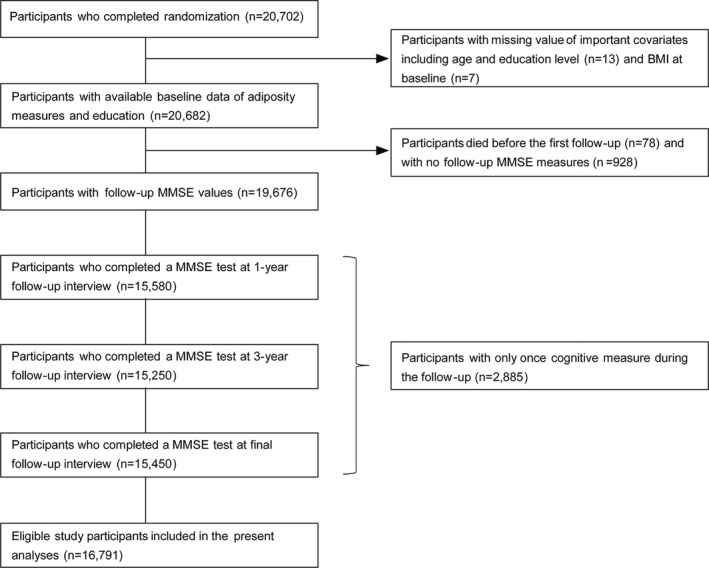
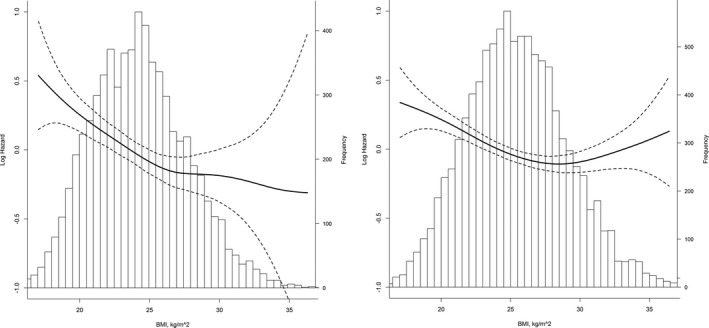
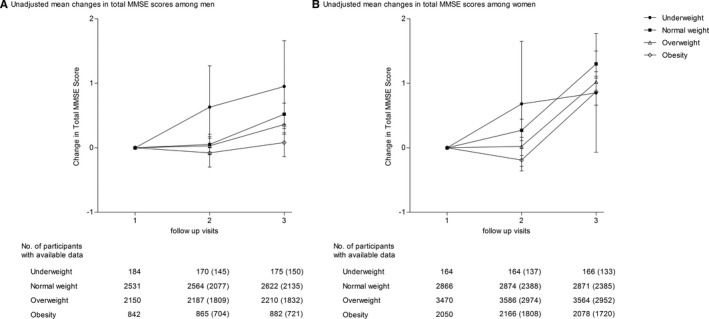
The analysis included 16 791 patients in the CSPPT who received at least 2 cognitive assessments by the Mini-Mental State Examination (MMSE) during the follow-up (median, 4.5 years; interquartile range, 4.2-4.8 years). Outcomes included changes in MMSE scores and cognitive impairment (defined as MMSE score less than education-specific cutoff point). A marked reduction in MMSE scores at the final (compared with at the 1-year) follow-up was apparent in both men (n=4838; mean [SD] score, 0.41 [3.62]) and women (n=7190; mean [SD] score, 1.07 [4.61]; both <0.001). Analysis using a mixed-effects model revealed an association between higher body mass index with less MMSE decline, even after controlling for demographics and comorbidities (men, β=0.0134 [SE, 0.0036]; women, β=0.0133 [SE, 0.0034]; both <0.001). A total of 1037 men (15.3%) and 3317 women (33.1%) developed cognitive impairment. In multivariable Cox regression analyses, being obese in men (11.3% versus 18.0%; hazard ratio, 0.75; 95% confidence interval, 0.60-0.94) and women (30.1% versus 36.5%; hazard ratio, 0.82; 95% confidence interval, 0.74-0.91) was a protective factor against cognitive impairment compared with normal body mass index.
Higher adiposity is independently associated with slower cognitive decline in Chinese hypertensive adults.
URL: http://www.clinicaltrials.gov. Unique identifier: NCT00794885 CSPPT.
肥胖是许多疾病的危险因素。然而,肥胖症与高血压患者认知能力下降之间的潜在关联尚无定论。我们对 CSPPT(中国脑卒中一级预防试验)进行了二次数据分析,以检验肥胖是否与高血压成年人的纵向认知表现相关。
该分析包括 CSPPT 中接受了至少 2 次由简易精神状态检查(MMSE)进行的认知评估的 16791 名患者,在随访期间(中位数 4.5 年;四分位距 4.2-4.8 年)。结局包括 MMSE 评分的变化和认知障碍(定义为 MMSE 评分低于教育特定截断点)。与第 1 年随访相比,最终随访时 MMSE 评分明显下降(n=4838;平均[SD]评分,0.41[3.62])和女性(n=7190;平均[SD]评分,1.07[4.61];均<0.001)。使用混合效应模型进行分析表明,即使在控制人口统计学和合并症后,较高的体重指数与 MMSE 下降较少有关(男性,β=0.0134[SE,0.0036];女性,β=0.0133[SE,0.0034];均<0.001)。共有 1037 名男性(15.3%)和 3317 名女性(33.1%)发生了认知障碍。在多变量 Cox 回归分析中,与正常体重指数相比,男性肥胖(11.3%比 18.0%;危险比,0.75;95%置信区间,0.60-0.94)和女性肥胖(30.1%比 36.5%;危险比,0.82;95%置信区间,0.74-0.91)是认知障碍的保护因素。
较高的肥胖程度与中国高血压成年人认知能力下降速度较慢独立相关。