Hôpital Croix-Rousse, Cardiology Department, European Society of Hypertension Excellence Centre, Hospices Civils de Lyon, France.
CREATIS UMR5220 INSERM U1044 INSA-Lyon Université de Lyon Université Claude Bernard Lyon 1, Lyon, France.
J Am Heart Assoc. 2017 Oct 10;6(10):e007062. doi: 10.1161/JAHA.117.007062.
The DENERHTN (Renal Denervation for Hypertension) trial confirmed the efficacy of renal denervation (RDN) in lowering daytime ambulatory systolic blood pressure when added to standardized stepped-care antihypertensive treatment (SSAHT) for resistant hypertension at 6 months.
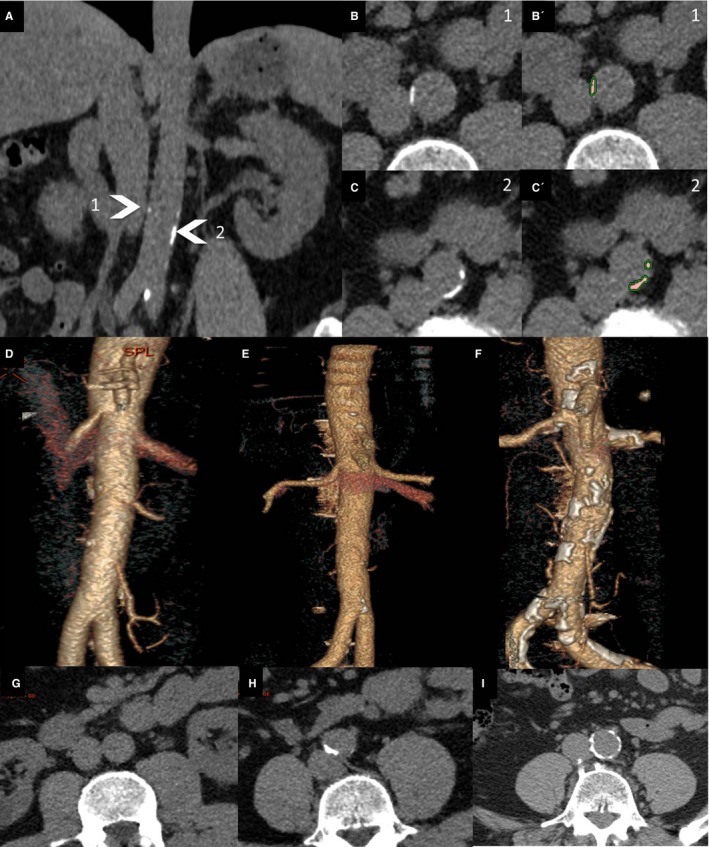
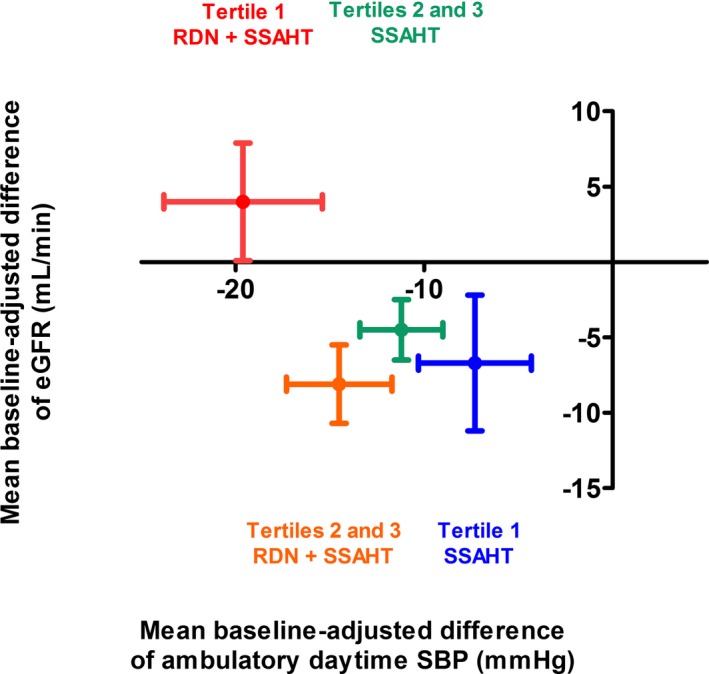
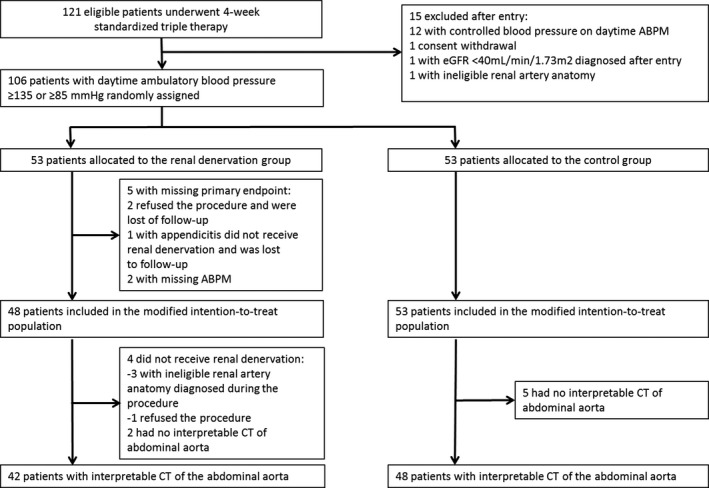
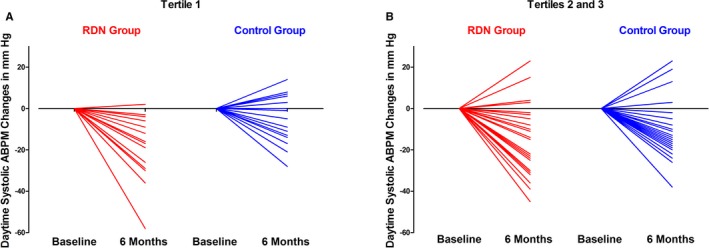
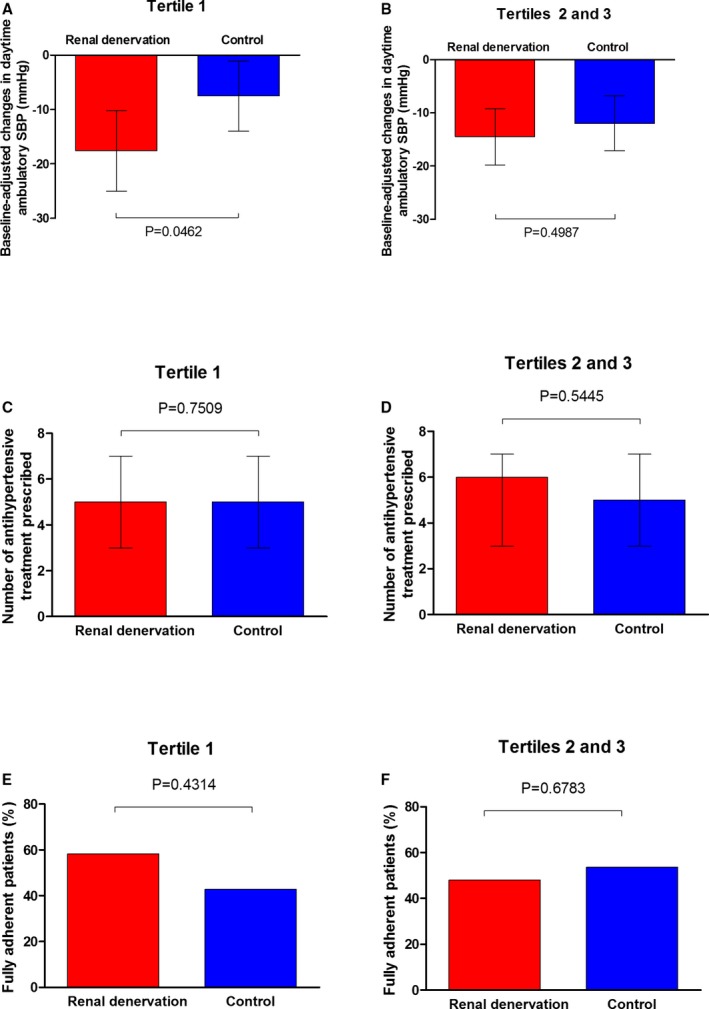
This post hoc exploratory analysis assessed the impact of abdominal aortic calcifications (AAC) on the hemodynamic and renal response to RDN at 6 months. In total, 106 patients with resistant hypertension were randomly assigned to RDN plus SSAHT or to the same SSAHT alone (control group). Total AAC volume was measured, with semiautomatic software and blind to randomization, from the aortic hiatus to the iliac bifurcation using the prerandomization noncontrast abdominal computed tomography scans of 90 patients. Measurements were expressed as tertiles. The baseline-adjusted difference in the change in daytime ambulatory systolic blood pressure from baseline to 6 months between the RDN and control groups was -10.1 mm Hg (=0.0462) in the lowest tertile and -2.5 mm Hg (=0.4987) in the 2 highest tertiles of AAC volume. Estimated glomerular filtration rate remained stable at 6 months for the patients in the lowest tertile of AAC volume who underwent RDN (+2.5 mL/min per 1.73 m) but decreased in the control group (-8.0 mL/min per 1.73 m, =0.0148). In the 2 highest tertiles of AAC volume, estimated glomerular filtration rate decreased similarly in the RDN and control groups (=0.2640).
RDN plus SSAHT resulted in a larger decrease in daytime ambulatory systolic blood pressure than SSAHT alone in patients with a lower AAC burden than in those with a higher AAC burden. This larger decrease in daytime ambulatory systolic blood pressure was not associated with a decrease in estimated glomerular filtration rate.
URL: http://www.clinicaltrials.gov. Unique identifier: NCT01570777.
DENERHTN(高血压的肾脏去神经支配)试验证实,在标准的阶梯式降压治疗(SSAHT)基础上,添加肾脏去神经支配(RDN)治疗抵抗性高血压,6 个月时日间动态收缩压降低是有效的。
本事后探索性分析评估了腹主动脉钙化(AAC)对 RDN 治疗 6 个月时血流动力学和肾脏反应的影响。共 106 例抵抗性高血压患者被随机分配至 RDN+SSAHT 或相同的 SSAHT (对照组)。使用半自动化软件,从主动脉裂孔至髂分叉,对 90 例患者的基线前非对比腹部 CT 扫描进行测量,盲法随机分组。用 tertiles 表示测量值。AAC 体积最低 tertile 的 RDN 组和对照组相比,日间动态收缩压从基线到 6 个月的变化差值为-10.1mmHg(=0.0462),AAC 体积 2 个最高 tertile 为-2.5mmHg(=0.4987)。在 AAC 体积最低 tertile 的 RDN 组中,估算肾小球滤过率在 6 个月时保持稳定(+2.5mL/min/1.73m),而对照组下降(-8.0mL/min/1.73m,=0.0148)。在 AAC 体积的 2 个最高 tertile 中,RDN 组和对照组的估算肾小球滤过率下降相似(=0.2640)。
与 SSAHT 单独治疗相比,AAC 负荷较低的患者接受 RDN+SSAHT 治疗后,日间动态收缩压下降更大。日间动态收缩压的这种较大下降与估算肾小球滤过率的下降无关。