School of Geography, Earth and Environmental Sciences, University of Birmingham, Edgbaston, Birmingham, B15 2TT, UK.
North Carolina Museum of Natural Sciences, Raleigh, NC, 27607, USA.
Nat Commun. 2017 Oct 10;8(1):733. doi: 10.1038/s41467-017-00827-7.
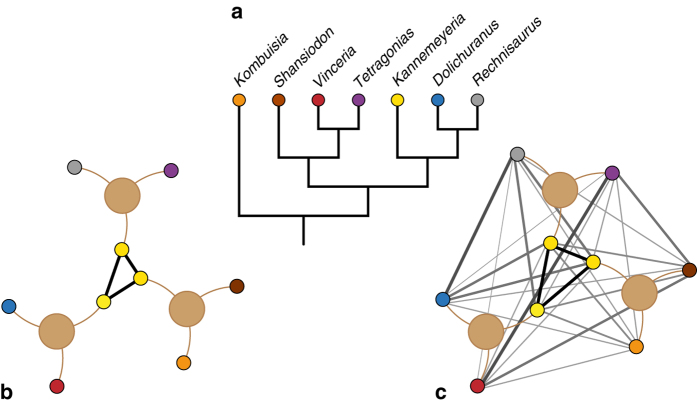
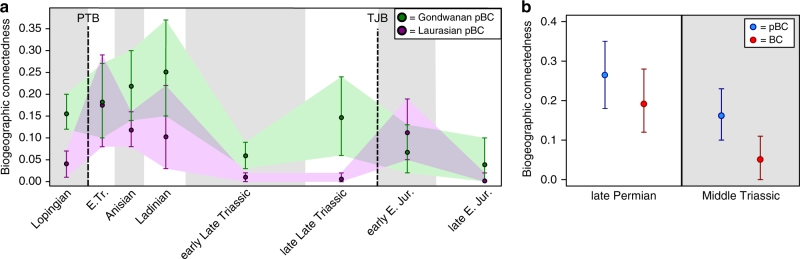
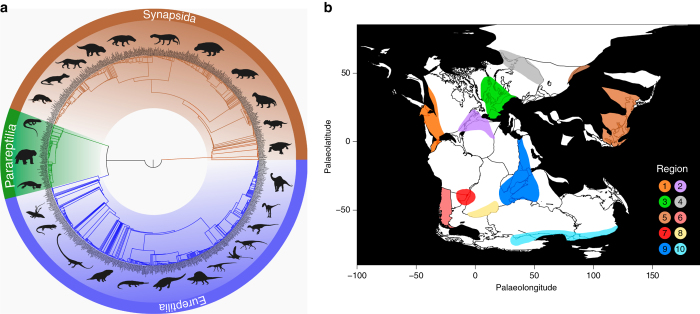
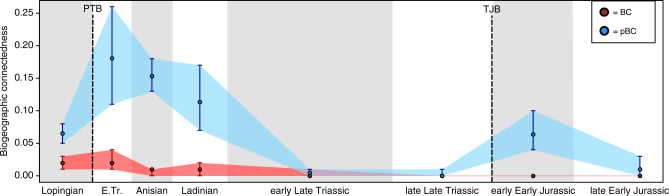
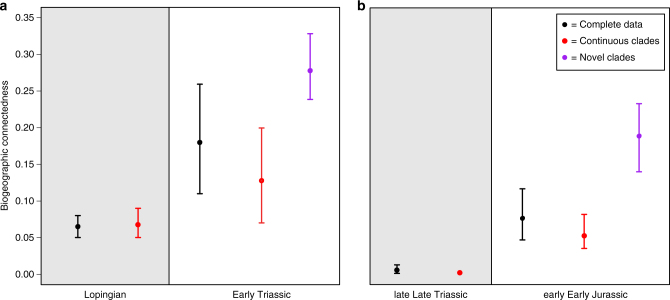
Mass extinctions have profoundly impacted the evolution of life through not only reducing taxonomic diversity but also reshaping ecosystems and biogeographic patterns. In particular, they are considered to have driven increased biogeographic cosmopolitanism, but quantitative tests of this hypothesis are rare and have not explicitly incorporated information on evolutionary relationships. Here we quantify faunal cosmopolitanism using a phylogenetic network approach for 891 terrestrial vertebrate species spanning the late Permian through Early Jurassic. This key interval witnessed the Permian-Triassic and Triassic-Jurassic mass extinctions, the onset of fragmentation of the supercontinent Pangaea, and the origins of dinosaurs and many modern vertebrate groups. Our results recover significant increases in global faunal cosmopolitanism following both mass extinctions, driven mainly by new, widespread taxa, leading to homogenous 'disaster faunas'. Cosmopolitanism subsequently declines in post-recovery communities. These shared patterns in both biotic crises suggest that mass extinctions have predictable influences on animal distribution and may shed light on biodiversity loss in extant ecosystems.Mass extinctions are thought to produce 'disaster faunas', communities dominated by a small number of widespread species. Here, Button et al. develop a phylogenetic network approach to test this hypothesis and find that mass extinctions did increase faunal cosmopolitanism across Pangaea during the late Palaeozoic and early Mesozoic.
大规模灭绝事件通过不仅减少分类多样性,而且重塑生态系统和生物地理模式,对生命的进化产生了深远的影响。特别是,它们被认为推动了生物地理世界性的增加,但这种假说的定量检验很少,并且没有明确纳入进化关系的信息。在这里,我们使用系统发育网络方法对跨越晚二叠世至早侏罗世的 891 种陆地脊椎动物物种进行了动物区系世界性的定量研究。这个关键的时间间隔见证了二叠纪-三叠纪和三叠纪-侏罗纪的大灭绝,超大陆潘加亚的分裂开始,以及恐龙和许多现代脊椎动物群的起源。我们的结果表明,在两次大灭绝之后,全球动物区系世界性都显著增加,主要是由于新的、广泛分布的分类群的出现,导致了同质化的“灾难动物群”。世界性随后在恢复后的群落中下降。这两个生物危机中的共享模式表明,大规模灭绝对动物分布有可预测的影响,并可能为现存生态系统中的生物多样性丧失提供线索。大规模灭绝被认为会产生“灾难动物群”,即由少数广泛分布的物种主导的群落。在这里,Button 等人开发了一种系统发育网络方法来检验这一假设,结果发现,在晚古生代和早中生代期间,大规模灭绝确实增加了泛大陆的动物区系世界性。