Xu Liang, Carrer Andrea, Zonta Francesco, Qu Zhihu, Ma Peixiang, Li Sheng, Ceriani Federico, Buratto Damiano, Crispino Giulia, Zorzi Veronica, Ziraldo Gaia, Bruno Francesca, Nardin Chiara, Peres Chiara, Mazzarda Flavia, Salvatore Anna M, Raspa Marcello, Scavizzi Ferdinando, Chu Youjun, Xie Sichun, Yang Xuemei, Liao Jun, Liu Xiao, Wang Wei, Wang Shanshan, Yang Guang, Lerner Richard A, Mammano Fabio
Shanghai Institute for Advanced Immunochemical Studies, ShanghaiTech UniversityShanghai, China.
Institute of Biochemistry and Cell Biology, Shanghai Institute for Biological Sciences, Chinese Academy of SciencesShanghai, China.
Front Mol Neurosci. 2017 Sep 22;10:298. doi: 10.3389/fnmol.2017.00298. eCollection 2017.
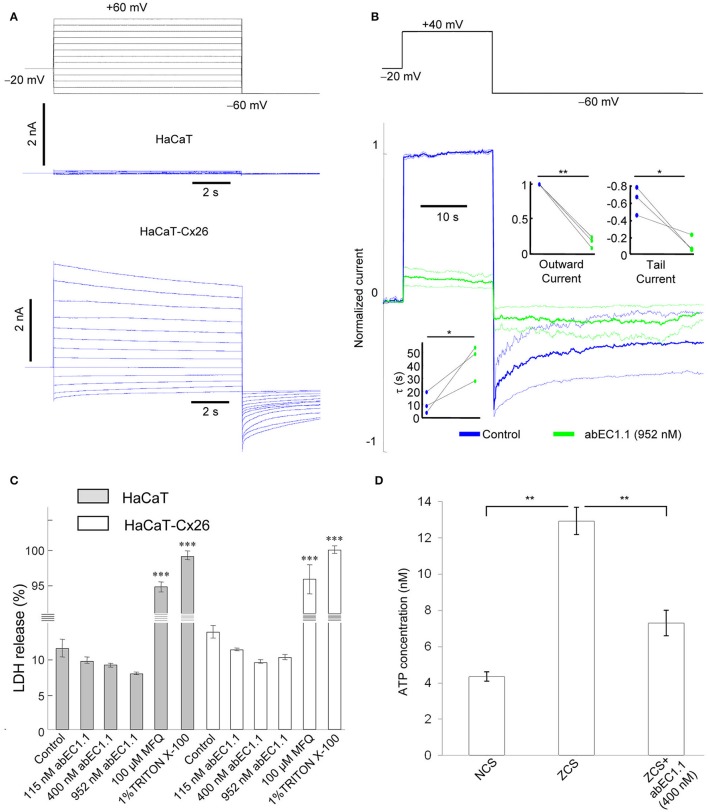
Mutations leading to changes in properties, regulation, or expression of connexin-made channels have been implicated in 28 distinct human hereditary diseases. Eight of these result from variants of connexin 26 (Cx26), a protein critically involved in cell-cell signaling in the inner ear and skin. Lack of non-toxic drugs with defined mechanisms of action poses a serious obstacle to therapeutic interventions for diseases caused by mutant connexins. In particular, molecules that specifically modulate connexin hemichannel function without affecting gap junction channels are considered of primary importance for the study of connexin hemichannel role in physiological as well as pathological conditions. Monoclonal antibodies developed in the last three decades have become the most important class of therapeutic biologicals. Recombinant methods permit rapid selection and improvement of monoclonal antibodies from libraries with large diversity. By screening a combinatorial library of human single-chain fragment variable (scFv) antibodies expressed in phage, we identified a candidate that binds an extracellular epitope of Cx26. We characterized antibody action using a variety of biochemical and biophysical assays in HeLa cells, organotypic cultures of mouse cochlea and human keratinocyte-derived cells. We determined that the antibody is a remarkably efficient, non-toxic, and completely reversible inhibitor of hemichannels formed by connexin 26 and does not affect direct cell-cell communication via gap junction channels. Importantly, we also demonstrate that the antibody efficiently inhibits hyperative mutant Cx26 hemichannels implicated in autosomal dominant non-syndromic hearing impairment accompanied by keratitis and hystrix-like ichthyosis-deafness (KID/HID) syndrome. We solved the crystal structure of the antibody, identified residues that are critical for binding and used molecular dynamics to uncover its mechanism of action. Although further studies will be necessary to validate the effect of the antibody , the methodology described here can be extended to select antibodies against hemichannels composed by other connexin isoforms and, consequently, to target other pathologies associated with hyperactive hemichannels. Our study highlights the potential of this approach and identifies connexins as therapeutic targets addressable by screening phage display libraries expressing human randomized antibodies.
导致连接蛋白所构成通道的特性、调节或表达发生改变的突变,已与28种不同的人类遗传性疾病相关联。其中8种疾病源于连接蛋白26(Cx26)的变体,Cx26是一种在内耳和皮肤的细胞间信号传导中起关键作用的蛋白质。缺乏作用机制明确的无毒药物,对由突变连接蛋白引起的疾病的治疗干预构成了严重障碍。特别是,在生理和病理条件下,特异性调节连接蛋白半通道功能而不影响间隙连接通道的分子,被认为对连接蛋白半通道作用的研究至关重要。在过去三十年中开发的单克隆抗体已成为最重要的一类治疗性生物制品。重组方法允许从具有高度多样性的文库中快速筛选和改进单克隆抗体。通过筛选在噬菌体中表达的人单链片段可变区(scFv)抗体的组合文库,我们鉴定出一种能结合Cx26细胞外表位的候选抗体。我们在HeLa细胞、小鼠耳蜗器官型培养物和人角质形成细胞衍生细胞中,使用多种生化和生物物理测定方法对抗体作用进行了表征。我们确定该抗体是由连接蛋白26形成的半通道的一种非常有效的、无毒且完全可逆的抑制剂,并且不影响通过间隙连接通道的直接细胞间通讯。重要的是,我们还证明该抗体能有效抑制与常染色体显性非综合征性听力损失伴角膜炎和豪猪样鱼鳞病 - 耳聋(KID/HID)综合征相关的活性过高的突变型Cx26半通道。我们解析了该抗体的晶体结构,确定了结合关键的残基,并利用分子动力学揭示了其作用机制。尽管需要进一步研究来验证该抗体的效果,但此处描述的方法可扩展用于筛选针对由其他连接蛋白异构体组成的半通道的抗体,从而针对与活性过高的半通道相关的其他病症。我们的研究突出了这种方法的潜力,并将连接蛋白确定为可通过筛选表达人随机抗体的噬菌体展示文库来靶向的治疗靶点。