da Silva Lopes Katharina, Ota Erika, Shakya Prakash, Dagvadorj Amarjargal, Balogun Olukunmi Omobolanle, Peña-Rosas Juan Pablo, De-Regil Luz Maria, Mori Rintaro
Global Health Nursing, Graduate School of Nursing Science, St. Luke's International University, Tokyo, Japan.
Faculty of Social Sciences, Kyorin University, Tokyo, Japan.
BMJ Glob Health. 2017 Sep 22;2(3):e000389. doi: 10.1136/bmjgh-2017-000389. eCollection 2017.
Low birth weight (LBW, birth weight less than 2500 g) is associated with infant mortality and childhood morbidity. Poor maternal nutritional status is one of several contributing factors to LBW. We systematically reviewed the evidence for nutrition-specific (addressing the immediate determinants of nutrition) and nutrition-sensitive (addressing the underlying cause of undernutrition) interventions to reduce the risk of LBW and/or its components: preterm birth (PTB) and small-for-gestational age (SGA).
We conducted a comprehensive literature search in MEDLINE, EMBASE, CINAHL and the Cochrane Database of Systematic Reviews (September 2015). Systematic reviews of randomised controlled trials focusing on nutritional interventions before and during pregnancy to reduce LBW and its components were eligible for inclusion into the overview review. We assessed the methodological quality of the included reviews using (AMSTAR), PROSPERO: CRD42015024814.
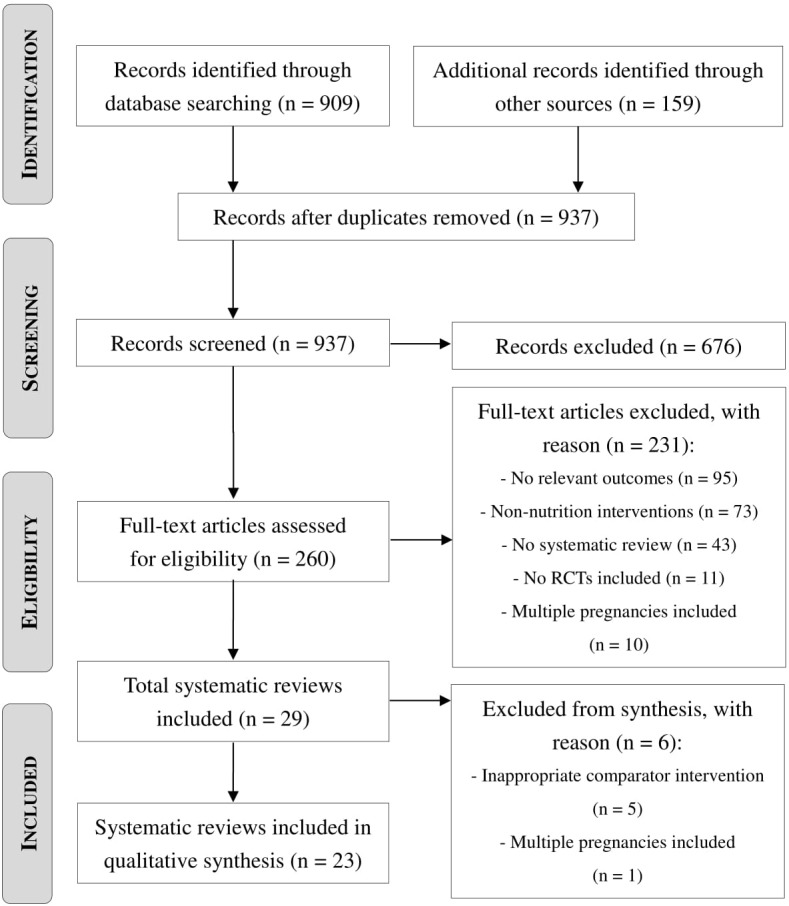
We included 23 systematic reviews which comprised 34 comparisons. Sixteen reviews were of high methodological quality, six of moderate and only one review of low quality. Six interventions were associated with a decreased risk of LBW: oral supplementation with (1) vitamin A, (2) low-dose calcium, (3) zinc, (4) multiple micronutrients (MMN), nutritional education and provision of preventive antimalarials. MMN and balanced protein/energy supplementation had a positive effect on SGA, while high protein supplementation increased the risk of SGA. High-dose calcium, zinc or long-chain n-3 fatty acid supplementation and nutritional education decreased the risk of PTB.
Improving women's nutritional status positively affected LBW, SGA and PTB. Based on current evidence, especially MMN supplementation and preventive antimalarial drugs during pregnancy may be considered for policy and practice. However, for most interventions evidence was derived from a small number of trials and/or participants. There is a need to further explore the evidence of nutrition-specific and nutrition-sensitive interventions in order to reach the WHO's goal of a 30% reduction in the global rate of LBW by 2025.
低出生体重(LBW,出生体重低于2500克)与婴儿死亡率和儿童期发病率相关。孕产妇营养状况不佳是导致低出生体重的多个因素之一。我们系统回顾了针对特定营养(解决营养的直接决定因素)和营养敏感(解决营养不良的根本原因)干预措施以降低低出生体重及其组成部分(早产(PTB)和小于胎龄儿(SGA))风险的证据。
我们于2015年9月在MEDLINE、EMBASE、CINAHL和Cochrane系统评价数据库中进行了全面的文献检索。聚焦于孕期前后营养干预以降低低出生体重及其组成部分的随机对照试验的系统评价有资格纳入概述性综述。我们使用AMSTAR评估纳入综述的方法学质量,PROSPERO注册号:CRD42015024814。
我们纳入了23项系统评价,其中包含34项比较。16项综述方法学质量高,6项中等,只有1项质量低。六种干预措施与低出生体重风险降低相关:口服补充(1)维生素A、(2)低剂量钙、(3)锌、(4)多种微量营养素(MMN)、营养教育以及提供预防性抗疟药。MMN和均衡的蛋白质/能量补充对小于胎龄儿有积极影响,而高蛋白补充会增加小于胎龄儿的风险。高剂量钙、锌或长链n - 3脂肪酸补充以及营养教育可降低早产风险。
改善妇女营养状况对低出生体重、小于胎龄儿和早产有积极影响。基于当前证据,孕期补充MMN和预防性抗疟药在政策和实践中可予以考虑。然而,对于大多数干预措施,证据来自少数试验和/或参与者。有必要进一步探索特定营养和营养敏感干预措施的证据,以实现世界卫生组织到2025年将全球低出生体重率降低30%的目标。