Procek Marcin, Stolarczyk Agnieszka, Pustelny Tadeusz
Department of Optoelectronics, Silesian University of Technology, 2 Krzywoustego St., 44-100 Gliwice, Poland.
Department of Physical Chemistry and Technology of Polymers, Silesian University of Technology, 9 Strzody St., 44-100 Gliwice, Poland.
Nanomaterials (Basel). 2017 Oct 11;7(10):312. doi: 10.3390/nano7100312.
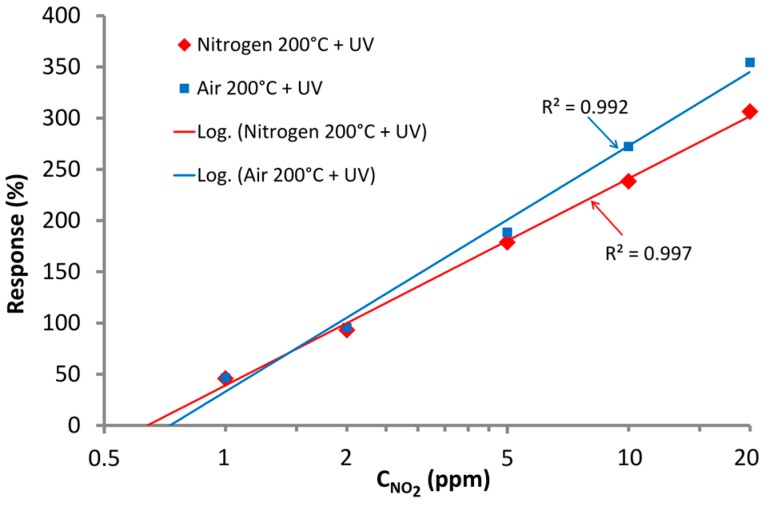
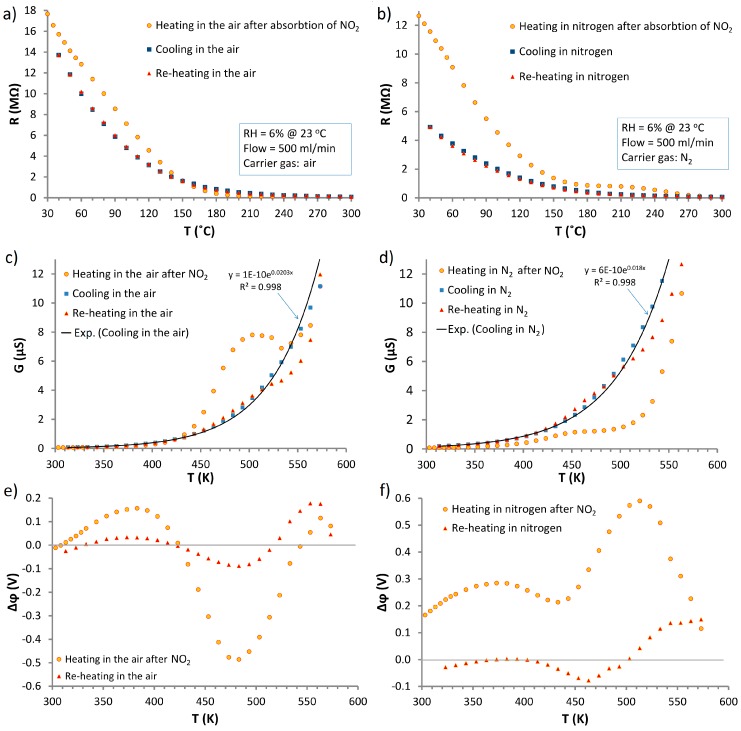
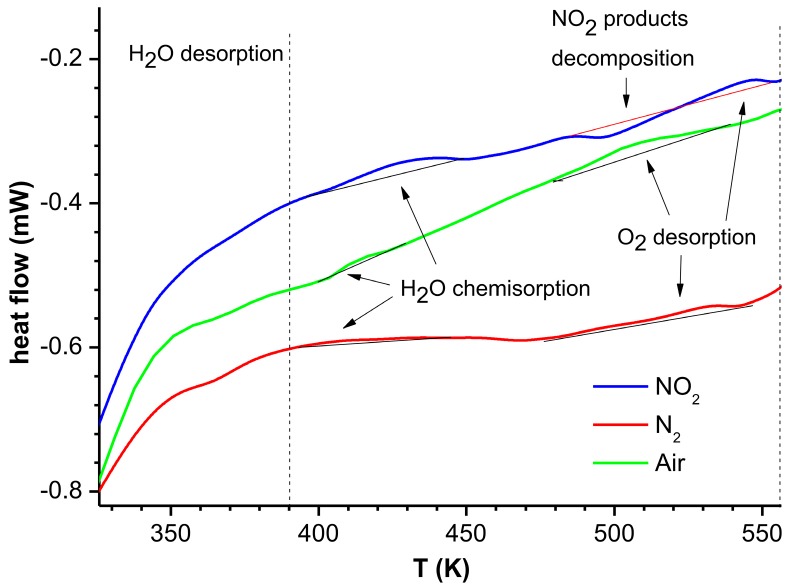
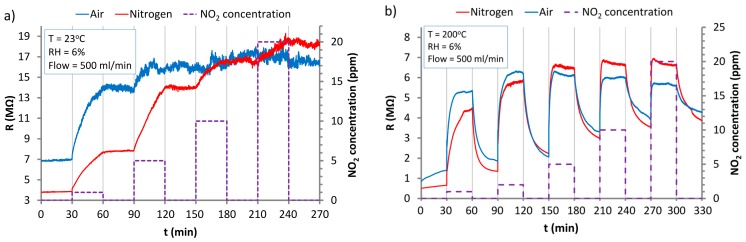
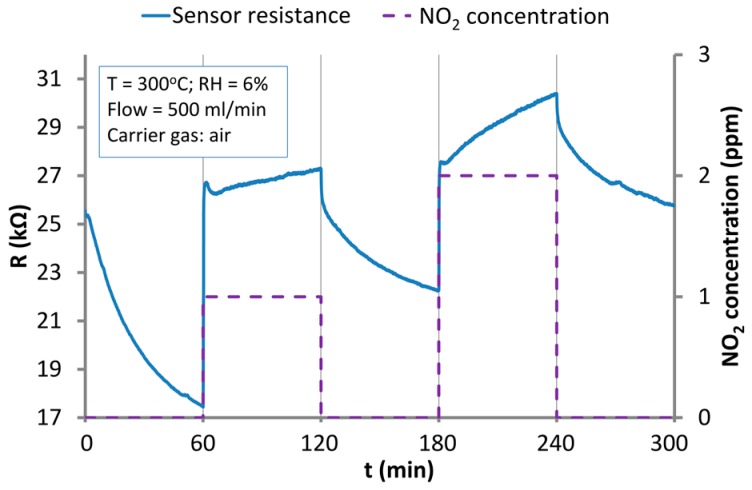
The main object of this study is the improvement of the dynamics of NO₂ sensors based on ZnO nanostructures. Investigations presented in this paper showed that the combination of temperature and ultraviolet (UV) activation of the sensors can significantly decrease the sensor response and regeneration times. In comparison with the single activation method (elevated temperature or UV), these times for 1 ppm of NO₂ decreased from about 10 min (or more) to less than 40 s. In addition, at the optimal conditions (200 °C and UV), sensors were very stable, were fully scalable (in the range on NO₂ concentration of 1-20 ppm) and baseline drift was significantly reduced. Furthermore, in this paper, extensive studies of the influence of temperature and carrier gas (nitrogen and air) on NO₂ sensing properties of the ZnO nanostructures were conducted. The NO₂ sensing mechanisms of the sensors operating at elevated temperatures and under UV irradiation were also discussed. Our study showed that sensor responses to NO₂ and response/regeneration times are comparable from sensor to sensor in air and nitrogen conditions, which suggests that the proposed simple technology connected with well-chosen operation conditions is repeatable. The estimated limit of detection of the sensors is within the level of ≈800 ppb in nitrogen and ≈700 ppb in air.
本研究的主要目标是改善基于ZnO纳米结构的NO₂传感器的动力学性能。本文所呈现的研究表明,传感器的温度和紫外线(UV)激活相结合可显著缩短传感器的响应和再生时间。与单一激活方法(升高温度或UV)相比,对于1 ppm的NO₂,这些时间从约10分钟(或更长)减少到不到40秒。此外,在最佳条件(200°C和UV)下,传感器非常稳定,具有完全可扩展性(在NO₂浓度为1 - 20 ppm范围内),并且基线漂移显著降低。此外,本文还对温度和载气(氮气和空气)对ZnO纳米结构的NO₂传感特性的影响进行了广泛研究。还讨论了在升高温度和UV照射下工作的传感器的NO₂传感机制。我们的研究表明,在空气和氮气条件下,传感器对NO₂的响应以及响应/再生时间在不同传感器之间具有可比性,这表明所提出的与精心选择的操作条件相关的简单技术具有可重复性。传感器在氮气中的估计检测限约为800 ppb,在空气中约为700 ppb。