School of Engineering, University of Birmingham, Birmingham B15 2TT, UK.
Department of Sport and Health Sciences, Technische Universität Munchen, 80992 Munchen, Germany.
Sensors (Basel). 2017 Oct 11;17(10):2308. doi: 10.3390/s17102308.
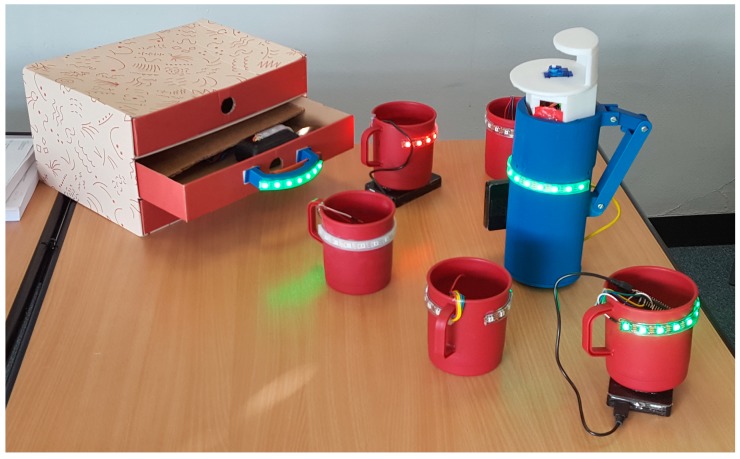
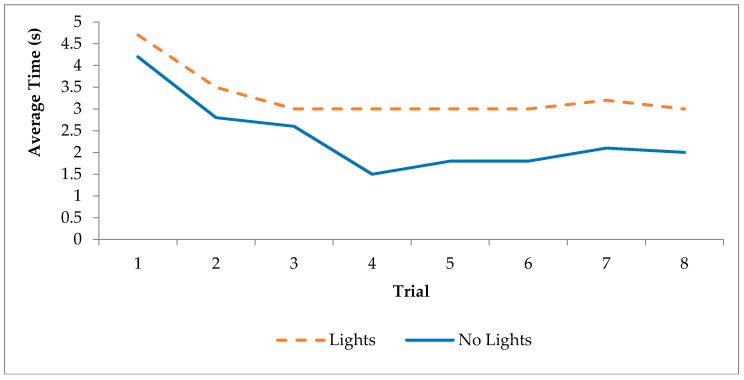
We explore the ways in which animate objects can be used to cue actions as part of coaching in Activities of Daily Living (ADL). In this case, changing the appearance or behavior of a physical object is intended to cue actions which are appropriate for a given context. The context is defined by the intention of the users, the state of the objects and the tasks for which these objects can be used. We present initial design prototypes and simple user trials which explore the impact of different cues on activity. It is shown that raising the handle of a jug, for example, not only cues the act of picking up the jug but also encourages use of the hand adjacent to the handle; that combinations of lights (on the objects) and auditory cues influence activity through reducing uncertainty; and that cueing can challenge pre-learned action sequences. We interpret these results in terms of the idea that the animate objects can be used to create affording situations, and discuss implications of this work to support relearning of ADL following brain damage or injury, such as might arise following a stroke.
我们探讨了如何使用有生命的物体作为动作提示,作为日常生活活动(ADL)指导的一部分。在这种情况下,改变物理对象的外观或行为旨在提示适合给定上下文的动作。上下文由用户的意图、对象的状态以及这些对象可用于的任务定义。我们展示了初步的设计原型和简单的用户试用,探索了不同提示对活动的影响。结果表明,例如,提起水壶的把手不仅提示拿起水壶的动作,还鼓励使用靠近把手的手;物体上的灯光和听觉提示的组合通过减少不确定性来影响活动;提示可以挑战预先学习的动作序列。我们根据有生命的物体可以用来创造有利情境的想法来解释这些结果,并讨论了这项工作对支持脑损伤或损伤后 ADL 重新学习的影响,例如中风后可能出现的情况。