Centre for International Health, Department of Global Public Health and Primary Care, University of Bergen, Bergen, Norway.
Department of Reproductive Health and Health Service Management, School of Public Health, Addis Ababa University, Addis Ababa, Ethiopia.
PLoS One. 2017 Oct 11;12(10):e0185315. doi: 10.1371/journal.pone.0185315. eCollection 2017.
While recognizing the recent remarkable achievement in the global malaria reduction, the disease remains a challenge to the malaria endemic countries in Africa. Beyond the huge health consequence of malaria, policymakers need to be informed about the economic burden of the disease to the households. However, evidence on the economic burden of malaria in Ethiopia is scanty. The aims of this study were to estimate the economic burden of malaria episode and to identify predictors of cost variability to the rural households.
A prospective costing approach from a household perspective was employed. A total of 190 malaria patients were enrolled to the study from three health centers and nine health posts in Adami Tullu district in south-central Ethiopia, in 2015. Primary data were collected on expenditures due to malaria, forgone working days because of illness, socioeconomic and demographic situation, and households' assets. Quantile regression was applied to predict factors associated with the cost variation. Socioeconomic related inequality was measured using concentration index and concentration curve.
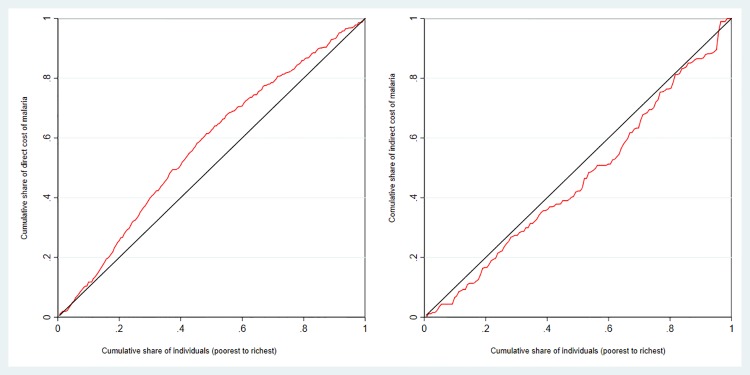
The median cost of malaria per episode to the household was USD 5.06 (IQR: 2.98-8.10). The direct cost accounted for 39%, while the indirect counterpart accounted for 61%. The history of malaria in the last six months and the level of the facility visited in the health system predominantly influenced the direct cost. The indirect cost was mainly influenced by the availability of antimalarial drugs in the health facility. The concentration curve and the concentration index for direct cost indicate significant pro-rich inequality. Plasmodium falciparum is significantly more costly for households compared to Plasmodium vivax.
The economic burden of malaria to the rural households in Ethiopia was substantial-mainly to the poor-indicating that reducing malaria burden could contribute to the poverty reduction as well.
尽管近年来在全球疟疾减少方面取得了显著成就,但该疾病仍然是非洲疟疾流行国家面临的挑战。除了疟疾对健康造成的巨大影响外,政策制定者还需要了解疾病给家庭带来的经济负担。然而,关于埃塞俄比亚疟疾经济负担的证据很少。本研究旨在估计疟疾发作的经济负担,并确定农村家庭成本变化的预测因素。
采用从家庭角度进行的前瞻性成本分析方法。2015 年,在埃塞俄比亚中南部的 Adami Tullu 区的三个卫生中心和九个卫生所共招募了 190 名疟疾患者。收集了与疟疾相关的支出、因疾病而损失的工作天数、社会经济和人口统计情况以及家庭资产等方面的原始数据。应用分位数回归来预测与成本变化相关的因素。使用集中指数和集中曲线来衡量与社会经济相关的不平等。
每个疟疾发作对家庭的中位数费用为 5.06 美元(IQR:2.98-8.10)。直接成本占 39%,而间接成本占 61%。过去六个月的疟疾史和卫生系统中就诊机构的级别主要影响直接成本。间接成本主要受卫生机构中抗疟药物的供应情况影响。直接成本的集中曲线和集中指数表明存在显著的贫富不均。与间日疟原虫相比,恶性疟原虫对家庭的费用更高。
疟疾给埃塞俄比亚农村家庭带来的经济负担相当大——主要是给穷人带来负担——这表明减轻疟疾负担也有助于减贫。