Departments of Internal Medicine-Nephrology.
Bioinformatics and Molecular Phenotyping, Michigan Regional Comprehensive Metabolomics Resource Core, University of Michigan, Ann Arbor, Michigan.
J Am Soc Nephrol. 2018 Jan;29(1):295-306. doi: 10.1681/ASN.2017030350. Epub 2017 Oct 11.
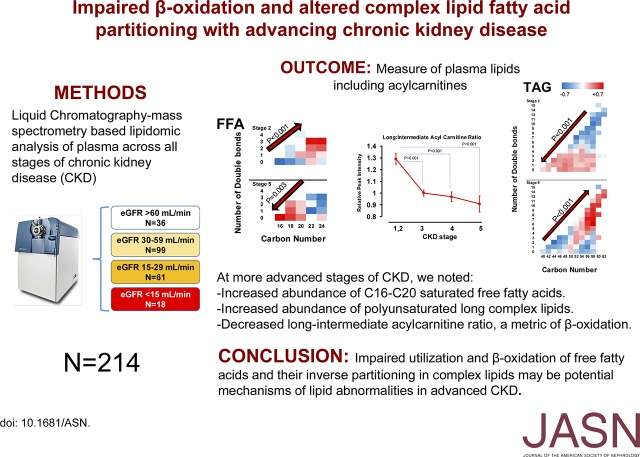
Studies of lipids in CKD, including ESRD, have been limited to measures of conventional lipid profiles. We aimed to systematically identify 17 different lipid classes and associate the abundance thereof with alterations in acylcarnitines, a metric of -oxidation, across stages of CKD. From the Clinical Phenotyping Resource and Biobank Core (CPROBE) cohort of 1235 adults, we selected a panel of 214 participants: 36 with stage 1 or 2 CKD, 99 with stage 3 CKD, 61 with stage 4 CKD, and 18 with stage 5 CKD. Among participants, 110 were men (51.4%), 64 were black (29.9%), and 150 were white (70.1%), and the mean (SD) age was 60 (16) years old. We measured plasma lipids and acylcarnitines using liquid chromatography-mass spectrometry. Overall, we identified 330 different lipids across 17 different classes. Compared with earlier stages, stage 5 CKD associated with a higher abundance of saturated C16-C20 free fatty acids (FFAs) and long polyunsaturated complex lipids. Long-chain-to-intermediate-chain acylcarnitine ratio, a marker of efficiency of -oxidation, exhibited a graded decrease from stage 2 to 5 CKD (<0.001). Additionally, multiple linear regression revealed that the long-chain-to-intermediate-chain acylcarnitine ratio inversely associated with polyunsaturated long complex lipid subclasses and the C16-C20 FFAs but directly associated with short complex lipids with fewer double bonds. We conclude that increased abundance of saturated C16-C20 FFAs coupled with impaired -oxidation of FFAs and inverse partitioning into complex lipids may be mechanisms underpinning lipid metabolism changes that typify advancing CKD.
对 CKD(包括终末期肾病)中的脂质的研究仅限于常规脂质谱的测量。我们旨在系统地识别 17 种不同的脂质类别,并将其丰度与酰基辅酶 A(β-氧化的一种衡量标准)在 CKD 各个阶段的变化相关联。我们从 CPROBE 队列(包含 1235 名成年人)中选取了一个由 214 名参与者组成的小组:36 名患有 1 或 2 期 CKD,99 名患有 3 期 CKD,61 名患有 4 期 CKD,18 名患有 5 期 CKD。参与者中,110 名男性(51.4%),64 名黑人(29.9%),150 名白人(70.1%),平均年龄(标准差)为 60(16)岁。我们使用液相色谱-质谱法测量了血浆脂质和酰基辅酶 A。总体而言,我们在 17 种不同的类别中识别出 330 种不同的脂质。与早期阶段相比,5 期 CKD 与更多的饱和 C16-C20 游离脂肪酸(FFA)和长多不饱和复杂脂质有关。长链到中链酰基辅酶 A 比,β-氧化效率的标志物,从 2 期到 5 期 CKD 呈梯度下降(<0.001)。此外,多元线性回归显示,长链到中链酰基辅酶 A 比与多不饱和长链复杂脂质亚类和 C16-C20 FFA 呈负相关,但与双键较少的短链复杂脂质呈正相关。我们的结论是,增加的饱和 C16-C20 FFA 丰度加上 FFA 的β-氧化受损和反向分配到复杂脂质中,可能是导致典型进展性 CKD 脂质代谢变化的机制。