Hirve Siddhivinayak, Kroeger Axel, Matlashewski Greg, Mondal Dinesh, Banjara Megha Raj, Das Pradeep, Be-Nazir Ahmed, Arana Byron, Olliaro Piero
Global Influenza Programme, World Health Organization, Geneva, Switzerland.
Centre for Medicine and Society and Centre for Anthropology, Freiburg University, Freiburg, Germany.
PLoS Negl Trop Dis. 2017 Oct 12;11(10):e0005889. doi: 10.1371/journal.pntd.0005889. eCollection 2017 Oct.
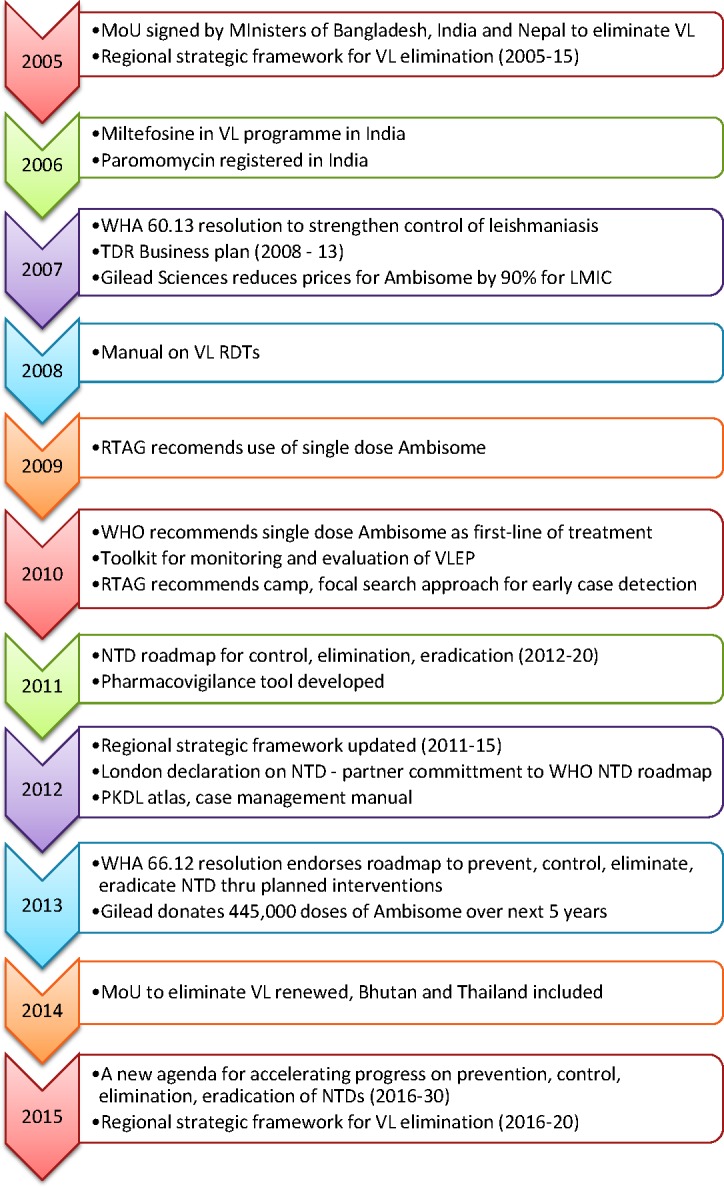
The decade following the Regional Strategic Framework for Visceral Leishmaniasis (VL) elimination in 2005 has shown compelling progress in the reduction of VL burden in the Indian subcontinent. The Special Programme for Research and Training in Tropical Diseases (TDR), hosted by the World Health Organization (WHO) and other stakeholders, has coordinated and financed research for the development of new innovative tools and strategies to support the regional VL elimination initiative. This paper describes the process of the TDR's engagement and contribution to this initiative.
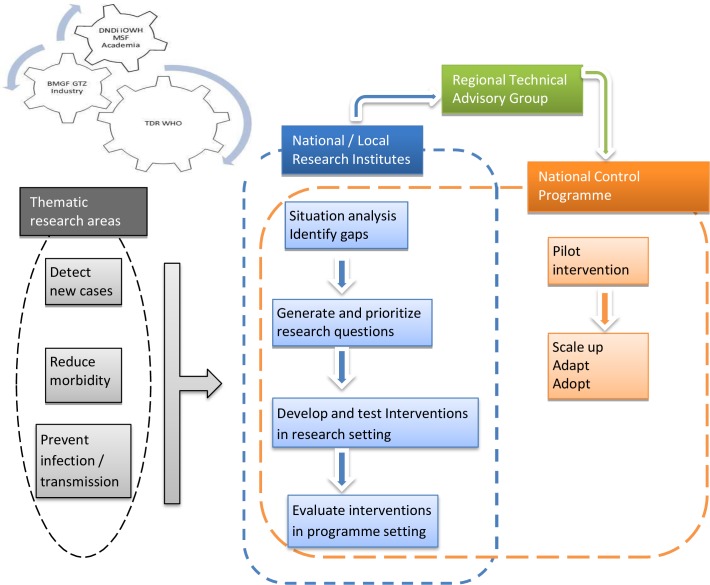
METHODOLOGY/PRINCIPAL FINDINGS: Multiple databases were searched to identify 152 scientific papers and reports with WHO funding or authorship affiliation around the following 3 framework strategies: detection of new cases, morbidity reduction, and prevention of infection. TDR has played a critical role in the evaluation and subsequent use of the 39-aminoacid-recombinant kinesin antigen (rK39) rapid diagnostic test (RDT) as a confirmatory test for VL in the national program. TDR has supported the clinical research and development of miltefosine and single-dose liposomal amphotericin B as a first-line treatment against VL. TDR has engaged with in-country researchers, national programme managers, and partners to generate evidence-based interventions for early detection and treatment of VL patients. TDR evaluated the quality, community acceptance, and cost effectiveness of indoor residual spraying, insecticide-treated bed nets, insecticide-impregnated durable wall linings, insecticidal paint, and environmental management as tools for integrated vector management in reducing sandfly density.
CONCLUSIONS/SIGNIFICANCE: TDR's engagement with country policy makers, scientists, and clinicians in the development of effective diagnosis, treatment, case detection, and vector control represents an important example of TDR's stewardship toward the elimination of VL in the Indian subcontinent.
2005年《内脏利什曼病消除区域战略框架》发布后的十年里,印度次大陆在减轻内脏利什曼病负担方面取得了显著进展。由世界卫生组织(WHO)及其他利益相关方主办的热带病研究和培训特别规划(TDR),协调并资助了相关研究,以开发新的创新工具和策略,支持区域内脏利什曼病消除倡议。本文描述了TDR参与该倡议并为之做出贡献的过程。
方法/主要发现:检索了多个数据库,以识别152篇由WHO资助或作者所属机构参与的科学论文和报告,这些论文和报告围绕以下3个框架策略展开:新病例检测、发病率降低以及感染预防。TDR在评估39氨基酸重组驱动蛋白抗原(rK39)快速诊断检测(RDT)并随后将其用作国家项目中内脏利什曼病的确证检测方面发挥了关键作用。TDR支持了米替福新和单剂量脂质体两性霉素B作为抗内脏利什曼病一线治疗药物的临床研发。TDR与国内研究人员、国家项目管理人员及合作伙伴合作,制定基于证据的干预措施,用于早期检测和治疗内脏利什曼病患者。TDR评估了室内滞留喷洒、经杀虫剂处理的蚊帐、经杀虫剂浸渍的耐用墙衬、杀虫涂料以及环境管理作为综合病媒管理工具在降低白蛉密度方面的质量、社区接受度和成本效益。
结论/意义:TDR与国家政策制定者、科学家和临床医生合作,开发有效的诊断、治疗、病例检测和病媒控制方法,这是TDR在印度次大陆消除内脏利什曼病方面发挥管理作用的一个重要范例。