Beckman Joshua A, Wood Brian R, Ard Kevin L, Price Christin N, Solomon Daniel A, Zuflacht Jonah P, Milian Jessica, Prenner Joshua C, Sax Paul E
Cardiovascular Division, Vanderbilt University Medical Center, Nashville, Tennessee, United States of America.
Division of Infectious Disease, Brigham and Women's Hospital, Boston, Massachusetts, United States of America.
PLoS One. 2017 Oct 12;12(10):e0181993. doi: 10.1371/journal.pone.0181993. eCollection 2017.
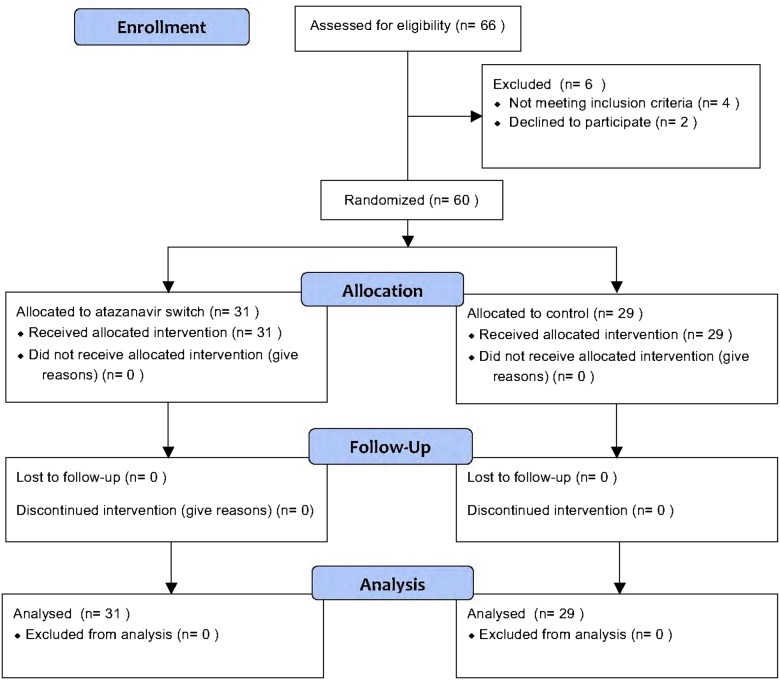
Bilirubin acts as a potent endogenous antioxidant, with higher concentrations associated with lower rates of CVD; the antiretroviral drug atazanavir (ATV) increases bilirubin levels but may also increase von Willebrand factor levels. We tested the hypothesis that increasing endogenous bilirubin using ATV would improve cardiometabolic risk factors and vascular function in older patients with HIV. Ninety participants were enrolled in two study protocols. In protocol 1, we evaluated markers of inflammation, thrombosis, and conduit artery endothelial function in subjects on non-ATV containing regimens. Participants were randomly assigned to continue baseline treatment or switch to an ATV-based regimen. Measurements were made at baseline and 28 days. In the protocol 2, we enrolled 30 subjects who received atazanavir for more than one year and were compared to the aim 1 protocol subjects at baseline. 60 subjects were enrolled in the first protocol (mean age 53, +/- 6 years), with 31 randomized to ATV and 29 continuing baseline treatment. Atazanavir significantly increased serum total bilirubin levels (p<0.001) and acutely but not chronically plasma total antioxidant capacity (p<0.001). An increase in von Willebrand Factor (p<0.001) and reduction in hs-CRP (p = 0.034) were noted. No changes were seen in either flow-mediated endothelium-dependent or vasodilation. In cross-sectional analysis (second protocol), similar findings were seen in the baseline attributes of non-atazanavir-based and long-term atazanavir users. Increasing serum bilirubin levels with atazanavir in subjects with HIV reduces hs-CRP, temporarily reduces oxidative stress, but increases von Willebrand Factor. Atazanavir does not improve endothelial function of conduit arteries.
ClinicalTrials.gov NCT03019783.
胆红素是一种强大的内源性抗氧化剂,浓度越高,心血管疾病(CVD)发生率越低;抗逆转录病毒药物阿扎那韦(ATV)可提高胆红素水平,但也可能升高血管性血友病因子水平。我们检验了这样一个假设,即使用阿扎那韦提高内源性胆红素水平会改善老年HIV患者的心脏代谢危险因素和血管功能。90名参与者被纳入两项研究方案。在方案1中,我们评估了接受不含阿扎那韦方案治疗的受试者的炎症、血栓形成和 conduit 动脉内皮功能标志物。参与者被随机分配继续基线治疗或改用基于阿扎那韦的方案。在基线和28天时进行测量。在方案2中,我们纳入了30名接受阿扎那韦治疗超过一年的受试者,并在基线时与方案1的受试者进行比较。60名受试者被纳入第一个方案(平均年龄53±6岁),其中31人随机接受阿扎那韦治疗,29人继续基线治疗。阿扎那韦显著提高了血清总胆红素水平(p<0.001),并急性但非慢性地提高了血浆总抗氧化能力(p<0.001)。观察到血管性血友病因子增加(p<0.001),高敏C反应蛋白降低(p = 0.034)。在血流介导的内皮依赖性或血管舒张方面均未观察到变化。在横断面分析(第二个方案)中,在未使用阿扎那韦的受试者和长期使用阿扎那韦的受试者的基线特征中观察到了类似的结果。在HIV受试者中,用阿扎那韦提高血清胆红素水平可降低高敏C反应蛋白,暂时降低氧化应激,但会增加血管性血友病因子。阿扎那韦不能改善 conduit 动脉的内皮功能。
ClinicalTrials.gov NCT03019783 。