Mancini Marcello, Salomone Megna Angelo, Ragucci Monica, De Luca Massimo, Marino Marsilia Giuseppina, Nardone Gerardo, Coccoli Pietro, Prinster Anna, Mannelli Lorenzo, Vergara Emilia, Monti Serena, Liuzzi Raffaele, Incoronato Mariarosaria
Institute of Biostructure and Bioimaging, National Research Council, Naples, Italy.
Division of Infectious Diseases, Rummo Hospital, Benevento, Italy.
PLoS One. 2017 Oct 12;12(10):e0185391. doi: 10.1371/journal.pone.0185391. eCollection 2017.
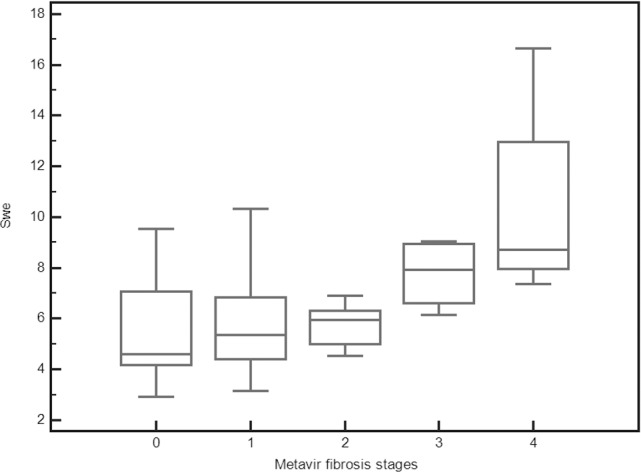
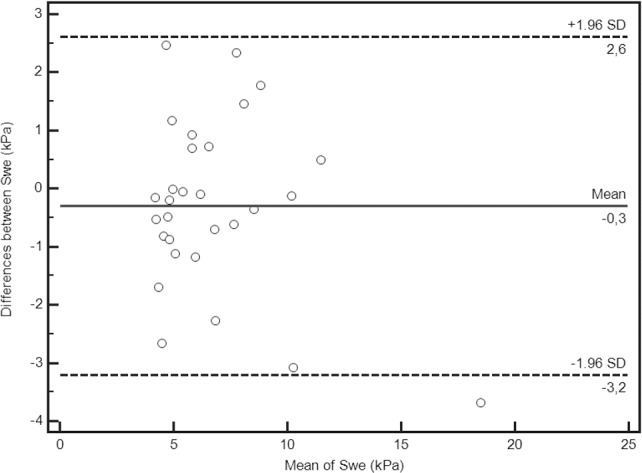
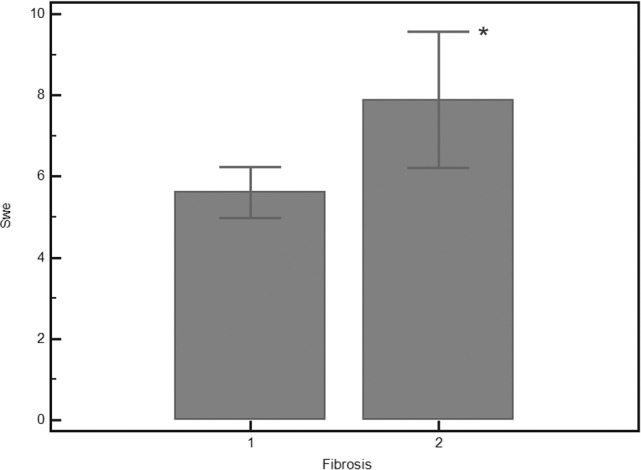
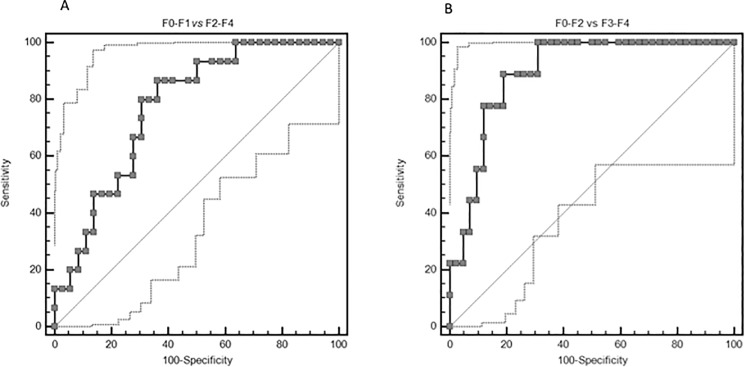
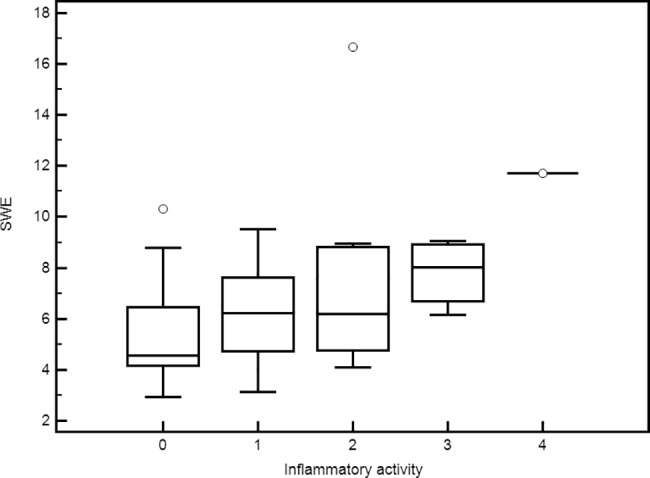
The presence of significant fibrosis is an indicator for liver disease staging and prognosis. The aim of the study was to determine reproducibility of real-time shear wave elastography using a hepatic biopsy as the reference standard to identify patients with chronic liver disease. Forty patients with chronic liver disease and 12 normal subjects received shear wave elastography performed by skilled operators. Interoperator reproducibility was studied in 29 patients. Fibrosis was evaluated using the Metavir score. The median and range shear wave elastography values in chronic liver disease subjects were 6.15 kPa and 3.14-16.7 kPa and were 4.49 kPa and 2.92-7.32 kPa in normal subjects, respectively. With respect to fibrosis detected by liver biopsy, shear wave elastography did not change significantly between F0 and F1 (p = 0.334), F1 and F2 (p = 0.611), or F3 and F4 (0.327); a significant difference was observed between the F0-F2 and F3-F4 groups (p = 0.002). SWE also correlated with inflammatory activity (Rs = 0.443, p = 0.0023) and ALT levels (Rs = 0.287, p = 0.0804). Age, sex and body mass index did not affect shear wave elastography measurements. Using receiver operator characteristic curves, two threshold values for shear wave elastography were identified: 5.62 kPa for patients with fibrosis (≥F2; sensitivity 80%, specificity 69.4%, and accuracy 77%) and 7.04 kPa for patients with severe fibrosis (≥F3; sensitivity 88.9%, specificity 81%, and accuracy 89%). Overall interobserver agreement was excellent and was analysed using an interclass correlation coefficient (0.94; CI 0.87-0.97).This study shows that shear wave elastography executed by skilled operators can be performed on almost all chronic liver disease patients with high reproducibility. It is not influenced by age, sex or body mass index, identifies severely fibrotic patients and is also related to inflammatory activity.
显著纤维化的存在是肝病分期和预后的一个指标。本研究的目的是确定以肝活检作为参考标准的实时剪切波弹性成像技术在识别慢性肝病患者方面的可重复性。40例慢性肝病患者和12例正常受试者接受了由熟练操作人员进行的剪切波弹性成像检查。对29例患者进行了操作者间可重复性研究。使用梅塔维(Metavir)评分评估纤维化情况。慢性肝病受试者的剪切波弹性成像值中位数和范围分别为6.15 kPa和3.14 - 16.7 kPa,正常受试者分别为4.49 kPa和2.92 - 7.32 kPa。关于肝活检检测到的纤维化,在F0和F1之间(p = 0.334)、F1和F2之间(p = 0.611)或F3和F4之间(0.327),剪切波弹性成像无显著变化;在F0 - F2组和F3 - F4组之间观察到显著差异(p = 0.002)。剪切波弹性成像(SWE)也与炎症活动(Rs = 0.443,p = 0.0023)和谷丙转氨酶(ALT)水平(Rs = 0.287,p = 0.0804)相关。年龄、性别和体重指数不影响剪切波弹性成像测量。使用受试者工作特征曲线,确定了剪切波弹性成像的两个阈值:纤维化患者(≥F2)为5.62 kPa(灵敏度80%,特异性69.4%,准确率77%),严重纤维化患者(≥F3)为7.04 kPa(灵敏度88.9%,特异性81%,准确率89%)。观察者间总体一致性良好,并使用组内相关系数进行分析(0.94;可信区间0.87 - 0.97)。本研究表明,由熟练操作人员执行的剪切波弹性成像几乎可以对所有慢性肝病患者进行,且具有高可重复性。它不受年龄、性别或体重指数的影响,能识别严重纤维化患者,并且还与炎症活动有关。