Bukhsh Allah, Lee Shaun Wen Huey, Pusparajah Priyia, Schmitt Andreas, Khan Tahir Mehmood
School of Pharmacy, Monash University, Jalan Lagoon Selatan, 47500, Bandar Sunway, Selangor, Malaysia.
Institute of Pharmaceutical Sciences, University of Veterinary & Animal Sciences, 54000, Lahore, Pakistan.
Health Qual Life Outcomes. 2017 Oct 12;15(1):200. doi: 10.1186/s12955-017-0776-8.
Numerous study tools on diabetes self-care have been introduced; however, most existing tools do not show expectable and meaningful correlations with patients' glycaemic control. The Diabetes Self-Management Questionnaire (DSMQ) was designed to appraise self-care activities which can predict glycaemic control outcomes. However, this tool has not been validated in Pakistan. Therefore, the aim of this study was to translate and examine the psychometric properties of the Urdu version of DSMQ among type 2 diabetes patients.
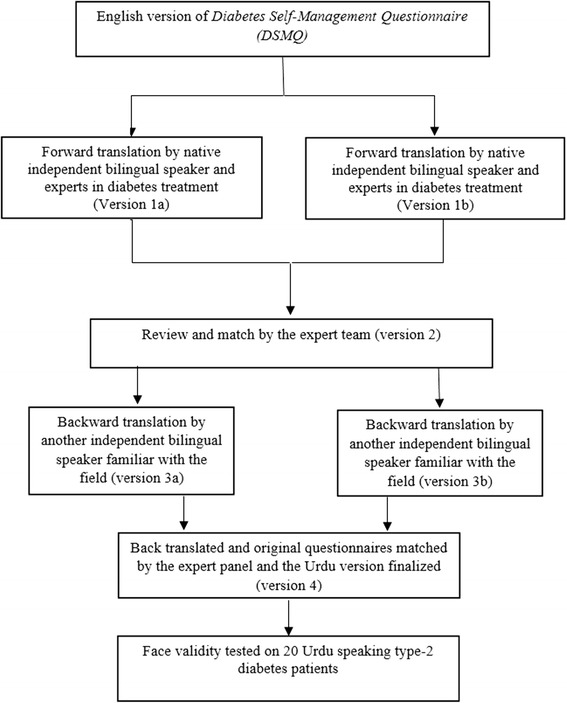
Standard forward-backward translation was used to translate the DSMQ into Urdu language. A convenience sample of 130 patients with type 2 diabetes was collected to assess the Urdu version's psychometric properties. Reliability was assessed by Cronbach's coefficient α and validity was assessed using confirmatory factor analysis and criterion-related correlations.
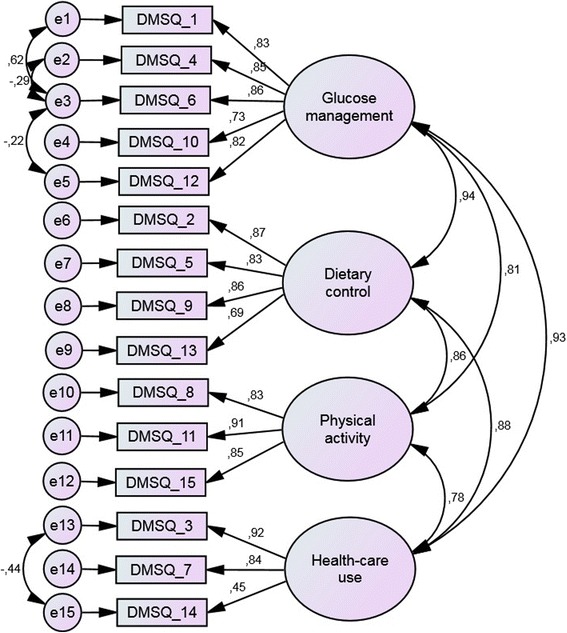
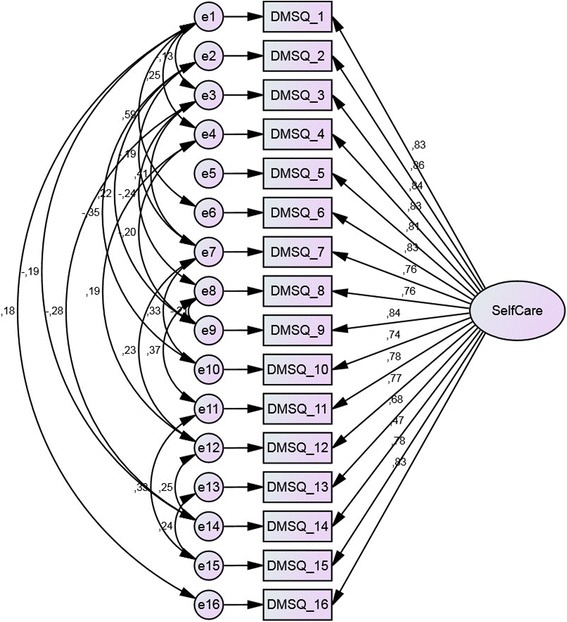
High internal consistency was found for all DSMQ scales (Sum scale: α = 0.96, Glucose Management: 0.91; Dietary Control: 0.88; Physical Activity: 0.89; Health-Care Use: 0.73). The DSMQ subscales showed significant correlations with HbA1c (Glucose Management: -0.75; Dietary Control: -0.76; Physical Activity: -0.71; Health-Care Use: -0.64; Sum Scale: -0.78; all p < 0.001). However, when associations with HbA1c were assessed in one multiple linear regression model, only Glucose Management and Dietary Control were significantly associated with lower HbA1c values (Beta = -0.42, p = 0.004 and Beta = -0.30, p = 0.028, respectively), while Physical Activity and Health-Care Use were not (p > 0.05). Adequate fit to the data was achieved for single factor model after successively modelling all significant correlations between the items' error terms, with Chi = 106.6, df = 84, p = 0.049; TLI = 0.98, CFI = 0.99 and RMSEA = 0.05 (90% CI 0.01-0.07). Whereas a comparatively lower fit indices to data were observed in case of four factor model.
The findings support the Urdu version of the DSMQ as a reliable and valid instrument for assessing self-care activities associated with glycaemic control in type 2 diabetes patients.
已经推出了许多糖尿病自我护理的研究工具;然而,大多数现有工具与患者的血糖控制之间并未显示出预期的有意义的相关性。糖尿病自我管理问卷(DSMQ)旨在评估能够预测血糖控制结果的自我护理活动。然而,该工具在巴基斯坦尚未得到验证。因此,本研究的目的是翻译并检验DSMQ乌尔都语版本在2型糖尿病患者中的心理测量特性。
采用标准的前后翻译法将DSMQ翻译成乌尔都语。收集了130例2型糖尿病患者的便利样本,以评估乌尔都语版本的心理测量特性。通过克朗巴赫系数α评估信度,使用验证性因素分析和与标准相关的相关性评估效度。
所有DSMQ量表均具有较高的内部一致性(总和量表:α = 0.96,血糖管理:0.91;饮食控制:0.88;体育活动:0.89;医疗保健利用:0.73)。DSMQ子量表与糖化血红蛋白显示出显著相关性(血糖管理:-0.75;饮食控制:-0.76;体育活动:-0.71;医疗保健利用:-0.64;总和量表:-0.78;所有p < 0.001)。然而,当在一个多元线性回归模型中评估与糖化血红蛋白的关联时,只有血糖管理和饮食控制与较低的糖化血红蛋白值显著相关(β = -0.42,p = 0.004和β = -0.30,p = 0.028),而体育活动和医疗保健利用则不然(p > 0.05)。在对项目误差项之间的所有显著相关性进行连续建模后,单因素模型对数据的拟合良好,卡方 = 106.6,自由度 = 84,p = 0.049;TLI = 0.98,CFI = 0.99,RMSEA = 0.05(90% CI 0.01 - 0.07)。而在四因素模型中观察到对数据的拟合指数相对较低。
研究结果支持DSMQ乌尔都语版本作为评估2型糖尿病患者血糖控制相关自我护理活动的可靠有效工具。