Ortega Joseph T, Suárez Alirica I, Serrano Maria L, Baptista Jani, Pujol Flor H, Rangel Hector R
Laboratorio de Virología Molecular, Centro de Microbiología y Biología Celular, Instituto Venezolano de Investigaciones Científicas, Caracas, Venezuela.
Laboratorio de Productos Naturales, Facultad de Farmacia, Universidad Central de Venezuela, Caracas, Venezuela.
AIDS Res Ther. 2017 Oct 12;14(1):57. doi: 10.1186/s12981-017-0183-6.
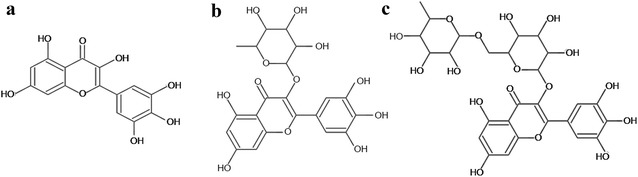
Plant extracts are sources of valuable compounds with biological activity, especially for the anti-proliferative activity against pathogens or tumor cells. Myricetin is a flavonoid found in several plants that has been described as an inhibitor of Human immunodeficiency virus type 1 (HIV-1) through its action against the HIV reverse transcriptase, but myricetin derivatives have not been fully studied. The aim of this study was to evaluate the anti-HIV-1 activity of glycosylated metabolites obtained from Marcetia taxifolia and derived from myricetin: myricetin rhamnoside and myricetin 3-(6-rhamnosylgalactoside).
Compounds were obtained from organic extracts by maceration of aerial parts of M. taxifolia. All biological assays were performed in the MT4 cell line. Antiviral activity was measured as inhibition of p24 and reverse transcriptase with a fluorescent assay.
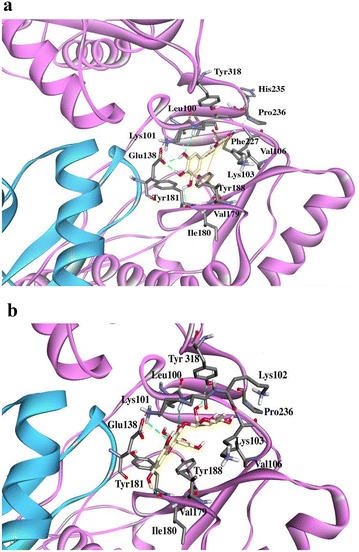
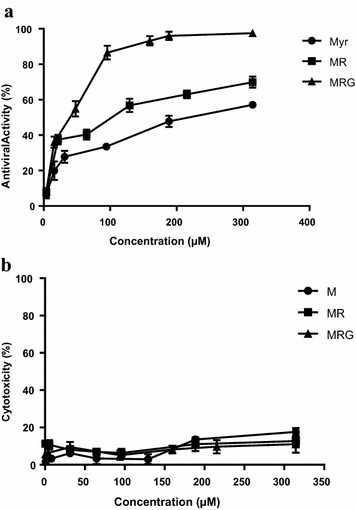
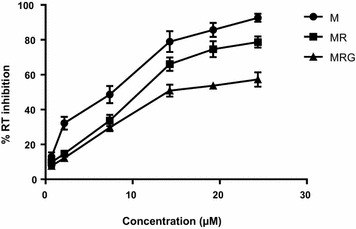
Both flavonoids have antiviral activity in vitro, with an EC50 of 120 µM for myricetin 3-rhamnoside (MR) and 45 µM for myricetin 3-(6-rhamnosylgalactoside) (MRG), both significantly lower than the EC50 of myricetin (230 µM). Although both compounds inhibited the reverse transcriptase activity, with an IC50 of 10.6 µM for MR and 13.8 µM for MRG, myricetin was the most potent, with an IC50 of 7.6 µM, and an inhibition greater than 80%. Molecular docking approach showed correlation between the free energy of binding with the assays of enzyme inhibition.
The results suggest that glycosylated moiety might enhance the anti-HIV-1 activity of myricetin, probably by favoring the internalization of the flavonoid into the cell. The inhibition of the HIV-1 reverse transcriptase is likely responsible for the antiviral activity.
植物提取物是具有生物活性的有价值化合物的来源,尤其是对病原体或肿瘤细胞具有抗增殖活性。杨梅素是一种存在于多种植物中的黄酮类化合物,已被描述为通过对HIV逆转录酶的作用来抑制1型人类免疫缺陷病毒(HIV-1),但杨梅素衍生物尚未得到充分研究。本研究的目的是评估从多花野牡丹中获得的、源自杨梅素的糖基化代谢产物:杨梅素鼠李糖苷和杨梅素3-(6-鼠李糖基半乳糖苷)的抗HIV-1活性。
通过浸渍多花野牡丹地上部分从有机提取物中获得化合物。所有生物学测定均在MT4细胞系中进行。抗病毒活性通过荧光测定法测量p24和逆转录酶的抑制情况。
两种黄酮类化合物在体外均具有抗病毒活性,杨梅素3-鼠李糖苷(MR)的半数有效浓度(EC50)为120μM,杨梅素3-(6-鼠李糖基半乳糖苷)(MRG)的EC50为45μM,两者均显著低于杨梅素的EC50(230μM)。尽管两种化合物均抑制逆转录酶活性,MR的半数抑制浓度(IC50)为10.6μM,MRG的IC50为13.8μM,但杨梅素的活性最强,IC50为7.6μM,抑制率大于80%。分子对接方法显示结合自由能与酶抑制测定之间存在相关性。
结果表明糖基化部分可能增强杨梅素的抗HIV-1活性,可能是通过促进黄酮类化合物内化进入细胞。HIV-1逆转录酶的抑制可能是抗病毒活性的原因。