Department of Global Health and Population, Harvard T H Chan School of Public Health, Boston, MA, USA.
Department of Global Health and Population, Harvard T H Chan School of Public Health, Boston, MA, USA.
Lancet Glob Health. 2017 Nov;5(11):e1123-e1132. doi: 10.1016/S2214-109X(17)30341-8.
The economic burden on households affected by tuberculosis through costs to patients can be catastrophic. WHO's End TB Strategy recognises and aims to eliminate these potentially devastating economic effects. We assessed whether aggressive expansion of tuberculosis services might reduce catastrophic costs.
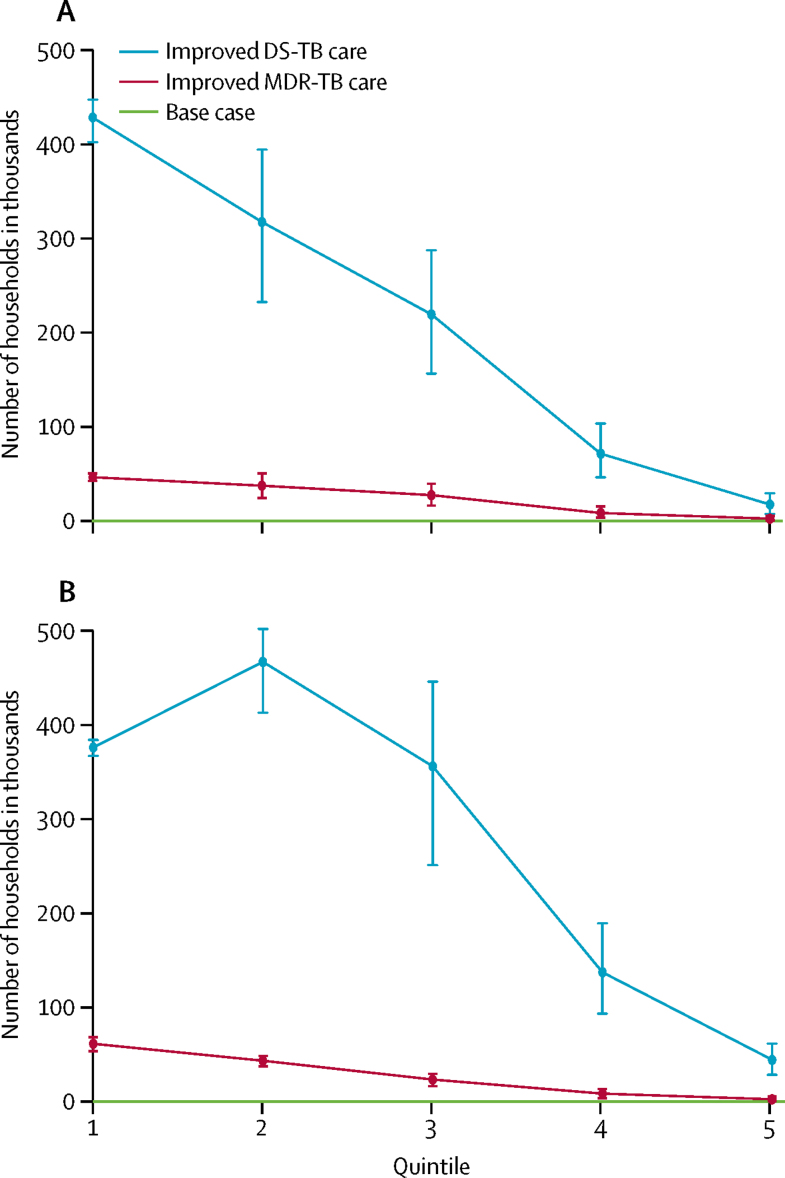
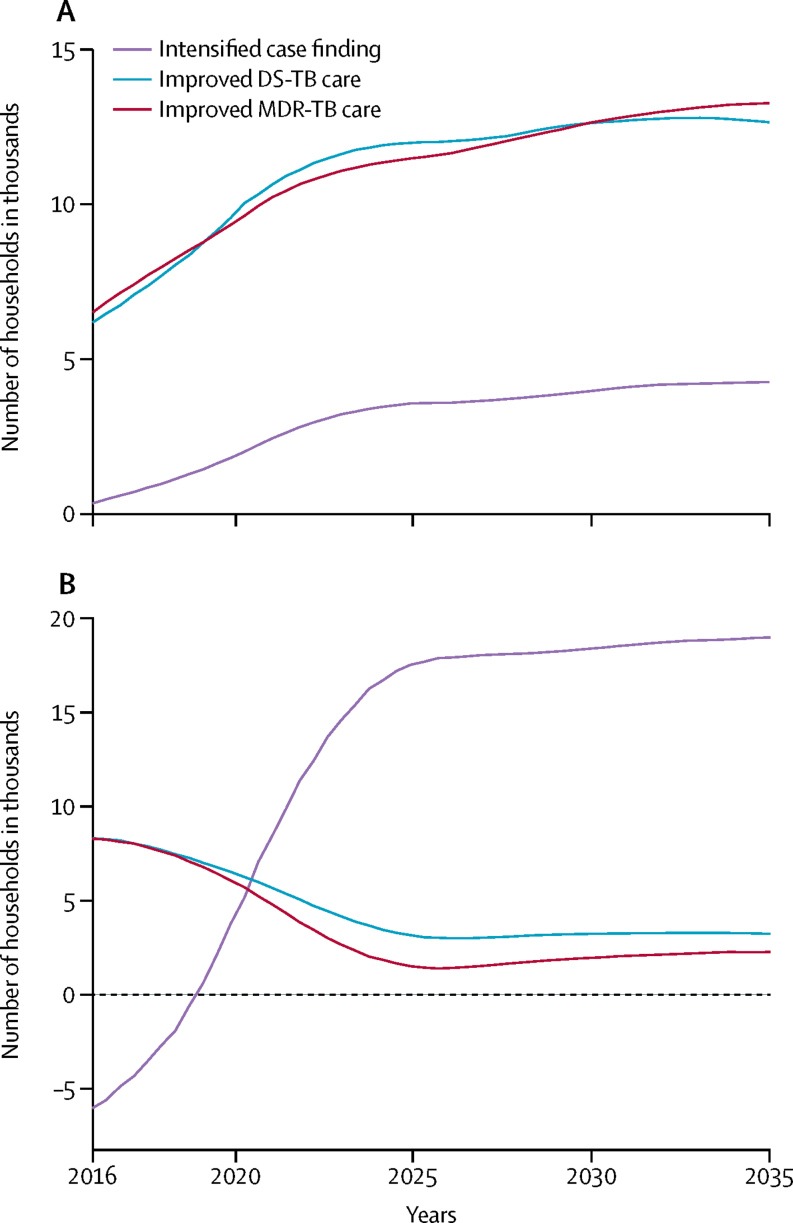
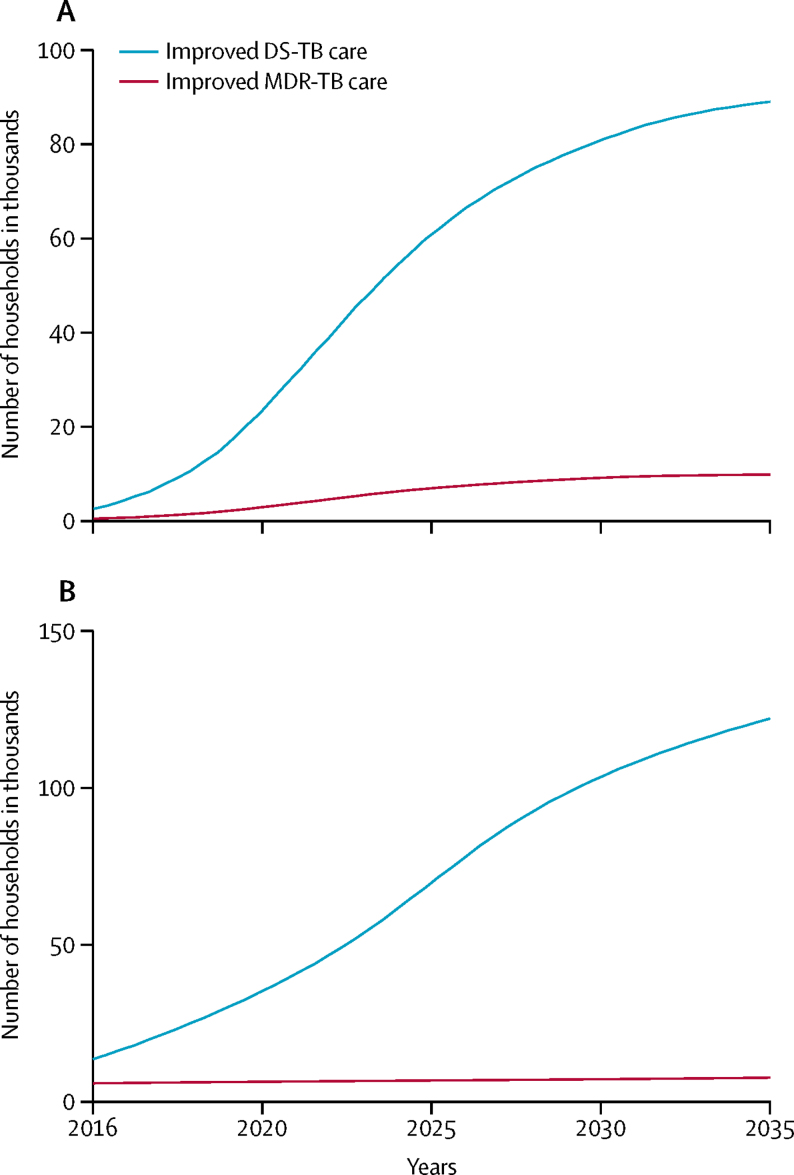
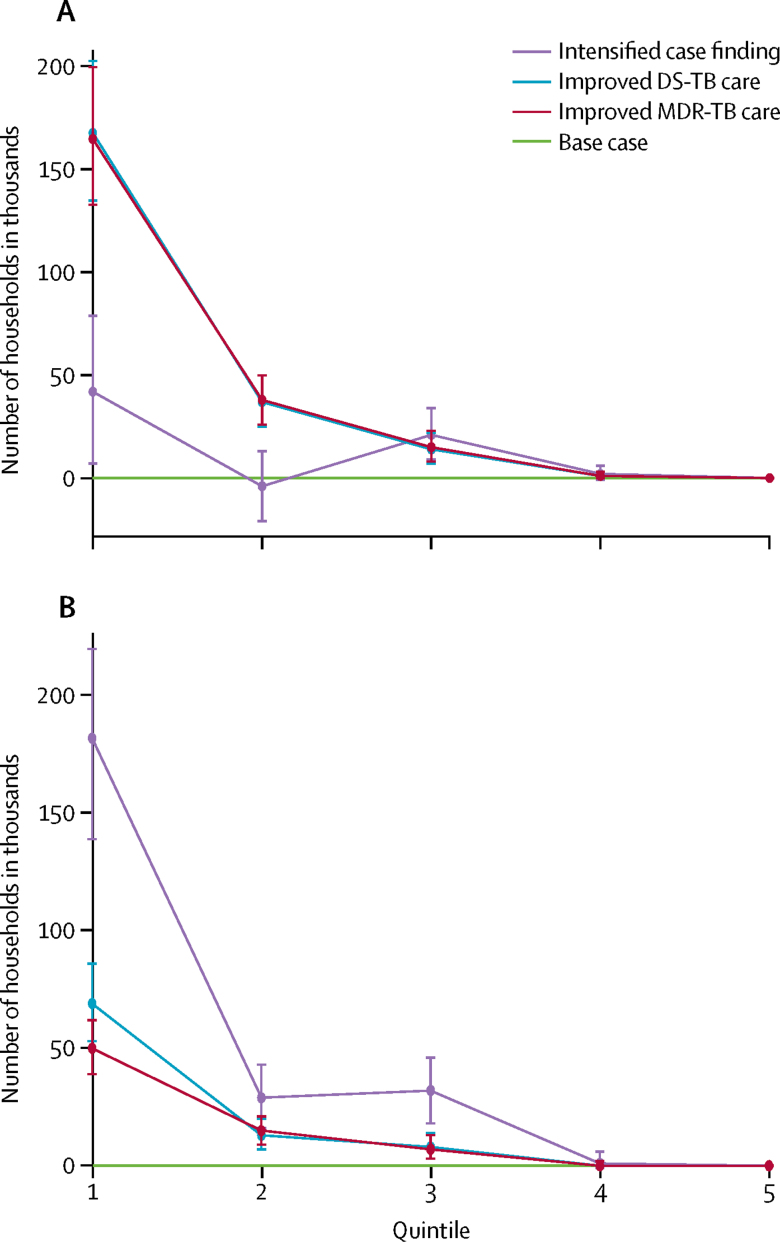
We estimated the reduction in tuberculosis-related catastrophic costs with an aggressive expansion of tuberculosis services in India and South Africa from 2016 to 2035, in line with the End TB Strategy. Using modelled incidence and mortality for tuberculosis and patient-incurred cost estimates, we investigated three intervention scenarios: improved treatment of drug-sensitive tuberculosis; improved treatment of multidrug-resistant tuberculosis; and expansion of access to tuberculosis care through intensified case finding (South Africa only). We defined tuberculosis-related catastrophic costs as the sum of direct medical, direct non-medical, and indirect costs to patients exceeding 20% of total annual household income. Intervention effects were quantified as changes in the number of households incurring catastrophic costs and were assessed by quintiles of household income.
In India and South Africa, improvements in treatment for drug-sensitive and multidrug-resistant tuberculosis could reduce the number of households incurring tuberculosis-related catastrophic costs by 6-19%. The benefits would be greatest for the poorest households. In South Africa, expanded access to care could decrease household tuberculosis-related catastrophic costs by 5-20%, but gains would be seen largely after 5-10 years.
Aggressive expansion of tuberculosis services in India and South Africa could lessen, although not eliminate, the catastrophic financial burden on affected households.
Bill & Melinda Gates Foundation.
结核病给患者带来的费用会给患者家庭带来巨大的经济负担。世卫组织的《终结结核病战略》认识到并旨在消除这些潜在的破坏性经济影响。我们评估了积极扩大结核病服务是否可能减轻灾难性的费用。
我们根据《终结结核病战略》,估算了印度和南非在 2016 年至 2035 年期间积极扩大结核病服务规模,从而减少结核病相关灾难性费用。我们利用结核病发病率和死亡率模型以及患者费用估算,研究了三种干预情景:改善耐多药结核病的治疗;改善耐多药结核病的治疗;通过强化病例发现扩大结核病护理的可及性(仅在南非)。我们将结核病相关灾难性费用定义为直接医疗、直接非医疗和间接费用之和,超过患者家庭总收入的 20%。干预效果被量化为发生灾难性费用的家庭数量的变化,并按家庭收入五分位数进行评估。
在印度和南非,改善耐多药和耐多药结核病的治疗可以使发生结核病相关灾难性费用的家庭数量减少 6-19%。最贫困的家庭将受益最大。在南非,扩大获得护理的机会可以将家庭结核病相关灾难性费用降低 5-20%,但主要在 5-10 年后才会看到收益。
在印度和南非积极扩大结核病服务规模可以减轻,但不能消除受影响家庭的灾难性经济负担。
比尔及梅琳达·盖茨基金会。