Department of Global Health, Boston University School of Public Health, Boston, MA, USA
Center for Health Decision Science, Harvard T.H. Chan School of Public Health, Boston, MA, USA.
BMJ Glob Health. 2023 Jul;8(7). doi: 10.1136/bmjgh-2023-012466.
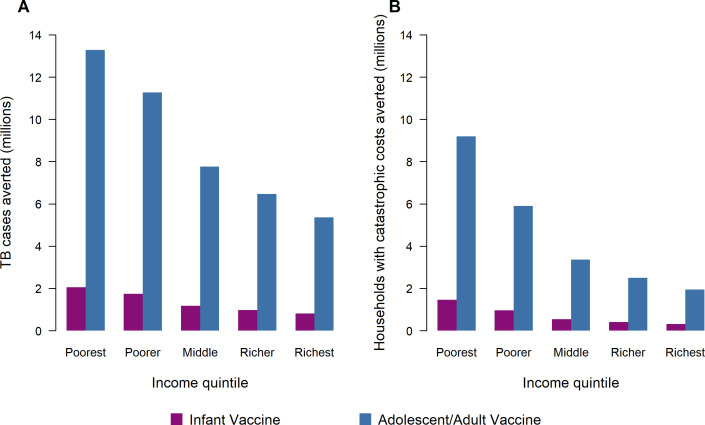
One in two patients developing tuberculosis (TB) in low-income and middle-income countries (LMICs) faces catastrophic household costs. We assessed the potential financial risk protection from introducing novel TB vaccines, and how health and economic benefits would be distributed across income quintiles.
We modelled the impact of introducing TB vaccines meeting the World Health Organization preferred product characteristics in 105 LMICs. For each country, we assessed the distribution of health gains, patient costs and household financial vulnerability following introduction of an infant vaccine and separately for an adolescent/adult vaccine, compared with a 'no-new-vaccine' counterfactual. Patient-incurred direct and indirect costs of TB disease exceeding 20% of annual household income were defined as catastrophic.
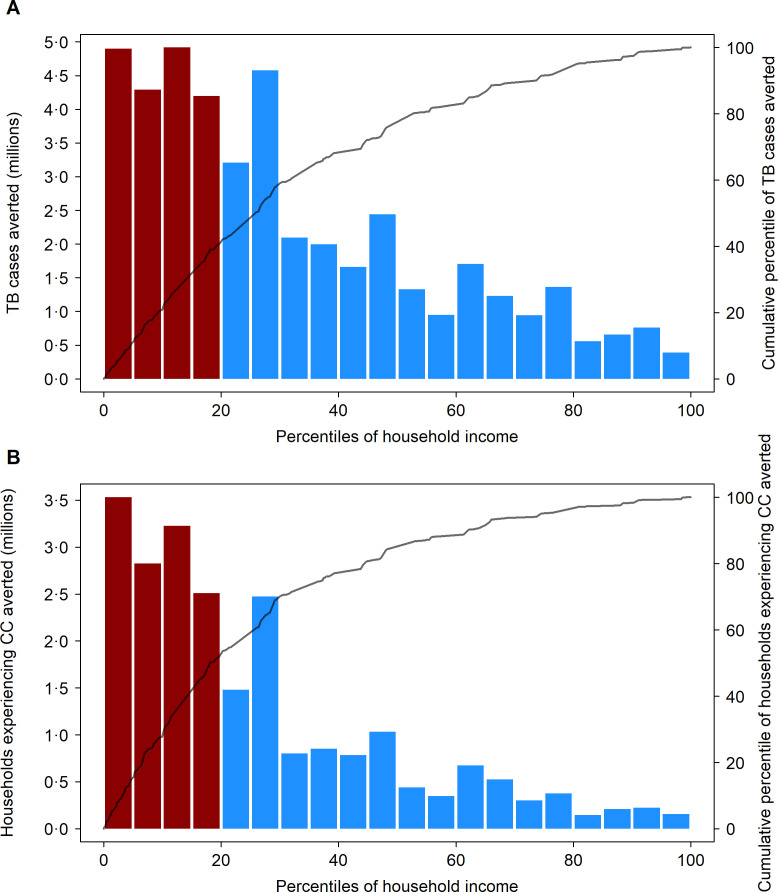
Over 2028-2050, the health gains resulting from vaccine introduction were greatest in lower income quintiles, with the poorest 2 quintiles in each country accounting for 56% of total LMIC TB cases averted. Over this period, the infant vaccine was estimated to avert US$5.9 (95% uncertainty interval: US$5.3-6.5) billion in patient-incurred total costs, and the adolescent/adult vaccine was estimated to avert US$38.9 (US$36.6-41.5) billion. Additionally, 3.7 (3.3-4.1) million fewer households were projected to face catastrophic costs with the infant vaccine and 22.9 (21.4-24.5) million with the adolescent/adult vaccine, with 66% of gains accruing in the poorest 2 income quintiles.
Under a range of assumptions, introducing novel TB vaccines would reduce income-based inequalities in the health and household economic outcomes of TB in LMICs.
在低收入和中等收入国家(LMICs)中,每两名发展为结核病(TB)的患者中就有一名面临灾难性的家庭开支。我们评估了引入新型 TB 疫苗的潜在财务风险保护,以及健康和经济利益将如何在收入五分位数中分配。
我们对在 105 个 LMIC 中引入符合世界卫生组织首选产品特征的新型 TB 疫苗的影响进行了建模。对于每个国家,我们评估了在引入婴儿疫苗和单独引入青少年/成人疫苗后,与“无新疫苗”反事实情况相比,健康收益、患者成本和家庭财务脆弱性的分布情况。TB 疾病导致的患者直接和间接成本超过家庭年收入的 20%被定义为灾难性。
在 2028 年至 2050 年期间,疫苗接种带来的健康收益在收入较低的五分位数中最大,每个国家最贫穷的两个五分位数占 LMIC 避免的总结核病病例的 56%。在此期间,婴儿疫苗估计可避免 59 亿美元(95%置信区间:53 亿至 65 亿美元)的患者总费用,青少年/成人疫苗估计可避免 389 亿美元(366 亿至 415 亿美元)。此外,预计婴儿疫苗将使 370 万户(330 万至 410 万户)家庭避免灾难性成本,青少年/成人疫苗将使 2290 万户(2140 万至 2450 万户)家庭避免灾难性成本,其中 66%的收益来自最贫穷的两个收入五分位数。
在一系列假设下,引入新型 TB 疫苗将减少 LMICs 中结核病的健康和家庭经济结果的基于收入的不平等。