Yamashita Tadashi, Reyes Tuliao Maria Teresa, Concel Meana Magdalena, Suplido Sherri Ann, Llave Cecilia L, Tanaka Yuko, Matsuo Hiroya
Kobe City College of Nursing, Kobe, Japan.
Health Department of Muntinlupa, Muntinlupa, Philippines.
Int J Womens Health. 2017 Sep 27;9:695-700. doi: 10.2147/IJWH.S141689. eCollection 2017.
A low ratio of utilization of healthcare services in postpartum women may contribute to maternal deaths during the postpartum period. The maternal mortality ratio is high in the Philippines. The aim of this study was to examine the current utilization of healthcare services and the effects on the health of women in the Philippines who delivered at home.
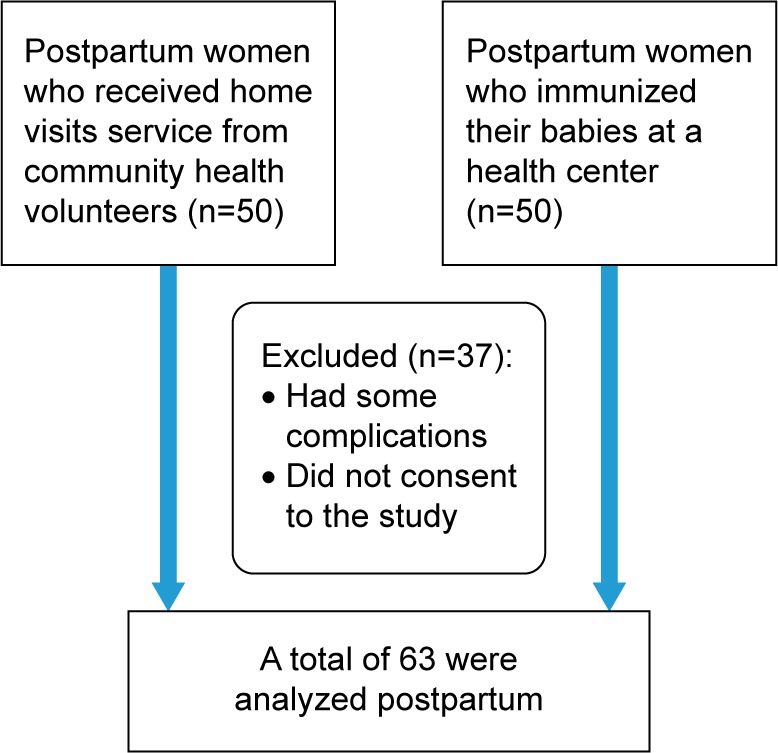
This was a cross-sectional analytical study, based on a self-administrated questionnaire, conducted from March 2015 to February 2016 in Muntinlupa, Philippines. Sixty-three postpartum women who delivered at home or at a facility were enrolled for this study. A questionnaire containing questions regarding characteristics, utilization of healthcare services, and abnormal symptoms during postpartum period was administered. To analyze the questionnaire data, the sample was divided into delivery at home and delivery at a facility. Chi-square test, Fisher's exact test, and Mann-Whitney test were used.
There were significant differences in the type of birth attendant, area of residence, monthly income, and maternal and child health book usage between women who delivered at home and those who delivered at a facility (<0.01). There was significant difference in the utilization of antenatal checkup (<0.01) during pregnancy, whilst there was no significant difference in utilization of healthcare services during the postpartum period. Women who delivered at home were more likely to experience feeling of irritated eyes and headaches, and continuous abdominal pain (<0.05).
Financial and environmental barriers might hinder the utilization of healthcare services by women who deliver at home in the Philippines. Low utilization of healthcare services in women who deliver at home might result in more frequent abnormal symptoms during postpartum.
产后妇女医疗保健服务利用率低可能导致产后期间孕产妇死亡。菲律宾的孕产妇死亡率很高。本研究的目的是调查菲律宾在家分娩妇女的医疗保健服务当前利用情况及其对妇女健康的影响。
这是一项横断面分析研究,基于自填式问卷,于2015年3月至2016年2月在菲律宾蒙廷卢帕市进行。63名在家或在医疗机构分娩的产后妇女参与了本研究。发放了一份包含有关产妇特征、医疗保健服务利用情况以及产后异常症状等问题的问卷。为分析问卷数据,样本被分为在家分娩组和在医疗机构分娩组。使用了卡方检验、费舍尔精确检验和曼-惠特尼检验。
在家分娩的妇女与在医疗机构分娩的妇女在接生人员类型、居住地区、月收入以及母婴健康手册使用情况方面存在显著差异(<0.01)。孕期产前检查的利用率存在显著差异(<0.01),而产后期间医疗保健服务的利用率没有显著差异。在家分娩的妇女更有可能出现眼睛刺痛、头痛和持续性腹痛(<0.05)。
经济和环境障碍可能会阻碍菲律宾在家分娩妇女利用医疗保健服务。在家分娩妇女医疗保健服务利用率低可能导致产后更频繁出现异常症状。