Harris Tony J C
Department of Cell & Systems Biology, University of Toronto, Toronto, Canada.
F1000Res. 2017 Aug 31;6:1620. doi: 10.12688/f1000research.11976.1. eCollection 2017.
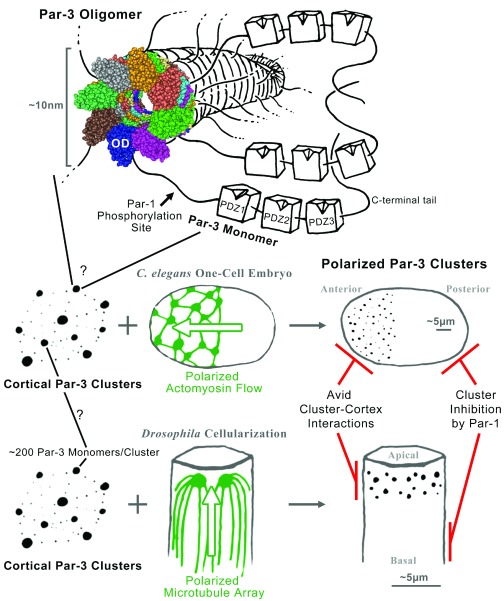
The scaffold protein Par-3 ( Bazooka) is a central organizer of cell polarity across animals. This review focuses on how the clustering of Par-3 contributes to cell polarity. It begins with the Par-3 homo-oligomerization mechanism and its regulation by Par-1 phosphorylation. The role of polarized cytoskeletal networks in distributing Par-3 clusters to one end of the cell is then discussed, as is the subsequent maintenance of polarized Par-3 clusters through hindered mobility and inhibition from the opposite pole. Finally, specific roles of Par-3 clusters are reviewed, including the bundling of microtubules, the cortical docking of centrosomes, the growth and positioning of cadherin-catenin clusters, and the inhibition of the Par-6-aPKC kinase cassette. Examples are drawn from , mammalian cell culture, and biochemical studies.
支架蛋白Par-3(巴左卡)是动物细胞极性的核心组织者。本综述重点关注Par-3的聚集如何促成细胞极性。它始于Par-3的同型寡聚化机制及其受Par-1磷酸化的调控。接着讨论了极化细胞骨架网络在将Par-3簇分布到细胞一端中的作用,以及随后通过受阻迁移和来自相反极的抑制来维持极化的Par-3簇。最后,综述了Par-3簇的特定作用,包括微管的捆绑、中心体的皮质对接、钙黏蛋白-连环蛋白簇的生长和定位,以及对Par-6-aPKC激酶盒的抑制。实例取自、哺乳动物细胞培养和生化研究。