Franco Juan Víctor Ariel, Terrasa Sergio Adrián, Kopitowski Karin Silvana
Research Area, Family and Community Medicine Division, Hospital Italiano de Buenos Aires, Buenos Aires, Argentina.
Department of Public Health, Instituto Universitario Hospital Italiano and Research Department, Hospital Italiano de Buenos Aires, Buenos Aires, Argentina.
J Family Med Prim Care. 2017 Jan-Mar;6(1):78-82. doi: 10.4103/2249-4863.214962.
The objective of this study is to describe the frequency and type of medication discrepancies (MD) through medication reconciliation and to describe the frequency of potentially inadequate prescription (PIP) medications using screening tool of older persons' prescriptions criteria.
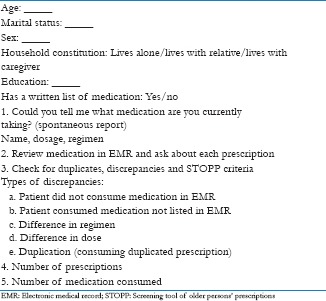
Cross-sectional comparison of electronic medical record (EMR) medication lists and patient's self-report of their comprehensive medication histories obtained through telephone interviews.
Elderly individuals (>65 years old) with more than ten medications recorded in their EMR, who had not been hospitalized in the past year and were not under domiciliary care, affiliated to a private community hospital.
The primary outcomes were the proportion of patients with MD and PIP. Secondary outcomes were the proportion of types of discrepancies and PIP. We analyzed possible associations between these variables and other demographic and clinical variables.
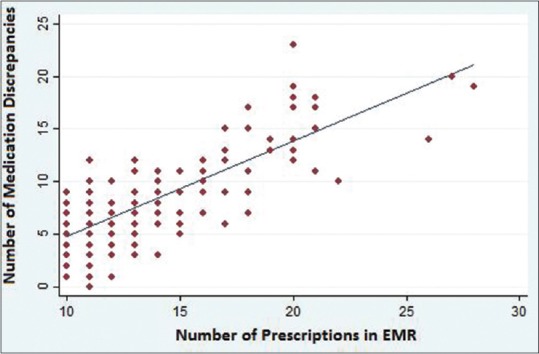
Out of 214 randomly selected individuals, 150 accepted to participate (70%). The mean number of medications referred to be consumed by patients was 9.1 (95% confidence interval [CI] =8.6-9.6), and the mean number of prescribed medications in their EMR was 13.9 (95% CI = 13.3-14.5). Ninety-nine percent had at least one discrepancy (total 1252 discrepancies); 46% consumed at least one prescription not documented in their EMR and 93% did not consume at least one of the prescriptions documented in their EMR. In 77% of the patients, a PIP was detected (total 186), 87% of them were at least within one of the following categories: Prolonged used of benzodiazepines or proton pump inhibitors and the use of aspirin for the primary prevention of cardiovascular disease.
There was a high prevalence of MD and PIP within the community of elderly adults affiliated to a Private University Hospital. Future interventions should be aimed at reducing the number of PIP to prevent adverse drug events and improve EMR accuracy by lowering medications discrepancies.
本研究的目的是通过药物重整描述用药差异(MD)的频率和类型,并使用老年人处方标准筛查工具描述潜在不适当处方(PIP)药物的频率。
对电子病历(EMR)用药清单与通过电话访谈获得的患者综合用药史自我报告进行横断面比较。
年龄超过65岁、EMR中记录有十种以上药物、过去一年未住院且未接受居家护理、隶属于一家私立社区医院的老年人。
主要观察指标为发生MD和PIP的患者比例。次要观察指标为差异类型和PIP的比例。我们分析了这些变量与其他人口统计学和临床变量之间可能存在的关联。
在随机选取的214名个体中,150人同意参与(70%)。患者提及的平均用药数量为9.1(95%置信区间[CI]=8.6-9.6),其EMR中记录的处方药物平均数量为13.9(95%CI=13.3-14.5)。99%的患者至少存在一处差异(共1252处差异);46%的患者服用了至少一种EMR中未记录的处方药物,93%的患者未服用EMR中记录的至少一种处方药物。77%的患者检测到PIP(共186例),其中87%至少属于以下类别之一:长期使用苯二氮䓬类药物或质子泵抑制剂以及使用阿司匹林进行心血管疾病的一级预防。
在隶属于私立大学医院的老年人群体中,MD和PIP的患病率较高。未来的干预措施应旨在减少PIP的数量,以预防药物不良事件,并通过减少用药差异提高EMR的准确性。