Division of Global Health, Department of Family Medicine and Public Health, University of California, San Diego. 9500 Gilman Drive #0725, La Jolla, CA, 92093-0725, USA.
Department of Family and Preventive Medicine, University of California-San Diego, 9500 Gilman Drive #0725, La Jolla, CA, 92093-0725, USA.
Int Arch Occup Environ Health. 2018 Feb;91(2):175-184. doi: 10.1007/s00420-017-1265-4. Epub 2017 Oct 13.
Mother's Day (May) is a holiday with substantial demand for flowers, associated with heightened flower production and escalated pesticide use. The effect of spray seasons on pesticide exposures of children living in agricultural communities but who do not work in agriculture is poorly understood. In this study, we estimated the association of time after Mother's Day harvest with children's acetylcholinesterase (AChE) activity. AChE is a physiological marker of organophosphate/carbamate pesticide exposures that may take up to 3 months to normalize after its inhibition.
We examined 308 children, aged 4-9 years, in Ecuadorian agricultural communities during a low flower-production season but within 63-100 days (mean: 81.5 days, SD: 10.9) after Mother's Day harvest. We quantified AChE activity (mean: 3.14 U/mL, SD: 0.49) from a single finger-stick sample.
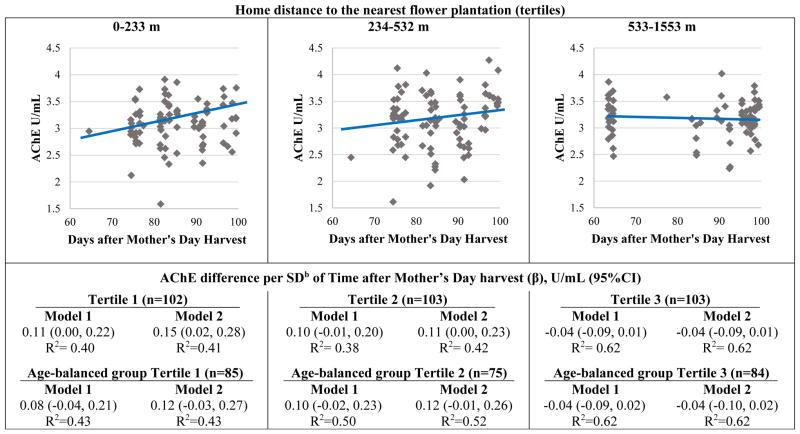
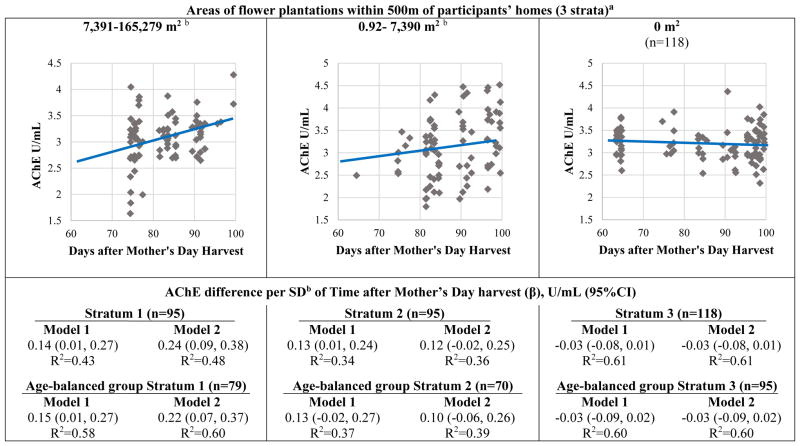
We observed positive linear associations between time after the harvest and AChE among participants living near plantations. The associations were strongest among participants living within 233 m [(0.15 U/mL (95% CI 0.02, 0.28)], slightly weaker among participants living within 234-532 m [0.11 U/mL (0.00, 0.23)], and not associated among participants at greater distances. Similar findings were observed across categories of areas of flower plantations within 500 m of homes.
These cross-sectional findings suggest that a peak pesticide-use period can decrease AChE activity of children living near plantations. These seasonal pesticide exposures could induce short- and long-term developmental alterations in children. Studies assessing exposures at multiple times in relation to pesticide spray seasons among children who do not work in agriculture are needed.
母亲节(五月)是一个花卉需求量大的节日,与花卉产量增加和农药使用量增加有关。人们对不住在农业社区但也不在农业领域工作的儿童在喷雾季节过后的农药暴露情况知之甚少。在这项研究中,我们估计了母亲节收获后时间与儿童乙酰胆碱酯酶(AChE)活性之间的关系。AChE 是有机磷/氨基甲酸酯类农药暴露的生理标志物,其活性在受到抑制后可能需要长达 3 个月的时间才能恢复正常。
我们在厄瓜多尔农业社区的低花卉生产季节期间检查了 308 名 4-9 岁的儿童,但他们在母亲节收获后 63-100 天(平均:81.5 天,SD:10.9)内。我们从单个手指刺样本中量化了 AChE 活性(平均:3.14 U/mL,SD:0.49)。
我们观察到在靠近种植园的参与者中,收获后时间与 AChE 之间存在正线性关系。在距离种植园 233 米以内的参与者中,这种关联最强[0.15 U/mL(95%CI 0.02,0.28)],在距离种植园 234-532 米的参与者中稍弱[0.11 U/mL(0.00,0.23)],而在距离种植园更远的参与者中则没有关联。在距离家庭 500 米以内的花卉种植园的各个区域类别中,也观察到了类似的发现。
这些横断面研究结果表明,高峰期农药使用可能会降低住在种植园附近的儿童的 AChE 活性。这些季节性农药暴露可能会对儿童产生短期和长期的发育影响。需要对不住在农业社区但也不在农业领域工作的儿童进行多次暴露评估,以了解与农药喷雾季节相关的暴露情况。